APC Rejects Sierra Leone Constitutional Amendment Vote, Demands Supreme Court Interpretation

 Osman Tolo Sesay
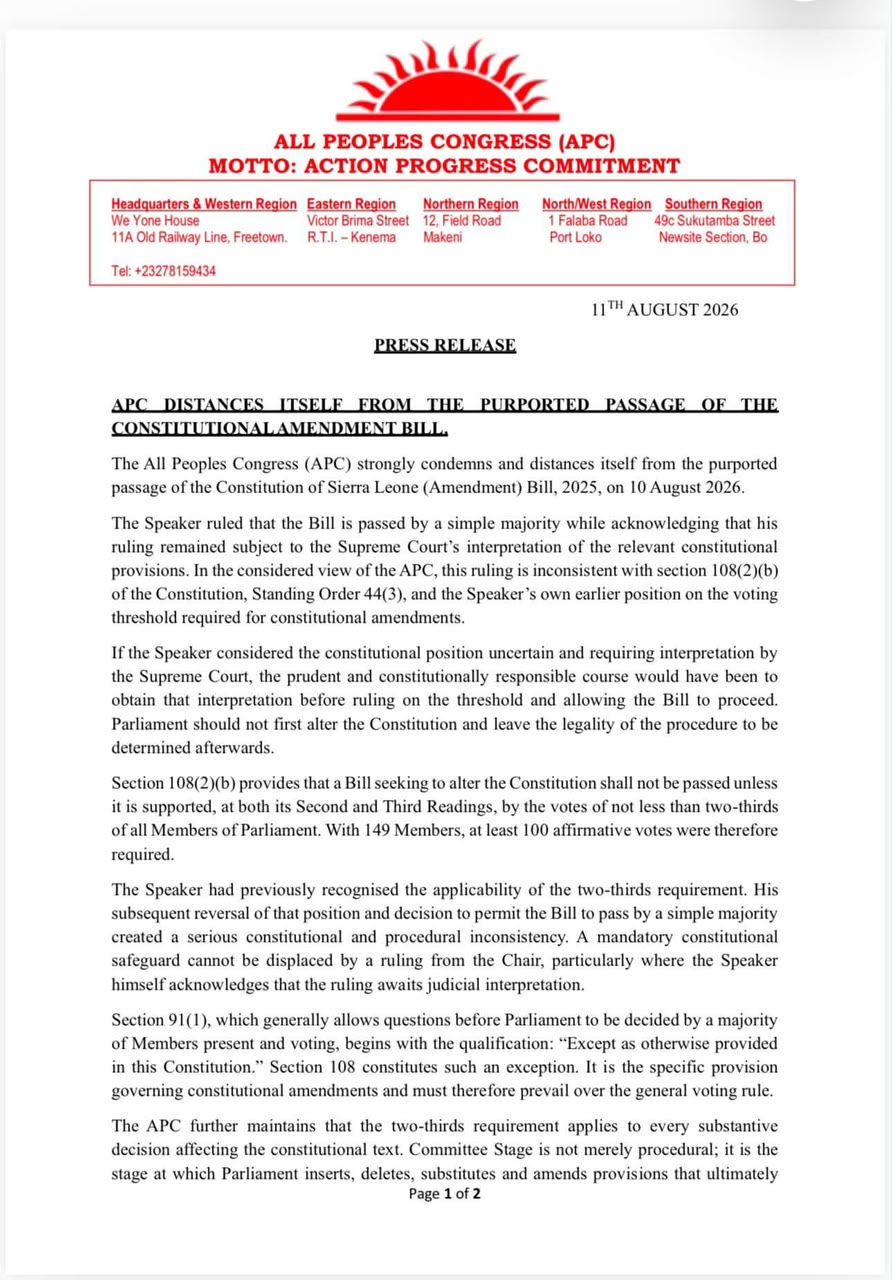
 The All People’s Congress (APC) has rejected Parliament’s reported passage of Sierra Leone’s Constitution Amendment Bill, 2025, arguing that the process violated the constitutional requirement for a two-thirds majority.
In a press release dated August 11, 2026, the opposition party said it neither authorised nor participated in the reported passage of the bill by 96 lawmakers after its members withdrew from Parliament during Monday’s proceedings.
The APC’s position centres on Section 108(2)(b) of the 1991 Constitution, which provides that a bill seeking to alter the Constitution must receive the support of at least two-thirds of Members of Parliament at the second and third readings.

With Parliament comprising 149 members, the APC said 100 affirmative votes would be required to meet that threshold. It therefore disputes the validity of proceeding with the bill on the basis of a simple majority.



The dispute arose after the Speaker ruled that individual provisions of the amendment bill could be decided by a simple majority during the committee stage. Contemporary reports said the ruling prompted APC lawmakers to leave the chamber rather than participate in the subsequent proceedings.
The APC argued that the Speaker’s ruling conflicts with both Section 108(2)(b) and Standing Order 44(3). Parliament’s published Standing Orders state that a bill altering the Constitution requires support from at least two-thirds of all Members of the House at the second and third readings.
The party also pointed to an earlier position by the Speaker in which the two-thirds requirement was recognised, describing the subsequent change as a constitutional and procedural inconsistency.
According to the APC, if the Speaker considered the constitutional provision uncertain and believed it required judicial interpretation, Parliament should have obtained guidance from the Supreme Court before proceeding with the vote.
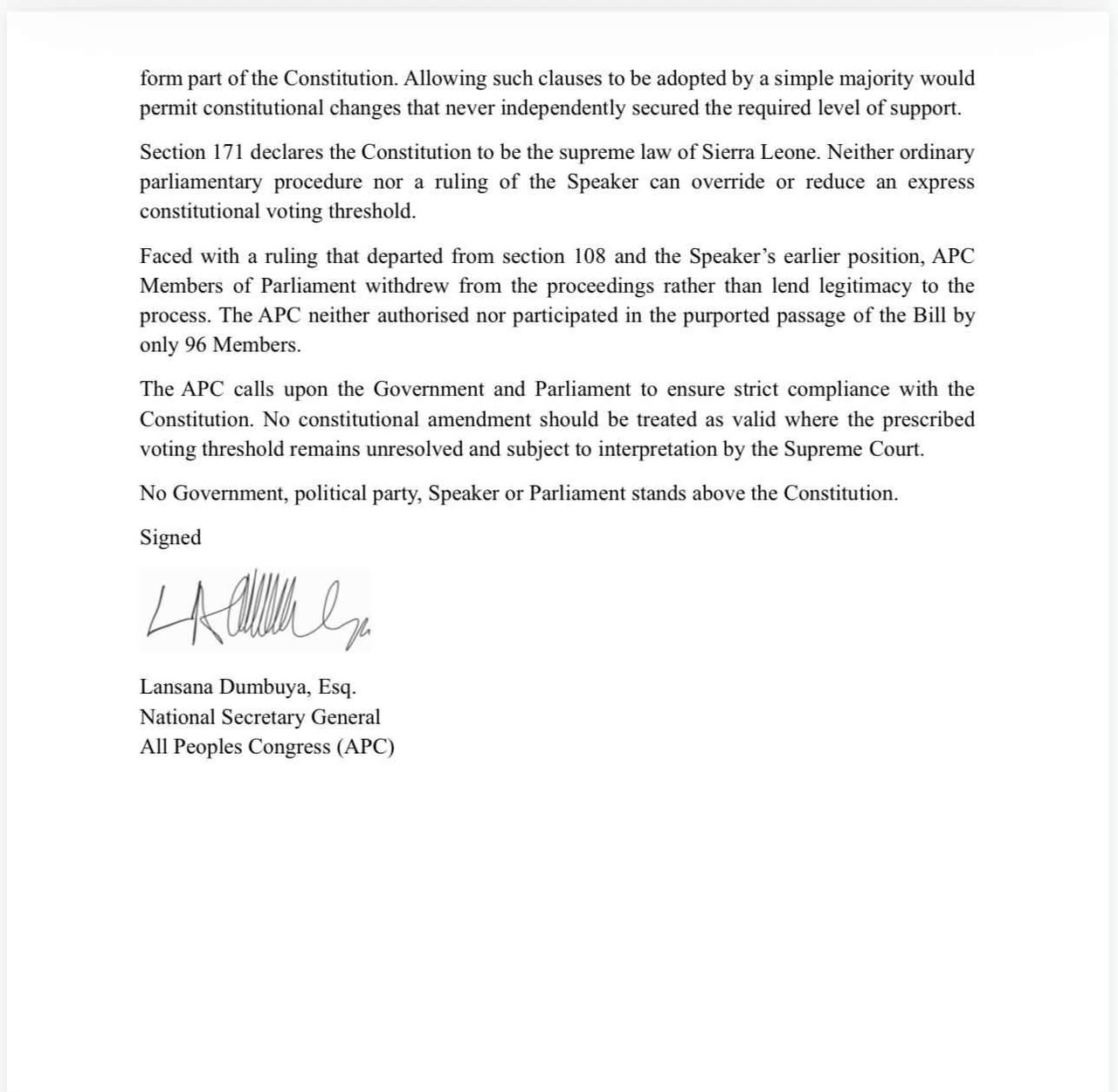
The party further argued that the committee stage cannot be treated as merely procedural because it is where lawmakers can insert, delete, substitute or otherwise alter provisions that ultimately become part of the Constitution.
The APC also invoked Section 91(1), which generally provides for decisions in Parliament to be made by a majority of members present and voting, but begins with the qualification that this applies unless the Constitution provides otherwise. The party maintains that Section 108 is the specific constitutional exception governing amendments.
The Constitution itself states that Parliament may alter the Constitution subject to the requirements of Section 108, including the two-thirds threshold for the relevant readings.
The opposition party said its lawmakers withdrew from the proceedings because they did not want to give legitimacy to a process they considered unconstitutional.
The APC has called on the government and Parliament to comply strictly with the Constitution, arguing that no constitutional amendment should be treated as valid while the required voting threshold remains disputed and subject to judicial interpretation.
The party concluded that neither the government, a political party, the Speaker nor Parliament is above the Constitution.