


 Post a comment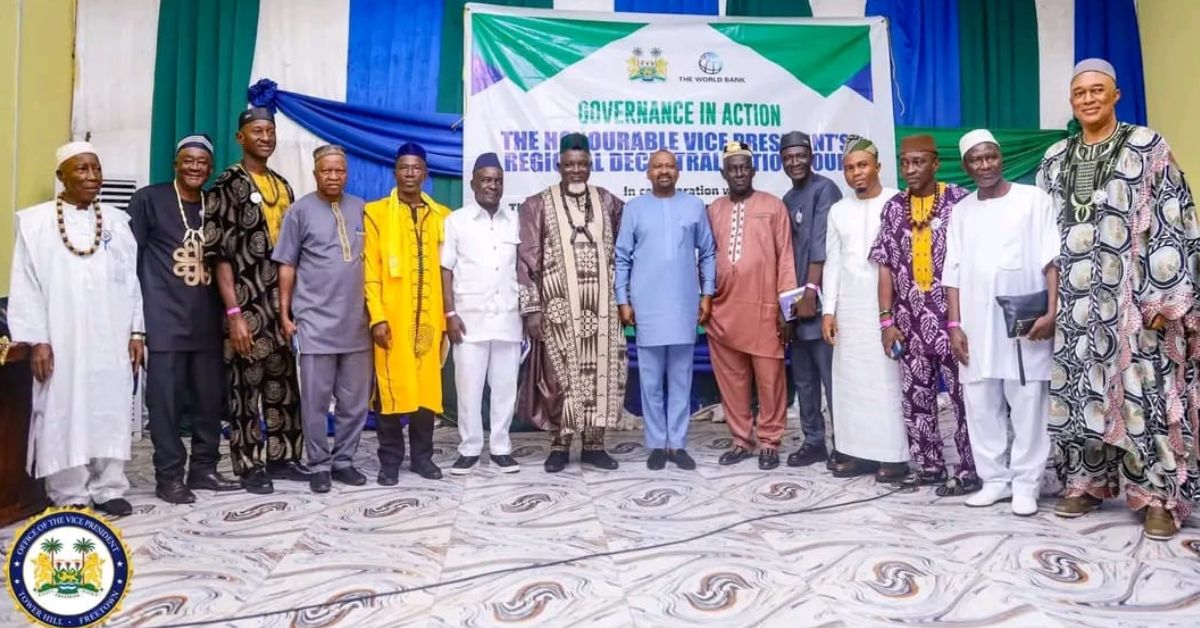
Vice President Dr Mohamed Juldeh Jalloh has concluded the Government’s Regional Decentralisation Tour in his home district of Port Loko, following consultations across the country focused on strengthening local governance, improving service delivery and bringing decision-making closer to communities.
The Vice President concluded the second leg of the tour on Saturday, September 5, 2026, after engagements with traditional authorities, district representatives, local councils and other stakeholders on challenges affecting governance and service delivery.
“I concluded my regional decentralisation tour in my home district of Port Loko. Across the country, we heard directly from traditional, district and local council leaders about the challenges affecting local governance and service delivery. Thanks to all participants,” Dr Jalloh said.

During the engagements, Vice President Jalloh announced plans for the Government to recruit about 800 Native Administrative Officers nationwide.
The proposed recruitment is intended to strengthen administrative capacity, security presence and governance within Sierra Leone’s chiefdoms, as part of wider efforts to reinforce grassroots institutions.
The initiative comes as the Government seeks to ensure that national development policies translate into more visible benefits for communities outside Freetown.
Ahead of the Makeni and Port Loko engagements, Dr Jalloh said the tour was guided by the principle that effective governance must remain connected to the people.
“A Government closer to the people is a Government that works,” he said.
He added: “I’ll be engaging directly with traditional, district and local council leaders to ensure national policy delivers local impact.”
The Makeni and Port Loko engagements formed the second leg of the Regional Decentralisation Tour. The first leg was held in Kenema and Bo on August 14 and 15, 2026, respectively.
The consultations brought together Paramount Chiefs, local councils, government officials, Ministries, Departments and Agencies, development partners and representatives from key sectors.
Discussions examined longstanding challenges affecting Sierra Leone’s decentralisation programme, including inadequate financing, weak institutional capacity, limited revenue mobilisation, coordination gaps between central and local authorities and the incomplete transfer of responsibilities to councils.
Dr Jalloh had earlier stressed during the Kenema engagement that the tour was designed primarily as a listening exercise rather than an opportunity for central government to impose solutions on local authorities.
“This is not a meeting where we come to tell you what to do. It is a learning process. We are here to listen to the challenges of local governance,” he stated.
According to the Vice President, recommendations from the consultations could inform Government policy, Cabinet decisions and, where necessary, legislative reforms aimed at strengthening Sierra Leone’s decentralisation framework.
A major issue raised during the consultations was the capacity of local councils to effectively deliver essential public services.
Councils have responsibilities covering areas including healthcare, education, sanitation, waste management, agriculture, roads, markets, drainage, land administration and social welfare.
Government officials acknowledged that transferring additional responsibilities to councils without providing adequate financial, technical and logistical resources could weaken the effectiveness of decentralisation.
Deputy Minister of Local Government and Community Affairs Alfred Moi Jamiru called for greater investment in local councils, stressing that stronger institutional capacity is necessary for councils to effectively discharge their responsibilities.
Chairman of the Local Government Service Commission, Dr. Falla D. Lamin, also highlighted the importance of competent personnel, improved coordination and stronger institutions in building an effective local government system.
Regional Coordination Committees were inaugurated during the Kenema and Bo consultations to strengthen collaboration among institutions and provide mechanisms for addressing decentralisation challenges at the regional level.
The consultations also examined relationships among traditional authorities, local councils and central government, with emphasis on clearly defining institutional responsibilities, authority and resources.
The objective is to reduce duplication, improve coordination and strengthen accountability across different levels of governance.
More than two decades after Sierra Leone restored elected local government, decentralisation remains a key component of efforts to bring governance and development closer to citizens. However, challenges around financing, accountability, administrative capacity and the effective devolution of responsibilities continue to affect the system.
The conclusion of the regional tour in Port Loko marks another step in the Government’s efforts to address the gap between national policymaking and the realities faced by communities.
For Vice President Jalloh, the broader objective is to ensure that governance extends beyond institutions in Freetown and produces tangible results in schools, health facilities, markets, councils, chiefdoms and communities across Sierra Leone.


