
Over 600 Sierra Leoneans Among Top 102 Nationalities Working in UK Health Sector
 Tolulope Aina
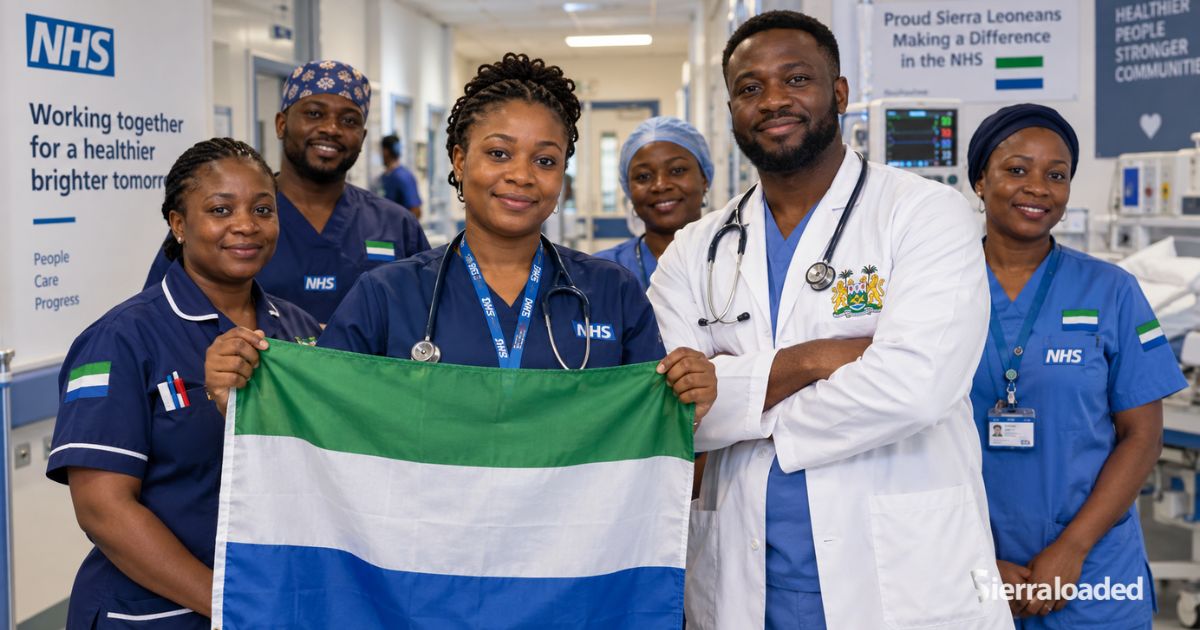
 A total of 637 Sierra Leonean nationals were employed in the United Kingdom’s National Health Service (NHS) as of June 2025, according to recently published data from the House of Commons Library.
Sierraloaded understands that the figure places Sierra Leone among the top 102 nationalities represented in the NHS workforce, though it remains significantly lower than other West African nations such as Nigeria (1,302) and Ghana (9,612).
The report, titled NHS staff from overseas: statistics, reveals that out of a total NHS workforce of 1.54 million in England, 21.3 per cent (325,039 staff) reported a non-British nationality. Sierra Leone’s 637 staff represent a small but notable fraction of that diverse workforce.

The data shows that while the majority of NHS staff (78.7 per cent) are British, the health service relies heavily on international recruitment to fill gaps. Asian nationals make up 9.9 per cent of the workforce, followed by EU nationals at 5.2 per cent and African nationals at 4.2 per cent. The proportion of NHS staff reporting an African nationality has risen sharply over the past decade, increasing from 1.9% in 2010 to 4.2% in June 2025.
The report highlights a significant shift in recruitment patterns over the past decade. Following the 2016 EU referendum, the proportion of EU staff in the NHS fell slightly, while the proportion of staff from Asian and African nations increased sharply.
For nurses and health visitors specifically, 18 per cent (60,336 staff) reported an Asian nationality, up from just 6 per cent in June 2016. The report notes that 95 per cent of these nurses were either Filipino or Indian.
The presence of 637 Sierra Leonean professionals in the UK highlights the broader issue of “brain drain” affecting the country itself. Sierra Leone continues to grapple with one of the most fragile health systems globally, a challenge severely exacerbated by the departure of trained doctors, nurses, and midwives to higher-income countries.
Recent global health data indicates that Sierra Leone has a health worker density of approximately 6.4 skilled workers per 10,000 people. This falls drastically short of the World Health Organization’s (WHO) recommended threshold of 44.5 doctors, nurses, and midwives per 10,000 population required to achieve basic Universal Health Coverage. This shortage places immense pressure on the remaining clinical staff in the country and limits domestic healthcare access.
The World Health Organization (WHO) has placed Sierra Leone on its Health Workforce Support and Safeguard List, recognising it as a country with a critical shortage of health professionals. The UK government had also placed Sierra Leone on its Code of Practice “red list” for international recruitment. This designation explicitly prohibits NHS employers and UK recruitment agencies from actively marketing vacancies or recruiting health and social care workers directly from Sierra Leone.
However, the red list restrictions only prevent targeted, active recruitment campaigns. Individual Sierra Leonean healthcare professionals are still legally permitted to independently seek and apply for vacancies within the NHS, which contributes to the steady headcount of 637 workers currently recorded in the system.
The figures highlight the continued allure of the UK’s health sector for Sierra Leonean professionals, even as the country struggles to retain its own trained doctors and nurses. The House of Commons Library report notes that nationality data is self-reported and may reflect cultural heritage rather than country of birth, but it remains the most comprehensive breakdown of the NHS’s international workforce available.