

APC Outlines Position on Constitutional Amendment Bill, Backs First-Past-the-Post and 55% Threshold
 Deborah Sorie
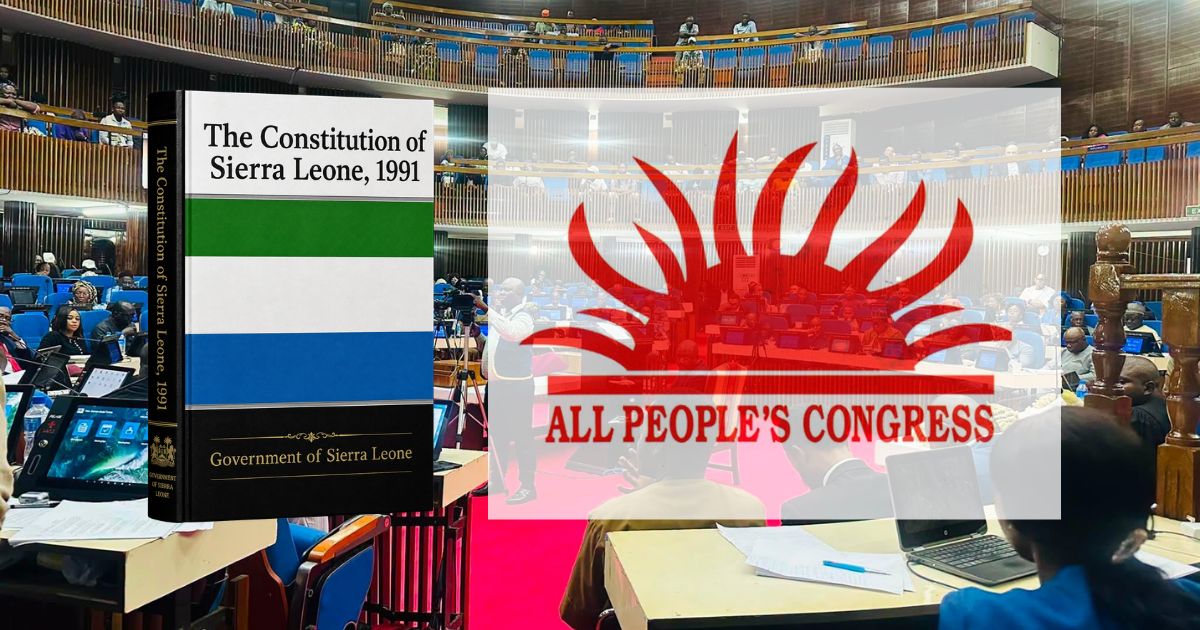
 The main opposition All Peoples Congress (APC) has formally outlined its position on the Constitution of Sierra Leone (Amendment) Bill, 2025, expressing support for certain provisions while firmly rejecting proposed changes to the electoral system and presidential election threshold.
In a press release issued on August 9, 2026, by National Secretary General Lansana Dumbuya, the APC responded to a recent parliamentary address by President Julius Maada Bio, emphasizing that constitutional reform should not be treated as an “all-or-nothing exercise”.
The bill, which Attorney General Alpha Sesay recently described as a vital step in moving Sierra Leone toward a “constitution of prosperity,” contains wide-ranging changes to the nation’s democratic framework.

The APC stated it is not opposed to constitutional reform in its entirety but insists that the expressed wishes of the people must be respected in the process. The party welcomed two key provisions in the Bill. The party expressed strong support for the proposed constitutional guarantee of a minimum 30% representation for women in political nominations, describing women as “indispensable contributors” to Sierra Leone’s development and arguing their meaningful participation in governance must be protected and strengthened.


The party also backed provisions enabling Sierra Leoneans with dual citizenship to contest parliamentary seats and serve in government positions. However, the APC endorsed maintaining stricter citizenship requirements for the offices of President and Vice‑President, calling this distinction “a fair and reasonable balance” that preserves constitutional integrity while expanding opportunities for diaspora participation.
The party is strongly advocating for the retention of the First-Past-the-Post (FPTP) constituency-based electoral system. The APC asserts that this system preserves the direct relationship and accountability between citizens and their elected Members of Parliament. According to the release, this stance reflects the views of key societal groups, including the Council of Paramount Chiefs, civil society organizations, and the Inter-Religious Council, who expressed support for constituency-based representation over Proportional Representation during public consultations.
“Consultation must have consequences,” the statement read, emphasizing that the voices of the people must count in the final decision.
The APC is also vehemently opposed to any alteration of the 55% constitutional threshold required for the election of the President.
The party argues that the 55% requirement is “not merely a number” but a mechanism that serves an important national purpose by forcing candidates to build support beyond their traditional political strongholds. If no candidate secures the required majority in the first round, the resulting runoff encourages dialogue, coalition-building, and national consensus—elements the APC views as critical for peace, stability, and national cohesion in a diverse country. This threshold historically shaped the 2018 general elections, where neither major candidate met the 55% mark initially, leading to a closely contested runoff that ultimately secured President Maada Bio’s first term.
The press release concluded with a direct appeal to all Members of Parliament, across both the APC and the ruling Sierra Leone People’s Party (SLPP).
The APC warned that constitutional amendments should never be made for “the political convenience of the moment,” reminding lawmakers that governments will come and go, but the Constitution remains the supreme law governing everyone.
“Do not disappoint the people of Sierra Leone,” the statement urged, calling on MPs to put the Republic above partisan considerations and ensure the final amendments reflect the genuine aspirations of the nation.