ILRAJ Raises Constitutional Concerns Over Passage of Amendment Bill
 Aaron Parker
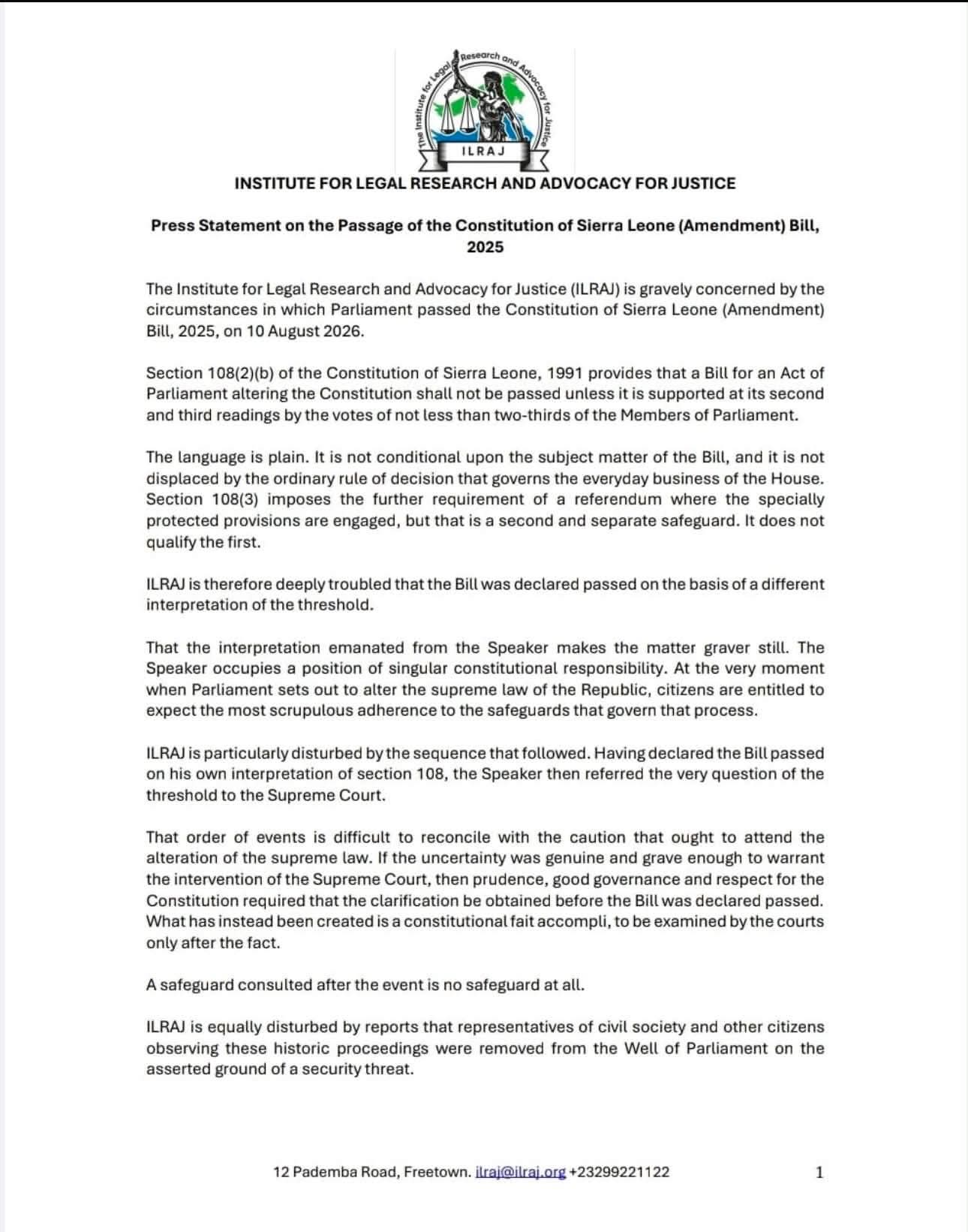
 The Institute for Legal Research and Advocacy for Justice (ILRAJ) has raised serious constitutional concerns over the circumstances surrounding Parliament’s passage of the Constitution of Sierra Leone (Amendment) Bill, 2025, on August 10, 2026.
In a press statement issued on Wednesday, August 12, ILRAJ argued that Section 108(2)(b) of the 1991 Constitution requires a constitutional amendment Bill to receive the support of at least two-thirds of Members of Parliament at both its second and third readings.
The Institute said the constitutional requirement is clear and is separate from the additional referendum requirement provided under Section 108(3) for specially protected provisions.

ILRAJ expressed concern that the Bill was declared passed based on an interpretation of the required threshold that differed from its reading of Section 108.


The organisation said the situation was particularly concerning because the interpretation came from the Speaker of Parliament, who it said bears a significant constitutional responsibility when Parliament is considering changes to the country’s supreme law.
ILRAJ also questioned the decision to refer the issue of the required threshold to the Supreme Court after the Speaker had already declared the Bill passed.
According to the Institute, if the constitutional question was sufficiently serious to require the Supreme Court’s interpretation, the clarification should have been obtained before the Bill was declared passed.
“What has instead been created is a constitutional fait accompli, to be examined by the courts only after the fact,” ILRAJ stated, adding that “a safeguard consulted after the event is no safeguard at all.”
The Institute further expressed concern over reports that civil society representatives and other members of the public observing the parliamentary proceedings were removed from the Well of Parliament on the grounds of a security threat.
ILRAJ called for a full and transparent explanation of the alleged threat, including who conducted the assessment, the information relied upon, the authority under which the observers were removed and why their exclusion was considered necessary.
The organisation argued that Parliament belongs to the people and that constitutional reform requires greater public scrutiny rather than reduced access.
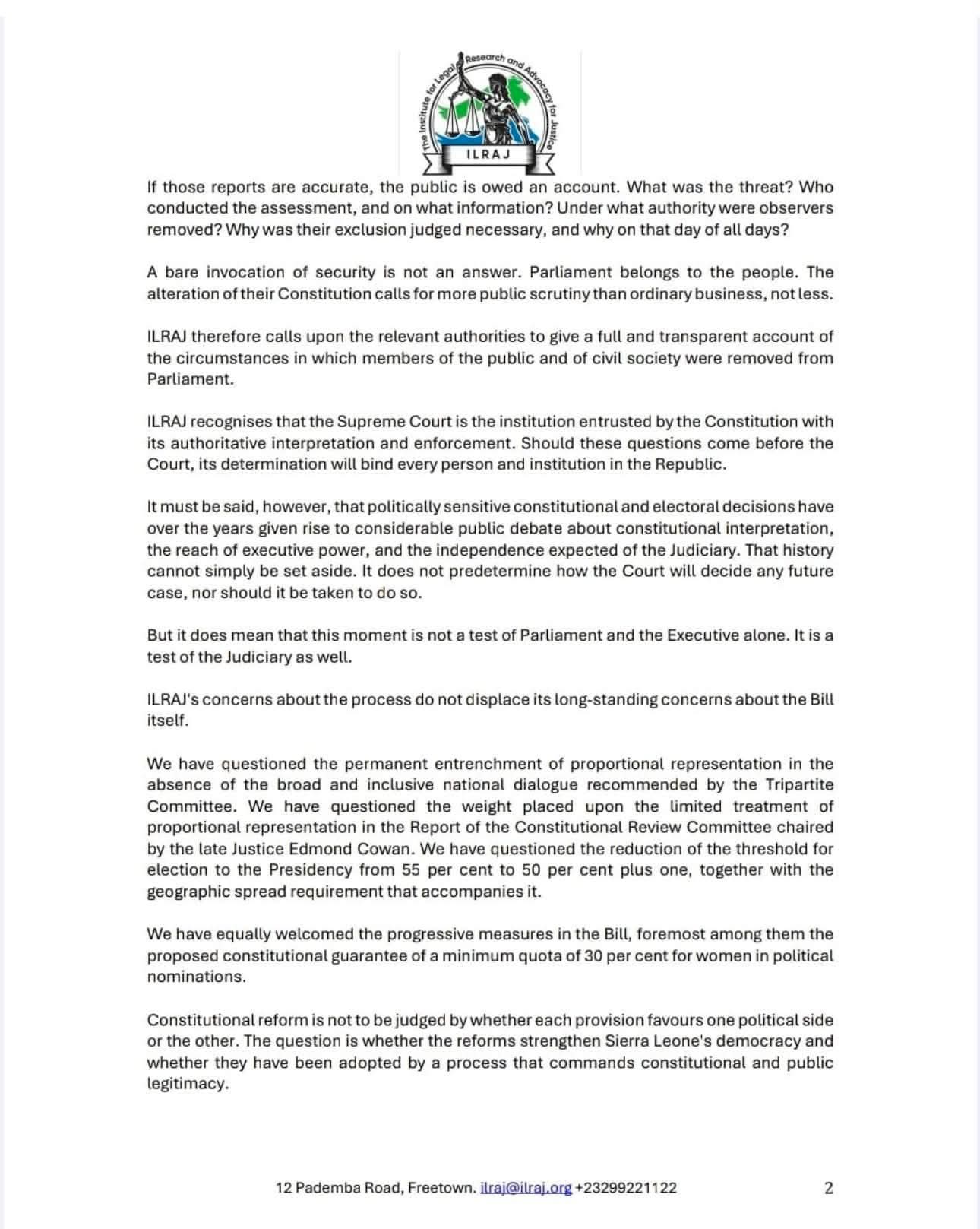
ILRAJ also acknowledged the constitutional role of the Supreme Court in providing authoritative interpretation and enforcement of the Constitution, saying any determination by the Court on the matter would be binding on all persons and institutions.
However, it noted that politically sensitive constitutional and electoral decisions have historically generated public debate over constitutional interpretation, executive power and judicial independence.
The Institute said the current situation therefore represents a test not only for Parliament and the Executive but also for the Judiciary.
Beyond the passage process, ILRAJ reiterated concerns it has previously raised about aspects of the amendment Bill, including the proposed permanent entrenchment of proportional representation without what it considers sufficient broad and inclusive national dialogue.
The organisation also questioned the weight given to the treatment of proportional representation in the Constitutional Review Committee’s report chaired by the late Justice Edmond Cowan.
ILRAJ further highlighted concerns over the proposed reduction of the presidential election threshold from 55 per cent to 50 per cent plus one, together with the accompanying geographic spread requirement.
At the same time, the Institute welcomed what it described as progressive provisions in the Bill, particularly the proposed constitutional guarantee of a minimum 30 per cent quota for women in political nominations.
ILRAJ stressed that constitutional reform should not be judged solely on whether individual provisions benefit one political side or another, but on whether the reforms strengthen Sierra Leone’s democracy and are adopted through a process that enjoys constitutional and public legitimacy.
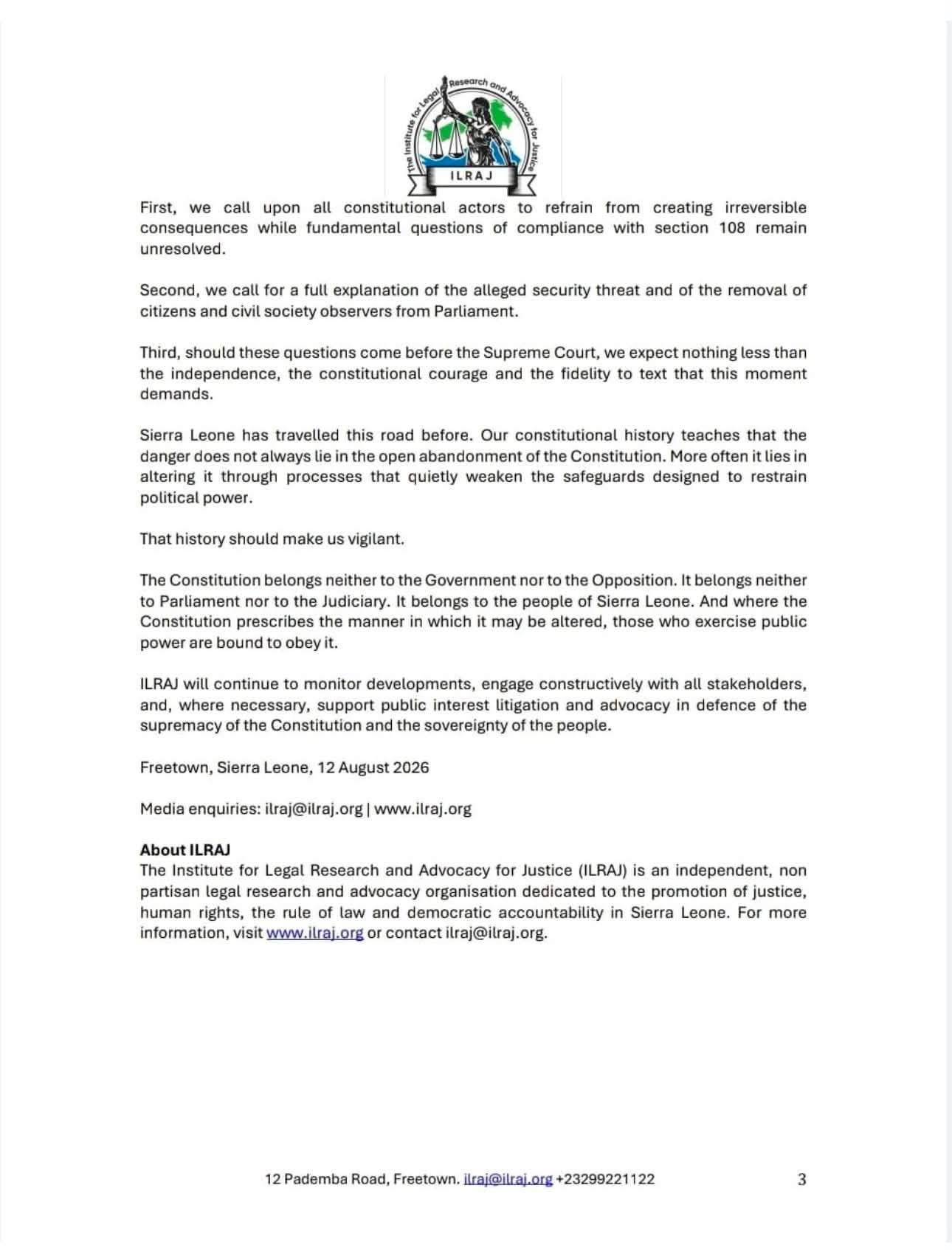
The Institute called on constitutional actors to refrain from creating irreversible consequences while questions surrounding compliance with Section 108 remain unresolved.
It also demanded a full explanation of the alleged security threat and the removal of citizens and civil society observers from Parliament, while urging the Supreme Court, should the matter come before it, to demonstrate independence, constitutional courage and fidelity to the constitutional text.
“Sierra Leone has travelled this road before,” ILRAJ stated, warning that constitutional safeguards can be weakened not only through openly abandoning the Constitution but also through processes that gradually undermine the mechanisms designed to restrain political power.
The organisation maintained that the Constitution belongs to the people of Sierra Leone and that all public institutions are bound to follow the procedures it prescribes for constitutional amendments.
ILRAJ said it would continue to monitor developments, engage stakeholders and, where necessary, support public interest litigation and advocacy aimed at protecting the supremacy of the Constitution and the sovereignty of the people.