


 Post a comment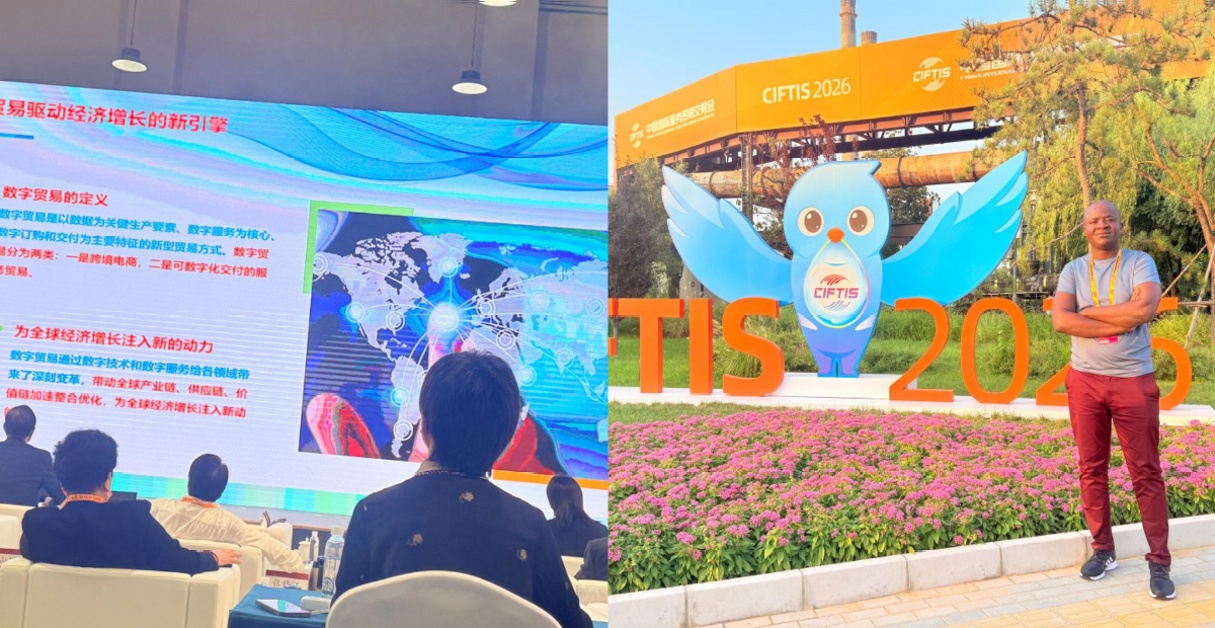
The model satellite hung above the entrance of the exhibition hall, and on the wall behind it a screen showed a coastal city rerouting its buses around a flooded underpass.
I was at the 2026 Thematic Forum of the China International Fair for Trade in Services, on “Building Smart City and Space Infrastructure in a Changing World”, when a delegate from an African capital leaned past me to read the small print on a ground-station diagram. A ground station is the dish on a hill that talks to the satellite overhead. In Sierra Leonean terms, it is the kind of thing that would sit above Leicester Peak and receive pictures of the rain falling on the Regent watershed.
That screen stayed in my head because of Regent. In August 2017 a hillside above the town moved and buried a settlement. Every rainy season since, the same wet winds drive water down the Freetown peninsula, choke drains in Aberdeen and washing temporary crossings in Wellington. No one in Freetown needs a lecture on what a flash flood does.

Forum language makes all this sound distant. A smart city means ordinary things wired together: the water meter, the traffic light, the tax register, the ambulance radio, all reading one another so a burst pipe in Lumley is logged before a resident calls the council. Space infrastructure means the satellites overhead and the dishes that talk to them, the machines that tell you where the rain is falling upstream, where the cassava is drying, where a landslide slope is saturating. These are not glamorous ideas. They are plumbing.
Sierra Leone will use this plumbing. It already does. The National Digital Development Strategy names e-government and broadband as national goals; the Chinese Embassy’s cooperation desk already funds roads, hospitals and scholarships; the justice sector I work for runs biometric identification and case management systems on criminal files. The buying decision is settled. The open question is who governs what is bought, on whose data, and at what price.
I have seen what happens when the hardware arrives ahead of the institution. The biometric system and the Case Management system we introduced across the justice sector worked in Freetown. There was steady power at the courts, a records officer who knew the machine, a bench that sat on schedule. It deteriorated within a year at a magistrates’ court upcountry, where the generator fuel ran out on the first Friday of the month and the presiding officer had been moved twice in eighteen months. The camera kept working. The office around it did not. That lesson sits behind every risk worth naming.
The first risk is a single vendor. If one company supplies the dish on the hill, the data platform on the server, and the software in the courts, the price of renewal in five years is whatever that company asks. The second is data sovereignty. The Cybersecurity and Crime Act 2021 gives Parliament the framework to decide where government data may sit. A satellite picture of Kono’s diamond areas or of the peninsula watershed is sensitive. If a foreign operator holds it on a machine we cannot inspect, we are paying for a system that reports against us as much as for us. The third is debt. Chinese suppliers offer concessional terms through South-South channels, and those terms still have to be repaid. Mamamah is the precedent Freetown already wrote: in 2018 the incoming government declined a Chinese- financed airport project on the grounds that it did not fit the national plan. We have done this before. The fourth risk is the institution itself. A flood alert from space is useful only if a district council has an officer paid to read it and a p hone tree that reaches the paramount chief in the threatened quarter.
Rwanda and Kenya show what governing early looks like. Rwanda’s land tenure regularisation programme put the country’s land titles onto a mapped system a surveyor can open from a tablet; the state decided who owns the map before the vendors arrived. The Kenya Space Agency buys satellite imagery on behalf of counties governments, so that no ministry negotiates a contract alone. Neither country launches rockets. Both wrote their rules first.
The first action belongs to the Ministry of Communication, Technology and Innovation, working with the Directorate of Science, Technology and Innovation. It should publish a written technical requirement before any vendor walks into a procurement room. The document would state what a ground station above Leicester Peak must receive, and that the dish, the server and the court software come from separate contracts. Your MP can be asked one question: has the ministry tabled that requirement before the Appropriation Committee, or are we buying blind?
The second action belongs to Parliament and the Ministry of Finance, anchored on the Cybersecurity and Crime Act 2021. Every cooperation memorandum should state in plain words where the data will be stored and which Sierra Leonean authority can demand a copy. A vendor who refuses to write that sentence is telling you something. The test your MP should apply is simple: has the Attorney General certified that the contract keeps the data inside Sierra Leone, or accessible to a named government office?
The third action belongs to the Ministry of Finance. It should run any digital infrastructure loan through the same public debt register as a road or a hospital. The 2018 decision on Mamamahproved that Freetown can decline a Chinese-financed project when the terms do not fit the plan. A smart-city loan is not different because it arrives on a server. Ask your councillor, and ask your MP, whether the project they are being asked to welcome is on the MoF public debt register, and whether they have seen the repayment schedule.
The fourth action cuts across three institutions. Fourah Bay College should start a one-year certificate in geospatial public management for district clerks, surveyors and court records officers. The National Disaster Management Agency should stand up an early-warning cell in each district that takes the satellite rainfall feeds before the rains begin. The Ministry of Lands, Housing and Country Planning should build the national land registry on that mapped data, the way Rwanda did. The question a councillor can put to the district officer is direct: who in this council receives th e flood alert, and have they run a drill this year?
I walked past the model satellite again on the same day. An official from the forum secretariat told the room that space infrastructure across the Global South would grow sharply before 2035. The figure did not stick in my head. What stuck is this: the map of how cities are run in twenty years is being drawn in Beijing this month. Sierra Leone can have its name on that map, in its own hand, or it can find its land already printed there by someone else. The pencil is in ours. It is due now.
When the Chinese Embassy’s cooperation desk brings smart-city proposals to Freetown, the Ministry of Finance should insist on two conditions before any memorandum of understanding is signed: that the data stays on a server located in Sierra Leone or is accessible to a named government authority, and that the contract trains at least twenty local technicians per year for the life of the system. Vietnam and Indonesia have written such clauses into their digital cooperation agreements; we can re ad those texts and adapt them.
Fourah Bay College should start a one-year postgraduate certificate in geospatial public management, teaching district clerks, surveyors, planning officers and justice sector staff how to read satellite maps, how to write a technical requirement, and how to run a small system when the vendor’s engineer has gone home. Mauritius and Singapore did not become competent in this field by importing experts; they grew the people who ask the questions first.
Inside the hall, I had the opportunity to asked a question to the panelist “Given that smart cities, regional integration, and space infrastructure are increasingly presented as interconnected pathways to development, how can Global South countries like Sierra Leone avoid becoming mere consumers of external technologies and data—and instead assert sovereignty over our own urban intelligence, regional connectivity, and orbital assets, especially when the governance frameworks for these domains are largely written by and for the Global North?” I left the hall past the same satellite model. An official from the forum’s organizing secretariat told me the review projected that space infrastructure in the Global South would grow by a wide margin before 2035. I did not catch the figure, and I did not ask him to repeat it, because the number is not the important thing. The important thing is that in Beijing this month they are drawing the map of how cities and countries will be run in twenty years. We can either have our names on that map, in our own hand, or we can find our land already drawn on It by someone else. The choice is ours, and it is due now.


