
944 Sierra Leonean World War 1 Carrier Corps Get Their Names Back in Glass and Light
 Ben Bassey
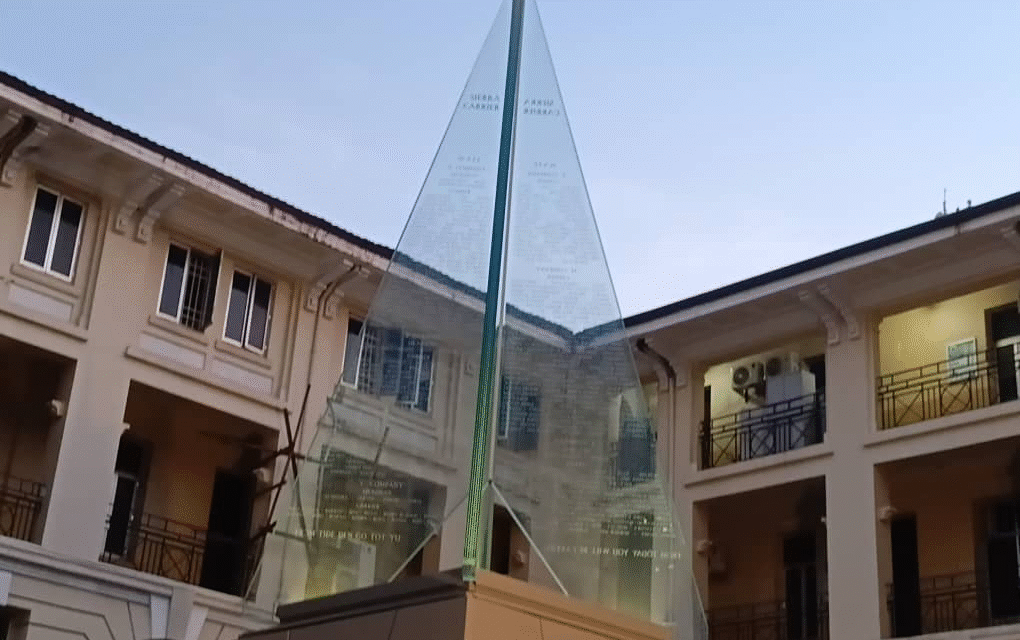
A new glass monument rising above Freetown’s 1931 war memorial has restored the individual names of 944 Sierra Leonean World War 1 Carrier Corps members, correcting a colonial-era omission that erased their identities for nearly a century.
The Commonwealth War Graves Commission unveiled the memorial on Saturday, November 7, 2026, at the Ministry of Finance courtyard on George Street, in partnership with Freetown City Council and the Ministry of Tourism and Cultural Affairs.
The original memorial, designed by Sir Edwin Lutyens and unveiled in 1931, listed the names of 229 soldiers but commemorated the Carrier Corps only as a number. The men who transported food, ammunition, and medical supplies across terrain impassable to vehicles and animals during the First World War were deemed to have insufficient space for individual recognition.

After the Second World War, the panels were adjusted to accommodate later casualties. In the process, all First World War dead were condensed onto a single panel, and even the numerical reference to the carriers disappeared.


Nearly 5,000 Sierra Leoneans served as carriers in the East Africa campaign, with at least 850 dying—most from disease rather than combat . They marched through dense forest, thick swamps, and mountainous country, keeping frontline troops supplied.
Nigerian architect Tosin Oshinówò and her Lagos-based studio extended Lutyens’ stone monument with a nine-metre glass prism etched with the carriers’ names. The design follows the original’s tapering geometry, rising higher to symbolically elevate those previously denied recognition.
“In this gesture, the Sierra Leone Carrier Corps are symbolically carried by their comrades, reversing the relationship between those who served and those who were served,” Oshinówò said.
The glass structure captures changing natural light during the day, while an integrated beacon projects a beam visible from up to five kilometres on significant commemorative occasions. Oshinówò is the first woman and first West African architect to design a CWGC memorial.
Vice Admiral Peter Hudson, vice chairman of the CWGC, said the memorial was intended to “move beyond anonymous sacrifice and recognise every individual by name, restoring dignity to the men whose contributions were overlooked for more than a century” .
Freetown Mayor Yvonne Aki-Sawyerr noted that the memorial’s reflective glass allows visitors to see themselves alongside the inscribed names, reinforcing the message that every life matters. She said the space would also commemorate Sierra Leoneans who died during the civil war and the Ebola outbreak, with November 7 marking 11 years since the end of Ebola in the country.
Tourism Minister Nabeela Tunis described the unveiling as “a meaningful step towards correcting historical omissions through public recognition,” while acknowledging that “a memorial does not resolve every question of reparations”.
The commemoration raises a question the ceremony did not address: whether the families of the fallen ever received financial compensation for their sacrifices. Historical evidence confirms the carriers’ service and their belated recognition, but does not establish whether restitution was ever paid.
For the descendants of men like Carrier Joe of “F” Company, who died of disease in October 1917 and whose name now appears on the Freetown Memorial, the glass prism offers something the original stone never did: a name to remember.