China-Africa Cooperation, Global South Solidarity and the Future of Sierra Leone: Lessons from the 15th China-Africa Think Tanks Forum
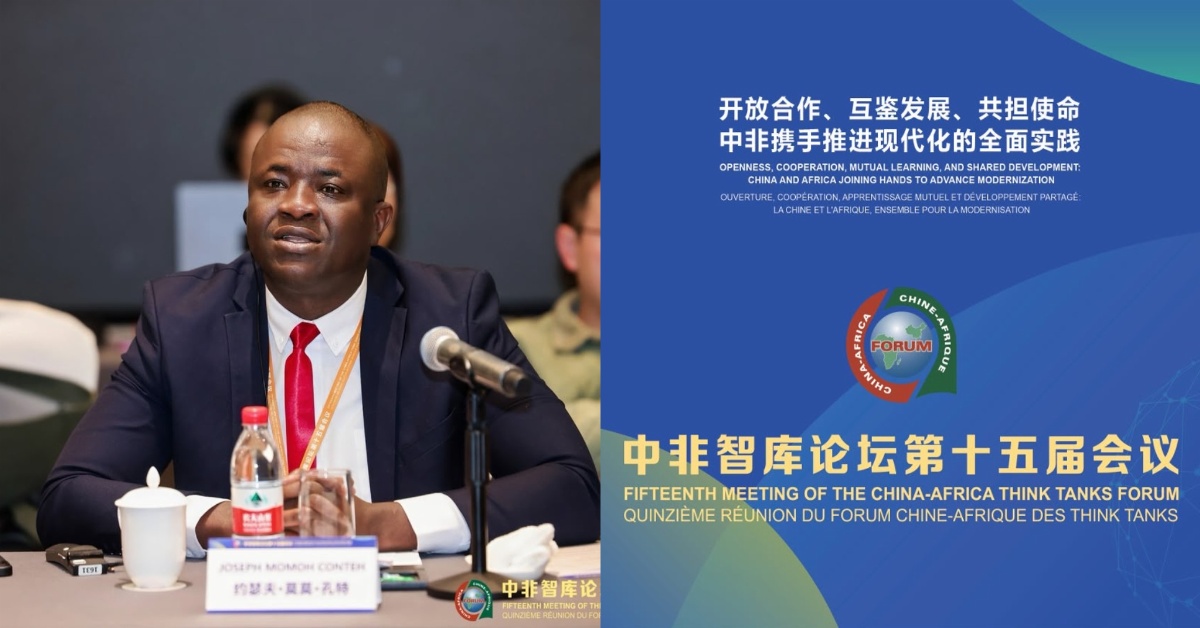
A Sierra Leonean voice at the 15th forum
Two things stayed with me from Yiwu: the noise of its commodity market at dawn, and the number of African scholars in one hall arguing about their own continent’s future. I came to the 15th China-Africa Think Tanks Forum for the first time as a Sierra Leonean PhD scholar at Peking University, where I am associated with the Institute of South-South Cooperation and Development and also working for the Justice Sector Coordination Office Ministry of Justice-Freetown. It puts African and Chinese researchers, officials and development thinkers in one room, which is rare enough to matter.
I presented a paper titled “Strengthening Solidarity and Cooperation of the Global South and Promoting Reform of the Global Governance System.” For a Sierra Leonean studying development far from home, it was a chance to test what I had learned against colleagues’ experience.

My presentation: why the Global South must work together



My argument began with one question: who writes the rules? Finance, trade and security rules were drafted when China and most of Africa were absent from the table. Africa supplies about a quarter of the United Nations’ members and holds no permanent seat on the Security Council. Voting weights at the International Monetary Fund and the World Bank still favourthe countries that designed them. For Sierra Leone the consequence is practical: a small economy sets its budget against interest rates and tariff rules it did not write.
I argued that solidarity rests on four foundations. Joint diplomacy gives small states a louder voice in international organisations. Economic cooperation must create jobs, which means processing and manufacturing at home. Strong institutions decide whether an agreement becomes a clinic or a stalled site; a state that cannot negotiate, tax and enforce a contract loses part of every deal. Transparent delivery lets citizens see what a project cost and produced.
Solidarity also has to respect difference: Nigeria’s priorities are not Botswana’s, and a common position has to accommodate both.
China’s role in cooperation and shared development
China’s role looks different from Freetown than from a headline. Chinese finance and contractors have built roads, bridges and power plants that people use daily. Chinese firms trade, invest and employ, and have brought machinery, digital systems and processing equipment where local capacity was thin. University partnerships now link research institutions in both regions. Scholarships and training have placed African professionals in Chinese universities, and I am one of them. Medical teams, laboratories and vaccines reached Sierra Leone during Ebola and COVID-19, and Chinese support arrived during the civil war.
The relationship predates China’s rise. Diplomatic ties began in 1971, the year Sierra Leone supported the restoration of China’s seat at the United Nations.
What Africans can learn is a discipline rather than a doctrine: planning over decades, testing a policy before national rollout, and spending early on power and transport. China can learn from Africa too, on agriculture, informal enterprise and the management of diversity. None of it transfers automatically. The record is uneven, and not every project has aged well. Every African government has to set its own priorities and bargain over terms, local content and jobs.
Judicial cooperation and cross-border rule of law
Trade does not survive where contracts cannot be enforced. Legal cooperation belongs in the China-Africa relationship.
The FOCAC Beijing Action Plan for 2025 to 2027 commits both sides to judicial, law enforcement and legislative exchanges, and to accelerate work on extradition and criminal judicial assistance treaties. Those are commitments, not completed achievements. The practical work covers exchanges between courts, mutual legal assistance in civil and criminal matters, recognition and enforcement of foreign judgments and arbitral awards where agreements allow, cooperation against corruption, cybercrime and trafficking, and training for judges, prosecutors and lawyers.
One term needs care. Judicial review means a court checking whether a government decision is lawful, a domestic constitutional matter. What China and African states discuss is judicial cooperation and legal exchange. The Yiwu programme reflected that, with papers on zero-tariff law and Kenya’s business environment.
For Sierra Leone the stake is direct. A justice system that cannot serve papers across a border, or enforce an award, will struggle to attract investors and protect citizens who work abroad.
Modernisation through China-Africa relations
Modernisation is often counted in concrete. Roads, bridges and power lines are visible, and they matter. A country is not modern because it has new buildings. Modernisation also means children who learn, clinics with medicine, industries that employ, science applied to farming, institutions that work, households with more secure incomes, clean water, and a state able to regulate new technology rather than merely import it.
China-Africa cooperation touches each of those through infrastructure, industrial development, skills training, research, technology and exchange of experience. The risk is to treat a partner’s model as a template. Chinese policy was shaped by Chinese conditions, including administrative capacity that many African states do not yet have. Copying the instrument without the capacity produces white elephants.
Sierra Leone’s path has to start where the country is: raise farm productivity, connect farms to markets, fix power, train teachers and technicians, and build the procurement and audit systems that make investment safe. That is a modernisationagenda, and it is ours to define.
Lessons from ISSCAD and Peking University
ISSCAD changed how I read a budget. I arrived treating development as a question of money: find the finance and results follow. The evidence points elsewhere. Money passes through institutions, and institutions decide whether it becomes a road or a payment to a consultant. A ministry that cannot plan, a procurement system that cannot police itself and an audit office without teeth will waste a good loan.
The same holds for poverty reduction. A household escapes poverty through a wage, a harvest or a clinic that works, and each depends on a state that can deliver.
Peking University gave me distance from my own system. Reading Chinese work on industrial policy, and hearing planners describe structural change, made the politics of development visible. The ISSCAD cohort draws students from across the developing world, and comparing our different constraints taught me more than any single model. Ethiopia, Ghana, Zambia and Kenya face problems close to ours, with different answers.
The lesson I keep is adaptation. Knowledge should not stay in a lecture room. At Yiwu I could place Sierra Leone’s constraints beside evidence from elsewhere and argue for reform without reciting a textbook.
What other Sierra Leoneans can learn
For readers in Sierra Leone who were not in Yiwu, six lessons seem worth carrying home.
A forum is useful only if the knowledge travels. Students, officials, researchers and entrepreneurs should follow these debates, and those of us who attend should report back honestly. None of this needs a large budget. It needs decisions about priorities and the patience to see them through.
Turning cooperation into results for our people
I left Yiwu convinced of something simple. China’s experience is worth studying, and China has shown that a poor country can change its condition within a generation. That is an argument about possibility.
The decision to change belongs to us. Partners can supply finance, equipment and training. They cannot supply the will to reform, the discipline of a budget or the integrity of a court. Sierra Leone’s development will be settled in Freetown, in its ministries, its courts, its classrooms and its farms, by people who use partnerships well and refuse to rent out their responsibilities.
Cooperation should be judged by results that outlast the project: a child in school, a clinic with drugs, a farmer who sells at a fair price, a graduate who finds work at home. Yiwu is a long way from Freetown. The distance is shorter when the lessons arrive.