

Chief Justice Kamanda Releases 47 Inmates, Reduces Sentences for 42 at Waterloo Prison Review
 Deborah Sorie
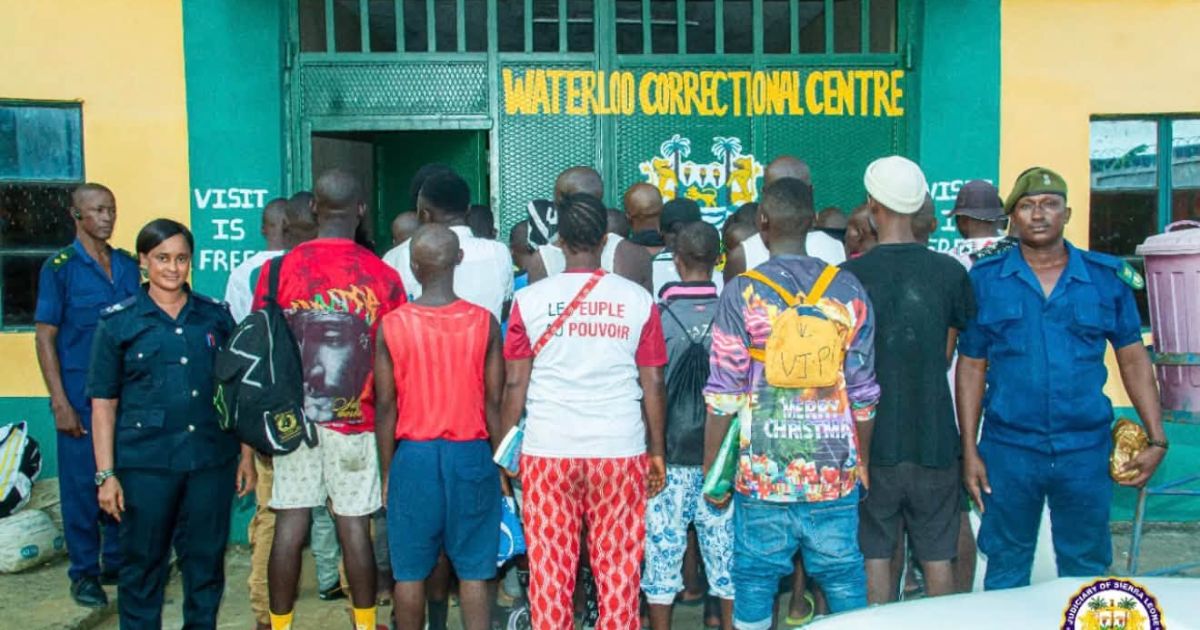
Sierra Leone’s Chief Justice, Honourable Justice Komba Kamanda, has overseen a judicial review exercise at the Waterloo Correctional Facility, resulting in the release of 47 convicted inmates and the reduction of sentences for 42 others and 21 sentences were upheld.
Conducted pursuant to Cap. 17 of the Laws of Sierra Leone, the exercise also saw 21 applications for early release refused following judicial consideration of the nature of the offences and the circumstances of the respective cases.
A three-member panel comprising Court of Appeal’s Court Justice Hon. John Bosco Alieu and High Court Justices Hon. Mark Ngegba and Hon. Isata Sellu-Tucker reviewed cases involving 110 convicted inmates and 48 remand prisoners.

The exercise forms part of the Judiciary’s efforts to promote fairness, access to justice and proportionate treatment of persons in custody, particularly those convicted of minor offences. It seeks to ensure that decisions on continued incarceration, sentence reduction and release are guided by the law and the circumstances of individual cases.


“Justice must not only be done in the courtroom; it must also be upheld within the walls of correctional facilities,” Chief Justice Kamanda said.
Among those released was Foday Kargbo, who had been sentenced to 36 months’ imprisonment or an alternative fine of Le40,000. He was released on time served after spending 18 months in custody.
Kargbo had appealed on compassionate grounds, citing the death of his wife while he was in prison and the hardship facing his five children, who were left in the care of his elderly mother. His release followed consideration of his conduct in custody, time served and family circumstances.
Tamba Sandy and Alie Swaray, who were serving four-year sentences for stealing beverages, were also released after 15 months in custody. Their appeal for leniency was reportedly supported by the complainant, and the Court ordered their release on time served after considering the circumstances.
The review also upheld continued incarceration in cases involving offences considered serious or harmful to the wider public.
Mustapha Bangura, convicted of stealing EDSA electricity cables and sentenced to 24 months’ imprisonment, has been denied early release.
The Court noted that Bangura had previously faced a similar charge but escaped conviction after prosecution witnesses failed to appear. In rejecting his appeal, the Judge described the offence as deliberate and emphasized its impact on thousands of people who depend on electricity services.
Considering the seriousness of the offence, its impact on the public, and his repeated involvement in cable theft, the Court ruled that he must serve his full sentence. The decision underscores the Judiciary’s firm stance against the theft of critical public infrastructure.
Applications for bail were made on behalf of 48 remand inmates, of which 29 were granted bail while 19 were refused.
Speaking on behalf of the released inmates, Francis Martin expressed gratitude to God and the Chief Justice, pledging that they would remain law-abiding citizens and avoid further conflict with the law.
Addressing the inmates shortly before they left the correctional facility, the Judiciary Spokesman, Moses Kamara, urged them to be grateful to God for what he described as an opportunity for mercy to prevail. He also commended the Honourable Chief Justice, Justice Komba Kamanda, for what he termed a “timely humanitarian intervention”.
Mr. Kamara urged the released inmates to conduct themselves in accordance with the law, respect the values of society and become responsible citizens. He reminded them that their freedom should serve as an opportunity to make positive contributions to their communities and the development of the country
The recently constructed Waterloo Correctional Facility, designed to accommodate 300 inmates, currently houses 532 inmates, including eight females. Of the total population, 395 are convicted inmates, highlighting the facility’s overcrowding challenge.
It should be noted that Waterloo review highlights the Judiciary’s approach to balancing the application of the law, humanitarian considerations, rehabilitation and public protection through individual case assessments.