
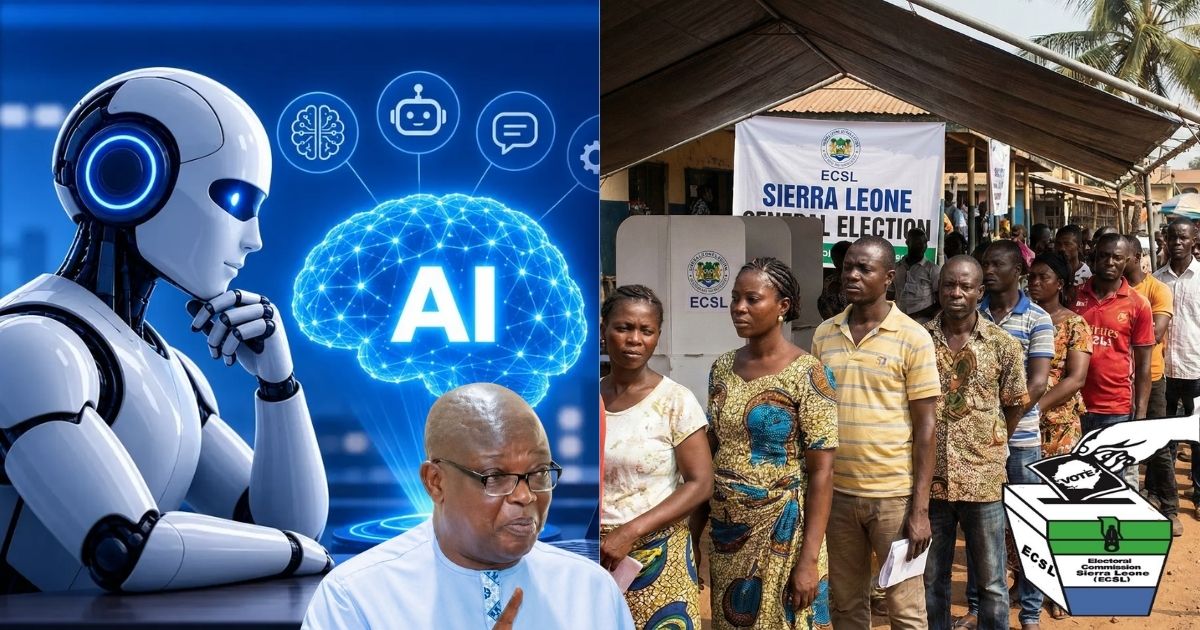
Civil Society Union Rejects ECSL’s Proposed Use of AI in 2028 Elections
 Daniel Amara
 The National Union of Civil Society in Sierra Leone has expressed strong opposition to the proposed use of Artificial Intelligence (AI) in the country’s upcoming elections, arguing that the technology requires broader public consultation and must be subjected to existing constitutional and legal provisions.
Speaking on the issue, Amb. Mohamed Lamin Sheriff, National Secretary-General of the National Union of Civil Society in Sierra Leone, said civil society organisations are not prepared to accept the introduction of AI into the electoral process without proper consultation with the people.
According to Amb. Sheriff, the country’s electoral system must remain guided by the 1991 Constitution, adding that any major change to the electoral process should be carefully examined to ensure it is consistent with the Constitution and other relevant laws.

He questioned the need for Sierra Leone, with a population of just over eight million people, to rely heavily on AI in conducting elections when the country already has personnel across the country who can participate in the electoral process.

”We as civil society in this country, we don’t accept them,” Amb. Sheriff stated, stressing that the Electoral Commission should first consult citizens before introducing any new system involving AI.
He argued that electoral authorities have a responsibility to engage political parties, civil society organisations and the wider public before implementing significant technological changes that could affect the credibility and transparency of elections.
Amb. Sheriff further raised concerns about the role AI could play in determining or influencing election results. He maintained that election results should be based on votes cast and verified through established electoral procedures rather than depending solely on an automated system.
”AI is not just command. They can’t just say, ‘command me for say yes, let this party win,” he said, highlighting what he described as the potential risks associated with relying on artificial intelligence in the electoral process.
The civil society leader also referred to constitutional provisions concerning parliamentary decisions, particularly Section 108 of the 1991 Constitution, which deals with the required majority for certain parliamentary decisions. He said civil society is closely observing developments surrounding constitutional and electoral matters, including the interpretation of the required parliamentary threshold.
He questioned whether the necessary constitutional procedures and consultations have been fully followed before introducing new electoral technologies.
Amb. Sheriff maintained that civil society organisations will continue to monitor the process and engage relevant institutions to ensure that any changes to the electoral system comply with Sierra Leone’s constitutional framework.
He concluded that the National Union of Civil Society’s position remains opposed to the use of AI in the electoral process in its current form, stressing that the people of Sierra Leone should be consulted before any such system is introduced.
”We don’t accept them, and the people of this country don’t accept them,’‘ he stated.