

NaMEA Boss Exposes Weak Monitoring of Government Projects in Sierra Leone
 Sahid Bangura
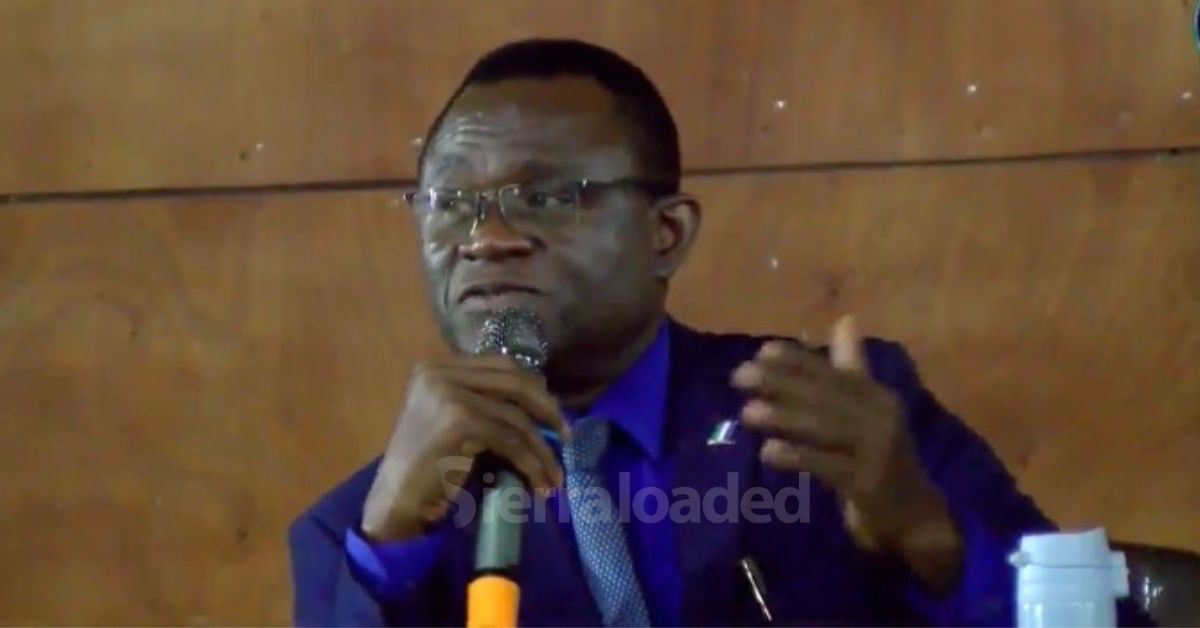
 The Director General of the National Monitoring and Evaluation Agency (NaMEA), Dr. James Edwin, has sharply criticised what he described as a superficial and ineffective culture of monitoring government projects in Sierra Leone, warning that many public projects are being treated as successful simply because a structure has been built.
Speaking during the Government Weekly Press Conference in Freetown on Tuesday, Dr. Edwin said visiting a project site, taking photographs and confirming that a bridge, road, school or health centre exists is not proper monitoring.
According to him, genuine monitoring must determine how much money was spent, whether the work met technical standards, if contractual obligations were fulfilled, whether timelines were respected and whether the intended beneficiaries actually received the benefits.

“Monitoring is not just about seeing a completed structure,” he said. “We must examine the financial, technical, contractual and implementation dimensions of every project.”



His remarks are likely to resonate with growing public concerns over the quality, cost and accountability of government-funded projects across the country.
Dr. Edwin revealed that NaMEA has uncovered cases in which projects and resources meant for specific communities were diverted elsewhere through the influence of powerful individuals.
In one case, he said, a school approved for a particular community was relocated to another area after interference by an influential person. Furniture intended for the school was also moved to a different village.
NaMEA intervened after local authorities raised concerns, and steps were taken to restore the project and its resources to the intended beneficiaries.
In another case in northern Sierra Leone, the agency discovered that equipment for a fisheries project, including a large boat fitted with machinery and refrigeration facilities, had been transferred from the community for which it was purchased to another village.
“After our intervention, the equipment was returned,” Dr. Edwin said, adding that the local chief told the agency that the community had never even seen the equipment before.
The disclosure raises serious questions about oversight, project management and the protection of public resources, particularly in rural communities where citizens often have limited power to challenge such actions.
Dr. Edwin said the agency’s role is not merely to produce reports or generate newspaper headlines but to ensure that problems identified through monitoring are corrected.
“Our focus is on solutions, results and impact on beneficiaries,” he stated. “The objective is to ensure that people do not lose the benefits intended for them.”
He acknowledged that monitoring existed before the creation of NaMEA but argued that Sierra Leone lacked a dedicated institution responsible for coordinating and institutionalising monitoring and evaluation nationwide.
The process of establishing the agency began around 2018 and was formalised through an Act of Parliament in 2024.
Since then, NaMEA has been training monitoring and evaluation personnel across government institutions, including engineers, education specialists and other technical experts, to strengthen professional oversight of public projects.
Dr. Edwin also challenged what he called a narrow understanding of monitoring and evaluation in Sierra Leone, saying that effective oversight requires structured procedures before, during and after field visits.
He disclosed that NaMEA produces annual monitoring and evaluation reports, some of which are already available to the public, while others are yet to be officially released.
The agency, he said, is making additional reports available to journalists and encouraged the public to access them through NaMEA’s website.
At a time when concerns about public expenditure, project quality and service delivery remain high, Dr. Edwin’s comments amount to one of the clearest acknowledgements from a senior government official that physical completion alone does not guarantee accountability, value for money or real benefits for citizens.