

Just In: UN Adopts Fatima Bio’s Resolution for International Day to End Child Marriage
 Sahid Bangura
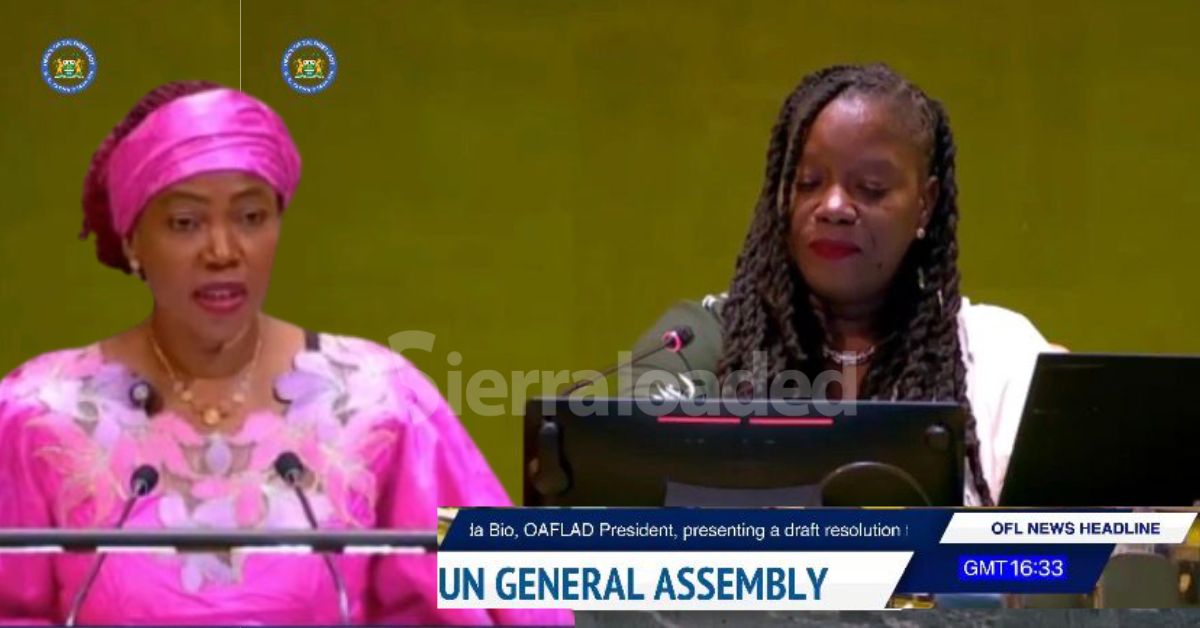
 The United Nations General Assembly has adopted a resolution proposing the establishment of an International Day for the Elimination of Child, Early and Forced Marriage, following an initiative led by Sierra Leone’s First Lady, Dr. Fatima Maada Bio.
First Lady Fatima Bio presented the draft resolution before the General Assembly on Friday, September 4, 2026, on behalf of President Julius Maada Bio, the Government and people of Sierra Leone, urging Member States to strengthen global efforts to protect girls from child, early and forced marriage.
The resolution proposes that November 27 be observed annually as the International Day for the Elimination of Child, Early and Forced Marriage.

Sierra Leone served as the main sponsor of the initiative, with 65 Member States joining as co-sponsors. In her address, First Lady Fatima Bio thanked countries that supported the resolution and called on those that had not yet joined to support the initiative.
“Your support sends a powerful message to girls everywhere: their rights, dignity and future are not negotiable,” she told the Assembly.
She said the proposed international day would provide an annual global platform for governments and stakeholders to renew political commitment, strengthen advocacy, raise awareness, promote accountability and accelerate action against child, early and forced marriage.
According to the First Lady, the initiative would also encourage governments to strengthen legislation and enforcement, increase investment in girls’ education and protection, challenge harmful social norms and amplify the voices of survivors and girls at risk.
Fatima Bio described child, early and forced marriage as a major barrier to gender equality, human rights and sustainable development, noting that the practice deprives girls of education, opportunities and the ability to make decisions about their own futures.
She further warned that forced marriage can expose girls to violence, exploitation and abuse, restrict their economic opportunities and contribute to intergenerational poverty.
“Behind every statistic on child, early and forced marriage is a child. There is a name. There is a dream. There is a future,” she said.
The First Lady also connected the issue to her personal experience, saying her presence at the United Nations was informed not only by Sierra Leone’s national commitment to protecting children but also by a journey from her own life that she was fortunate to survive.
She argued that eliminating child marriage should be regarded not only as a human rights obligation but also as an investment in human capital, families, economies and national development.
“We cannot speak credibly of gender equality while millions of girls are denied the right to determine the course of their own lives,” she said.
Fatima Bio, who is also President of the Organisation of African First Ladies for Development (OAFLAD), stressed that establishing an international day alone would not end the practice.
“An International Day cannot, by itself, end child marriage. But political attention can. Strong laws can. Effective institutions can. Education can. Economic opportunities can. Community leadership can. And, above all, sustained political will can,” she said.
She pointed to Sierra Leone’s Prohibition of Child Marriage Act 2024, enacted under the leadership of President Julius Maada Bio, as a significant national measure to strengthen the protection of children.
However, she acknowledged that legislation must be supported by effective enforcement, strong institutions, education, community engagement, economic empowerment and sustained political leadership.
Fatima Bio called on UN Member States to strengthen their legal and institutional frameworks to prevent and eliminate child, early and forced marriage and ensure that survivors and girls at risk have access to protection, justice, education, healthcare and economic opportunities.
“Strong laws set standards. Strong institutions enforce them. Strong political leadership changes society,” she said.
The First Lady also recognised Zambia and Canada for their leadership in advancing General Assembly Resolution 79/158 on child, early and forced marriage, while commending Zambian President Hakainde Hichilema for his efforts as an African champion in the campaign to end the practice.
She further praised President Julius Maada Bio for placing the protection and empowerment of women and girls on Sierra Leone’s national agenda.
Fatima Bio described the adoption of the resolution as a collective commitment by the international community to protect childhood, uphold the dignity and rights of girls and prevent another generation from losing its childhood and future to child, early and forced marriage.
The adoption marks a significant diplomatic milestone for Sierra Leone’s campaign to strengthen international action against the practice and places the country at the centre of a global initiative focused on protecting girls and advancing their rights.