APC Raises Alarm Over Tablet Shortages, Training Failures Ahead of 2026 Census
 Aminata Koroma
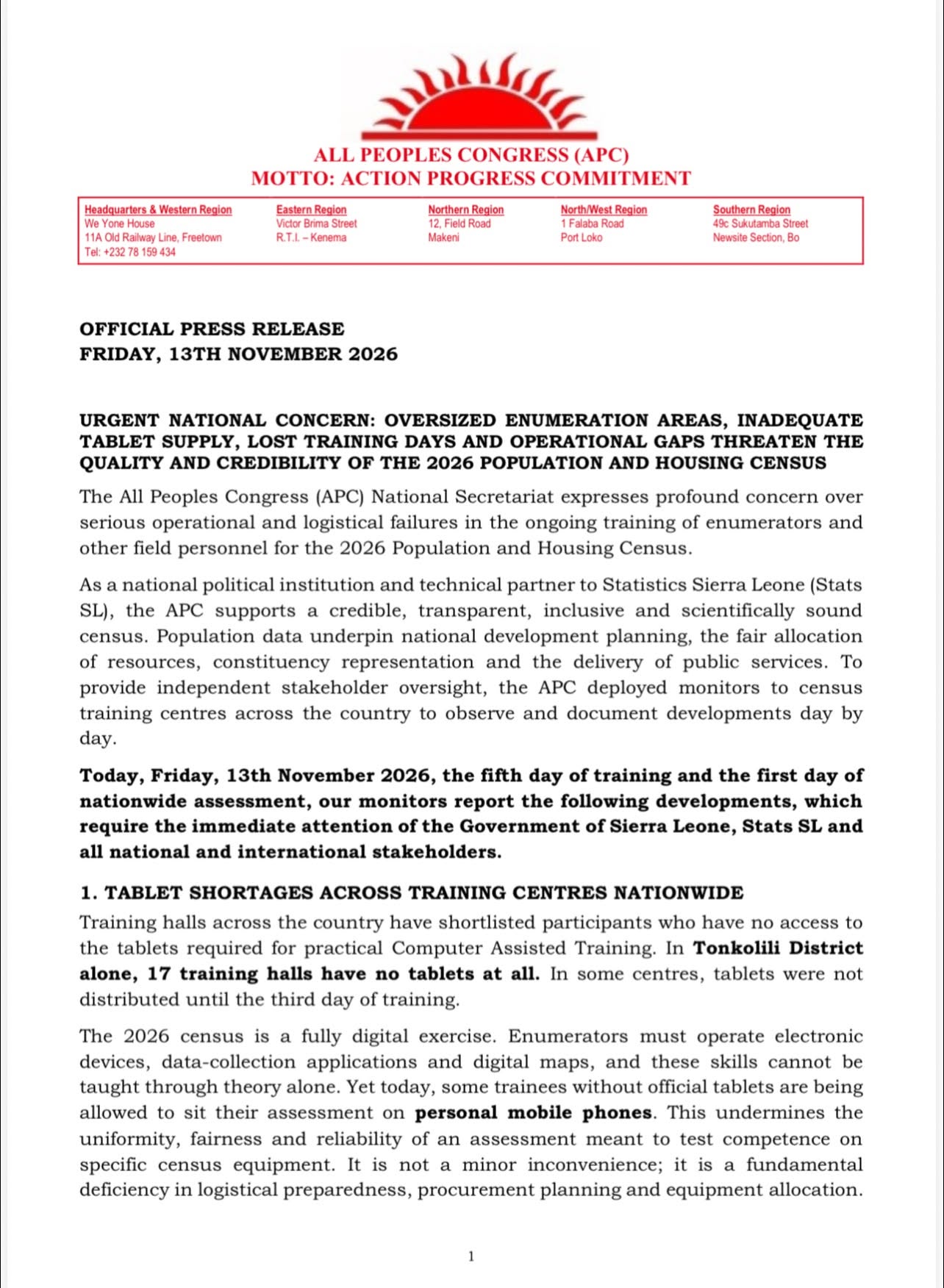
The All Peoples Congress (APC) has raised concerns over what it described as serious operational and logistical failures in the ongoing training of enumerators and other field personnel for the 2026 Population and Housing Census.
In a press release issued on Friday, November 13, 2026, the APC said its monitors deployed to training centres across the country observed several challenges, including shortages of tablets, unannounced changes in training venues, lost training days, and concerns about the size of Enumeration Areas (EAs).
The Party said the reported challenges required the Government of Sierra Leone, Statistics Sierra Leone (Stats SL), and other national and international stakeholders to address them immediately to safeguard the credibility of the census.

According to the APC, several training centres nationwide have participants without access to the tablets required for practical Computer-Assisted Training. It cited Tonkolili District as an example, where 17 training halls reportedly had no tablets, while some centres did not receive the devices until the third day of training.



The Party expressed concern that some trainees without official tablets were being allowed to sit their assessments using personal mobile phones, arguing that such an arrangement could undermine the uniformity, fairness and reliability of an assessment designed to test competence using specific census equipment.
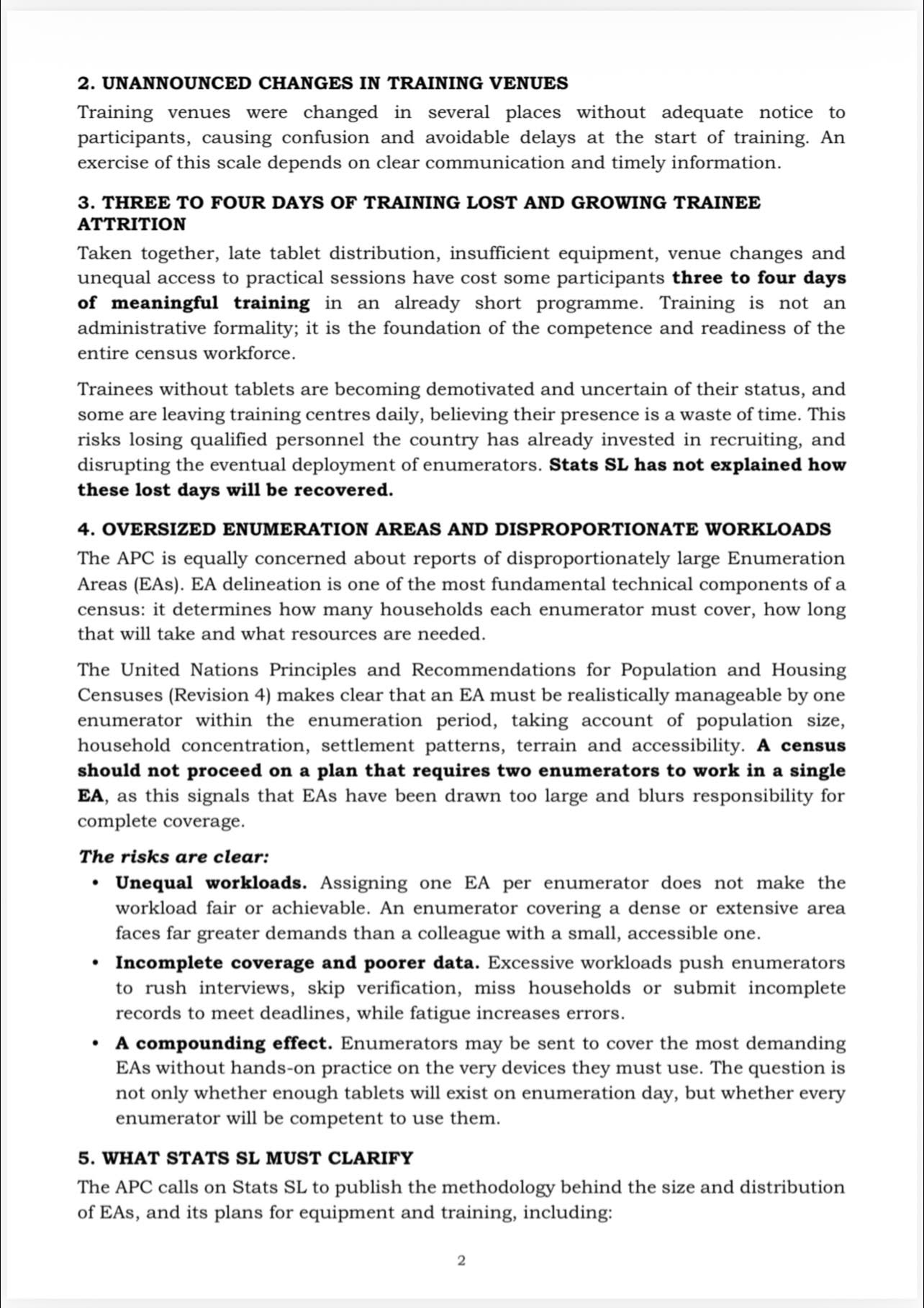
It further noted that the late distribution of tablets, inadequate equipment, changes in training venues and unequal access to practical sessions had deprived some participants of three to four days of meaningful training.
The APC warned that the situation was demotivating trainees, with some reportedly leaving training centres daily because they believed their attendance was no longer worthwhile. It said the development could result in the loss of qualified personnel already recruited for the exercise and disrupt the eventual deployment of enumerators.
The Party also raised concerns over reports of disproportionately large Enumeration Areas, noting that the size and distribution of EAs determine the number of households assigned to enumerators, the time required to complete their assignments and the resources needed.
Referring to the United Nations Principles and Recommendations for Population and Housing Censuses (Revision 4), the APC said Enumeration Areas should be realistically manageable by individual enumerators within the stipulated enumeration period, taking into account population size, household concentration, settlement patterns, terrain and accessibility.
It warned that excessive workloads could result in unequal assignments, incomplete household coverage, rushed interviews, missed households and inaccurate data.
The APC further cautioned that assigning two enumerators to a single EA could indicate that the areas had been drawn too large, potentially creating difficulties in ensuring clear responsibility and complete coverage.
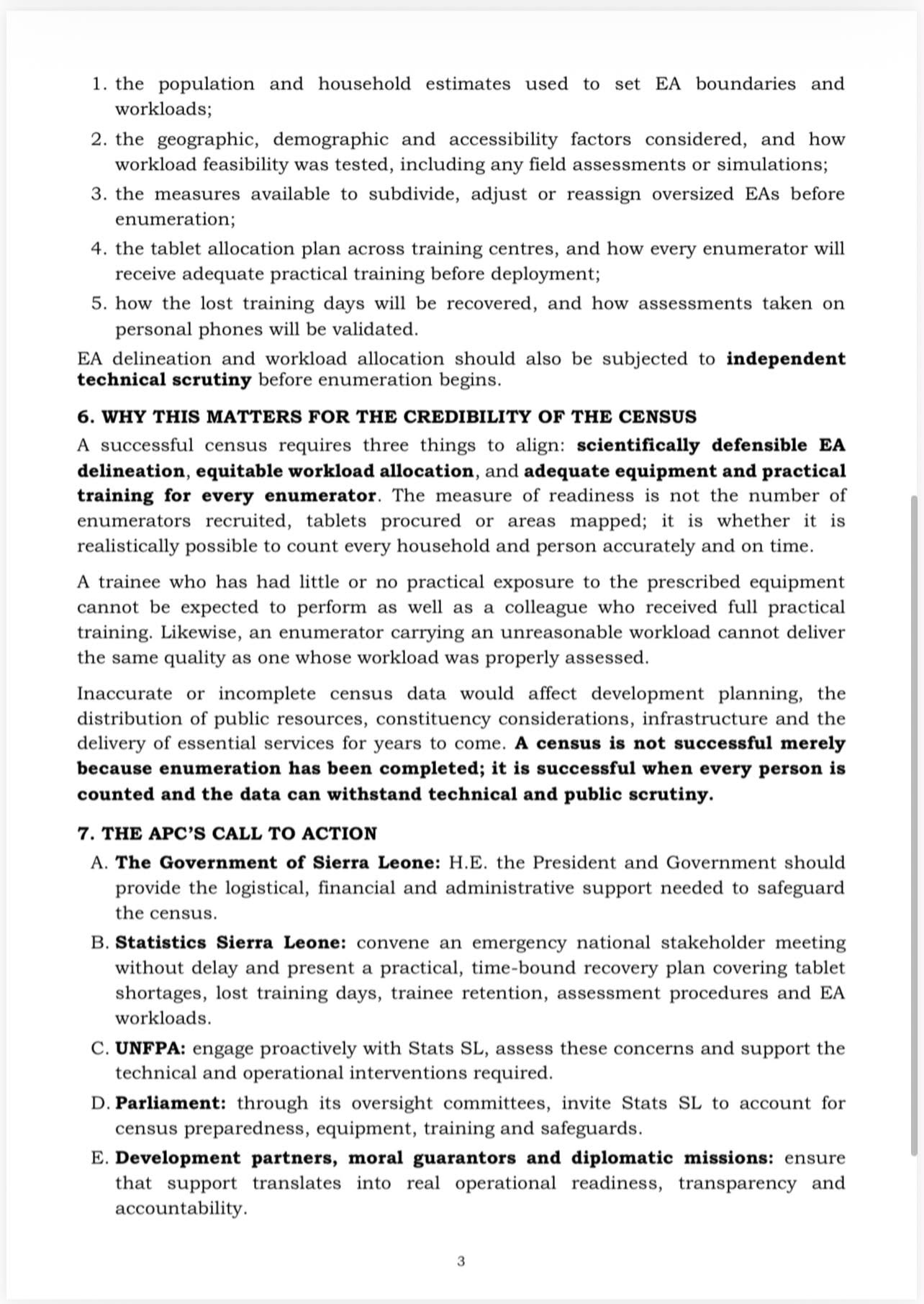
Against this background, the Party called on Stats SL to publish the methodology used in determining the size and distribution of Enumeration Areas, including the population and household estimates, geographical and demographic considerations, accessibility factors and workload assessments.
It also urged the statistics institution to explain the measures available to subdivide, adjust or reassign oversized EAs before enumeration begins.
On training and equipment, the APC called for clarification on the tablet allocation plan across training centres, how every enumerator would receive adequate practical training, how lost training days would be recovered and how assessments conducted using personal mobile phones would be validated.
The Party also called for independent technical scrutiny of EA delineation and workload allocation before the commencement of enumeration.
The APC maintained that a credible census required scientifically defensible EA delineation, equitable workload allocation and adequate equipment and practical training for all enumerators.
It warned that inaccurate or incomplete census data could have long-term implications for national development planning, the distribution of public resources, constituency representation, infrastructure development and the delivery of essential services.
As part of its recommendations, the Party called on President Julius Maada Bio and the Government to provide the necessary logistical, financial and administrative support to safeguard the census.
It also urged Stats SL to convene an emergency national stakeholder meeting and present a practical, time-bound recovery plan addressing tablet shortages, lost training days, trainee retention, assessment procedures and EA workloads.
The APC further called on the United Nations Population Fund (UNFPA) to engage with Stats SL, assess the concerns raised and support the technical and operational interventions required.
Parliament was also urged to use its oversight committees to invite Stats SL to account for census preparedness, equipment distribution, training arrangements and safeguards.
The Party called on development partners, diplomatic missions and other stakeholders to ensure that their support translates into operational readiness, transparency and accountability.
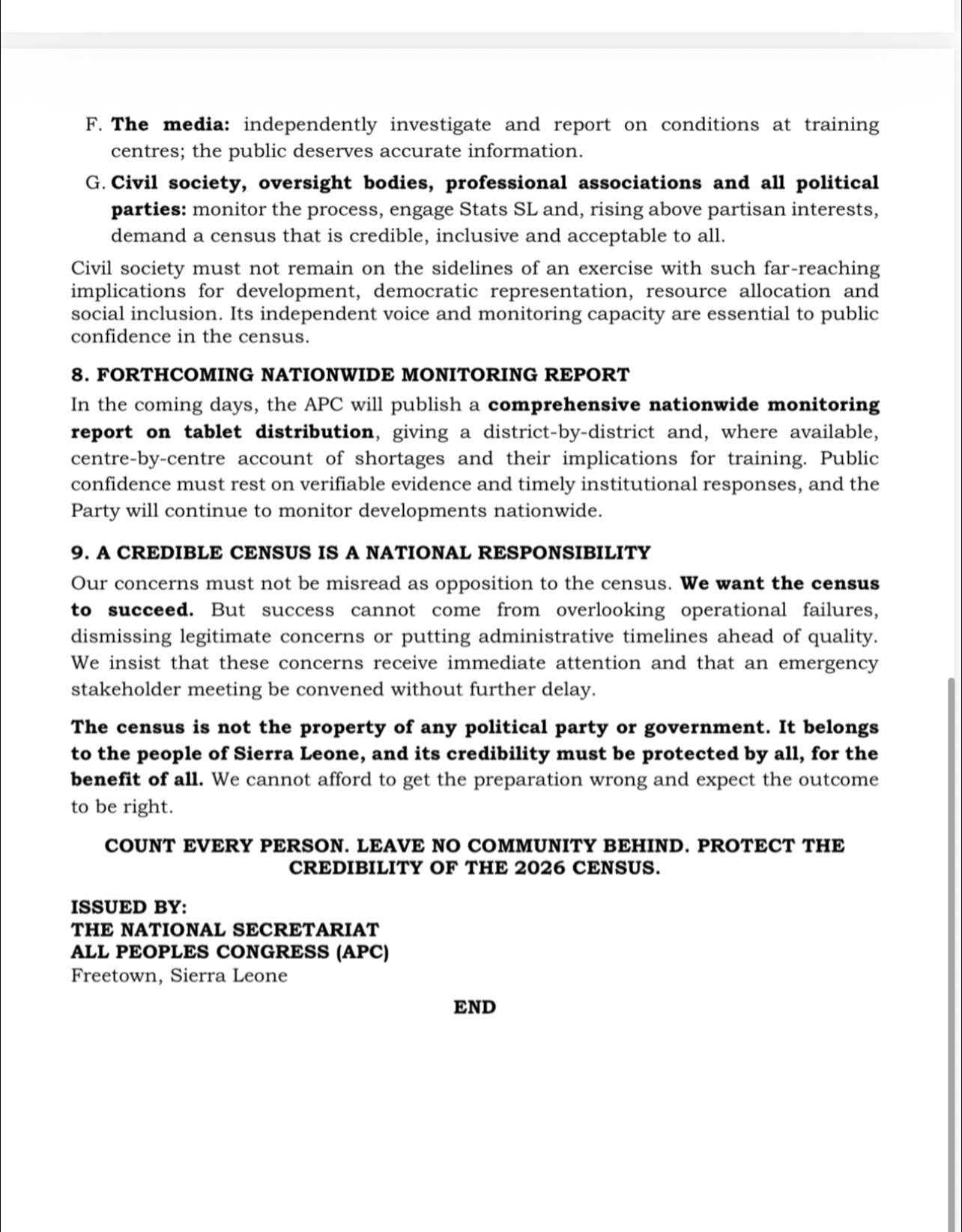
It also encouraged the media to independently investigate conditions at training centres, while urging civil society organisations, professional associations, oversight bodies and political parties to monitor the process and engage Stats SL in the interest of a credible and inclusive census.
The APC disclosed that it would publish a comprehensive nationwide monitoring report in the coming days, providing district-by-district and, where available, centre-by-centre details of tablet distribution and the implications of shortages for the ongoing training.
The Party stressed that its concerns should not be interpreted as opposition to the census, but rather as a call for the necessary interventions to ensure its success.
It maintained that the census belonged to the people of Sierra Leone and should be protected by all stakeholders, warning that adequate preparation was essential to ensuring that every person was counted and that the resulting data could withstand technical and public scrutiny.