

Op-Ed: Why Sierra Leone May Struggle to Resolve Its Current Constitutional Amendment Crisis
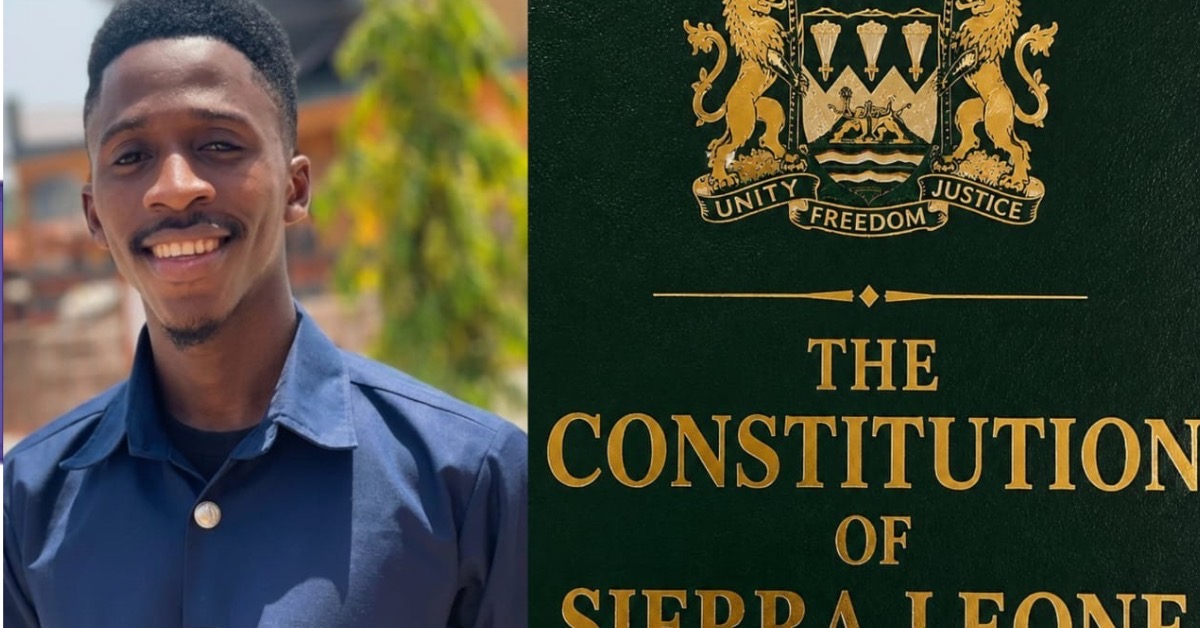
 Emmanuel Gbondo
 There are moments in the life of a nation when the Constitution ceases to be a document discussed primarily by lawyers, politicians and constitutional scholars and becomes a matter of intense public concern.
Sierra Leone appears to have reached such a moment.
For several weeks, the country has witnessed an increasingly contentious debate over proposed constitutional amendments. Legal scholars, political commentators and public officials have advanced competing interpretations of the constitutional provisions governing the process. Some have defended the procedure, while others have questioned its legality and legitimacy.

What is particularly striking is the extent to which ordinary Sierra Leoneans have become engaged in the debate. Citizens who may previously have paid little attention to constitutional provisions are now discussing sections, procedures and competing interpretations with remarkable intensity.

That engagement is, in itself, not necessarily a bad thing.
A Constitution belongs to the people. When citizens begin asking who has the authority to amend it, what procedures must be followed and whose interests proposed changes ultimately serve, democratic accountability is strengthened.
Yet the current controversy raises a deeper concern: Can Sierra Leone resolve its constitutional dispute when the competing legal positions are closely intertwined with the political interests of the country’s two major political parties?
Beyond Sections and Subsections
Much of the current debate has focused on whether Section 91 or Section 108 of the 1991 Constitution provides the appropriate constitutional route for the proposed amendments.
That is an important legal question, and ultimately one for constitutional experts and the courts to determine.
But the crisis cannot be understood solely through the language of constitutional provisions.
Beneath the legal arguments lies a much larger political contest involving the Sierra Leone People’s Party (SLPP) and the All People’s Congress (APC), each of which has a profound interest in how the country’s political and electoral system is structured.
Constitutional reform can undoubtedly strengthen institutions, improve governance and protect citizens’ rights. But it would be unrealistic to pretend that constitutional amendments concerning political institutions and elections are entirely detached from questions of political power.
Electoral rules determine how political representation is produced. They influence parliamentary numbers and can ultimately shape which party has the ability to form and sustain a government.
That makes the current disagreement far more consequential than a technical dispute over constitutional drafting.
The Political Stakes of Proportional Representation
The question of Proportional Representation (PR) illustrates the difficulty particularly clearly.
The adoption of PR for the 2023 parliamentary elections fundamentally altered the electoral arithmetic. The results gave the governing SLPP a strong parliamentary position, while the APC was confronted with the implications of an electoral system different from the traditional first-past-the-post model.
From the SLPP’s perspective, the 2023 experience demonstrated the political possibilities of PR.
From the APC’s perspective, the same experience provided reason to scrutinise whether permanently entrenching PR in the constitutional framework could affect its future prospects of winning parliamentary power.
This creates a difficult political calculation.
If the APC believes that permanently constitutionalising PR could disadvantage its future electoral prospects, it would be unrealistic to expect the party to support such an arrangement simply because doing so might make the constitutional review process easier.
Conversely, the SLPP may have little political incentive to abandon a system it regards as legitimate and under which it has demonstrated electoral strength.
The disagreement, therefore, is not merely about constitutional language.
It is also about the future distribution of political power in Sierra Leone.
What Should We Expect from an Opposition Party?
This is where it becomes important to distinguish between understanding a political position and endorsing every action taken in pursuit of it.
The primary objective of an opposition party in a democratic system is to challenge the governing party and ultimately seek to replace it through legitimate political competition.
Opposition parties are expected to scrutinise government policy, challenge decisions they consider problematic and resist measures they believe could undermine their future prospects of governing.
If the APC genuinely believes that permanently entrenching PR could adversely affect its electoral prospects, its resistance should not automatically be interpreted as evidence of opposition to constitutional reform itself.
The same principle should apply in reverse.
If the government believes that its proposed reforms are constitutionally sound and in the national interest, it should be able to defend them through transparent legal and political arguments rather than assuming that every objection is an attempt to obstruct governance.
The APC’s parliamentary walkout before the anticipated vote can therefore be interpreted in competing ways.
Government supporters may regard it as an attempt to frustrate constitutional reform.
The APC may regard it as a legitimate political and constitutional protest.
Both interpretations are likely to remain part of the public debate.
And that is precisely what makes the situation so delicate.
A Supreme Court Decision May Not End the Political Dispute
The legal questions surrounding the parliamentary process may ultimately have to be resolved through judicial interpretation.
But even a definitive court ruling may not, by itself, resolve the political controversy.
A judgment could settle a question of constitutional interpretation while leaving unresolved the political distrust that produced the dispute in the first place.
One side could regard the judgment as a vindication of its position, while the other could focus on what it considers unresolved constitutional or procedural questions.
Political parties would issue statements. Lawyers and constitutional scholars would offer competing interpretations. Public debate would intensify across television, radio and social media.
The country could therefore find itself facing another cycle of political and legal confrontation.
The essential point is this:
Courts can interpret constitutions, but they cannot create political trust by judicial order.
The Deeper Crisis: Political Trust
Perhaps the most important dimension of the current controversy is the absence of trust between Sierra Leone’s principal political actors.
The SLPP does not necessarily view the APC’s objections as politically neutral.
The APC, in turn, does not necessarily view the government’s constitutional proposals as politically neutral.
Each side risks interpreting the other’s actions through the prism of political survival.
When the government proposes an amendment, the opposition may suspect political advantage.
When the opposition resists an amendment, the government may suspect deliberate obstruction.
Even legal arguments can become politically interpreted when public confidence in the motives of political actors is already weak.
This creates a dangerous environment for constitutional reform.
Without a meaningful degree of political trust, even a legally valid amendment can become politically divisive.
The Lessons of the 2023 Elections
The experience of the 2023 elections cannot simply be separated from the current debate.
The elections demonstrated that electoral systems are not merely technical mechanisms. They influence representation, parliamentary composition and the distribution of political power.
That experience inevitably shapes how political parties approach proposals concerning electoral arrangements.
The SLPP has experienced the political advantages associated with PR.
The APC has experienced the political implications from the opposition benches.
It is therefore unrealistic to expect both parties to approach the question as though it were purely an academic exercise in constitutional design.
At stake is a fundamental political question:
Who will have the opportunity to govern Sierra Leone in the future, and under what electoral rules?
Where Does This Leave Ordinary Sierra Leoneans?
This may be the most important question of all.
While political parties debate parliamentary numbers, lawyers analyse constitutional provisions and politicians defend competing positions, ordinary citizens are asking what the controversy means for their country.
They want a Constitution that works.
They want credible elections.
They want independent and respected institutions.
They want political parties to compete fairly.
They want Parliament to function effectively.
They want the courts to be trusted.
Above all, they want political leaders to remember that the Constitution does not belong to the SLPP, the APC, Parliament, the Presidency or the legal profession.
It belongs to the people of Sierra Leone.
That principle should remain at the centre of any constitutional reform process.
Constitutional reform must not become another battlefield in the country’s broader struggle for political dominance.
What Could the Endgame Look Like?
At this stage, no one can say with certainty how the current controversy will end.
Several possibilities remain open: prolonged litigation, political negotiations, further parliamentary engagement or a compromise involving the principal political stakeholders.
There is also the possibility that regional or international democratic institutions could become more engaged if the disagreement were to threaten broader political stability.
But none of these mechanisms is likely to provide a durable solution unless Sierra Leone’s political actors recognise a fundamental principle:
A constitutional settlement perceived by one major political party as a permanent victory over another is unlikely to produce lasting political stability.
The Constitution must be larger than the next election.
Looking Beyond 2028
Perhaps the question Sierra Leoneans should be asking is not:
Which political party benefits from this amendment?
The more important question is:
What kind of political system do we want future generations to inherit?
If constitutional rules are designed primarily to disadvantage today’s political opponents, future governments may eventually inherit and exploit those same rules.
Political power changes hands.
Governments come and go.
Presidents leave office.
Opposition parties eventually become governing parties.
But the Constitution remains.
That is why constitutional amendments require exceptional caution, particularly when they affect the rules governing political representation and access to power.
The political advantage enjoyed by one party today may become a disadvantage tomorrow.
A National Interest Above Political Interests
This debate should not be reduced to a contest between the SLPP and the APC.
Nor should disagreement automatically be interpreted as disloyalty to the nation.
A mature democracy must be capable of accommodating disagreement, legal challenge and political competition without allowing those differences to undermine the constitutional order itself.
Sierra Leone has an opportunity to demonstrate precisely that kind of democratic maturity.
The country should debate the Constitution.
It should challenge constitutional interpretations.
It should litigate genuine legal disputes.
Political parties should defend their interests.
But none of these activities should cause the national interest to disappear from view.
If the current constitutional process concludes with one major political party believing that it has been defeated, humiliated or permanently disadvantaged, Sierra Leone may have amended its Constitution without resolving the deeper political problem.
The words may change.
The political culture may not.
That would be a missed opportunity of historic proportions.
The most important constitutional reform Sierra Leone needs may therefore not necessarily be a new clause, a new section or a new electoral formula.
It may be something more fundamental: a political culture in which national institutions are treated as belonging to the entire nation rather than to whichever political party happens to control them at a particular moment.
Sierra Leone must come before the SLPP.
Sierra Leone must come before the APC.
And Sierra Leone must come before the ambitions of any individual politician.
Because when the political contest is finally over, the political parties will change, governments will change and leaders will change.
But the country will remain.
The political chess game will eventually end. The board that remains is Sierra Leone.
And all of us-government, opposition and citizens alike-will still have to live on it.