

Sierra Leone’s Constitution on Trial: The Supreme Court’s Defining Moment
Introduction
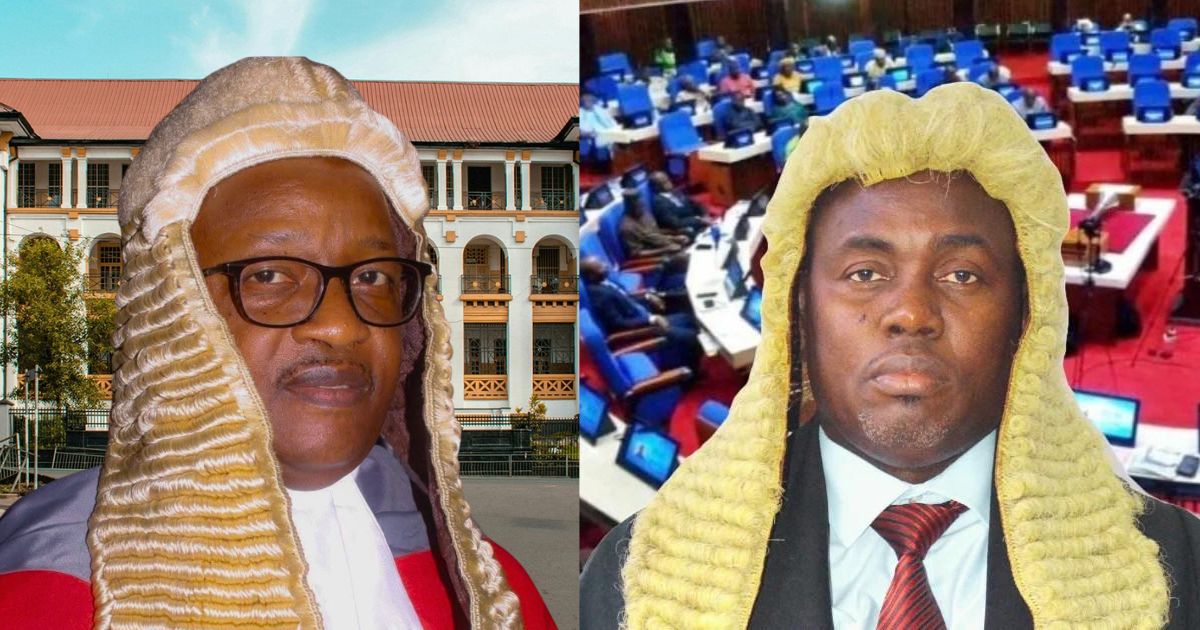
The judiciary’s public notice that the Supreme Court will hear all matters relating to the Constitutional Amendment Bill 2025 on October 7, 2026, underscores the principle of constitutionalism. This means the Constitution is the supreme source of both power and legality. In essence, it is a government of laws, not of men. Therefore, this defining moment also places the Supreme Court itself on trial. The public will forever judge its independence and fidelity to the Constitution by how it handles this case.
My argument is that the Supreme Court must uphold the rigid two-thirds threshold of the members of Parliament under Section 108. Only then can it protect the Constitution from being amended by the ordinary lawmaking process and preserve the guardrail that binds our nation together.
The Legal Framework
The 1991 Constitution establishes its supremacy. It creates a framework that restrains both the government and the people and demands their fidelity to its text. Section 171(15) affirms this by establishing the Constitution as the grundnorm, the fundamental standard from which all other laws derive their validity. Any law contrary to it is null and void.

To achieve this, the Constitution limits the powers of the three organs of government. The Executive is entrusted with enforcing the law, but Section 40(3) designates the President as its chief guardian. The Legislature is assigned the power to make laws under Section 106(2), but must do so in accordance with the Constitution. The Judiciary is credited with the power to interpret the law under Section 120(3), subject to no other person or authority. Citizens, too, are bound by Section 13(a) to abide by the Constitution.


The ultimate safeguards are found in Section 124, which empowers the Supreme Court with original and exclusive authority for judicial review. This covers any interpretation of the Constitution arising from the actions of the other two organs of government.
To facilitate this, Section 127(1) grants the Supreme Court enforcement powers for any action concerning the Constitution through a judicial review process that any person can bring. Similarly, under Section 122(1), the President can seek a judicial opinion from the Supreme Court on any issue warranting his action. I humbly submit that this includes constitutional matters.
This avenue has brought at least three constitutional matters surrounding the Amendment Bill before the Supreme Court: one by the opposition All People’s Congress party (APC), one by a sitting member of parliament of the APC, and the third a judicial opinion petition by the President.
It is therefore reasonable to expect the Supreme Court will take jurisdiction and consolidate these matters, as they all touch on a central question: whether the Bill was passed by the prescribed method of the Constitution, i.e., by a two-thirds majority of the members of Parliament to amend the Constitution, as provided by Section 108.
For the court to decline jurisdiction to hear the matter on its merits, as some commentators are suggesting, would be to rob itself of its most sacred duty. As established in the famous American judicial review case Marbury v. Madison, it is the province and duty of the court to say what the law is.
Law and Politics
This legal uncertainty surrounding the Amendment Bill underscores the critical existential crisis facing Sierra Leone’s constitutionalism. Our constitutional history shows that its four major amendments have been intertwined with political advancement. The 1961 Constitution brought independence; the 1971 Constitution transitioned the state to a republic; the 1978 Constitution established a one-party state; and the 1991 Constitution reintroduced multi-party democracy. It is therefore incontrovertible that every constitutional change in Sierra Leone has been a vehicle for political advancement.
While this Bill does not amount to a wholesale change of the political system like its predecessors, it does, among other things, advance a significant change at the representative level, from a parliamentary constituency-based system to proportional representation. This undoubtedly confirms my point that every constitutional amendment in Sierra Leone advances politics.
The Test: How to Decide
Against this backdrop, the 1991 Constitution faces its greatest threat in its 35-year existence. It has survived two military coups and 11 years of civil war, grave assaults at the hands of guns. But will it survive the pen, the gavel of the Supreme Court in this case?
The central question touches the very soul of the Constitution’s guardrail: the two-thirds threshold that guards against frivolous or unmerited changes to the covenant that binds all the tribes and approximately 8 million people together. Here, the proverb is tested.
To answer this question simply, I categorize the possible approaches to upholding the integrity of the two-thirds threshold under Section 108. The first is a rigid approach: a strict two-thirds of the members of parliament. The second is a middle-ground approach: two-thirds of occupied seats, more flexible, but risky. The third is a dangerous and reckless approach: a simple majority or two-thirds of those present, as in ordinary lawmaking.
In my humble opinion, only the rigid approach is reasonable. The Constitution’s text is clear. Section 108(2)(b) requires two-thirds of the members of parliament to alter the Constitution. To lower that threshold to occupied seats, to those merely present, or to a simple majority would be to amend the Constitution through the ordinary lawmaking process found in Section 91(1), not through the prescribed method for altering the Constitution. That would undermine the very safeguard the Constitution creates.
Given what is at stake, this moment will define the Supreme Court’s constitutional legacy. Its independence and fidelity to the Constitution are being closely scrutinized on an issue that touches the foundation of our nation.
Failure by the Supreme Court to meet this test would open a floodgate of constitutional instability. It would accomplish the destruction of constitutionalism that the gun failed to achieve. It would prove in the negative sense that the pen is mightier than the gun, and that is the test we now face.
But a ruling to uphold the rigid two-thirds threshold would create the constitutional stability that no gun revolution has ever achieved. In that moment, the pen would prove itself mightier than the gun, in the positive sense.
It is therefore with respect that I remind the Supreme Court that the power to interpret the Constitution must be subject to the Constitution. This makes its authority a privilege, not a monopoly of constitutional meaning.
References
- Conteh, A. O. Essays on the Sierra Leone Constitution 1991. Belize, 2001.
- Constitution of Sierra Leone, 1961 (Sierra Leone).
- Constitution of Sierra Leone, 1971 (Sierra Leone).
- Constitution of Sierra Leone, 1978 (Sierra Leone).
- Constitution of Sierra Leone, 1991 (Act No. 6 of 1991) (Sierra Leone).
- Marbury v. Madison, 5 U.S. (1 Cranch) 137 (1803).
- Marcus-Jones, W. S. Legal Development and Constitutional Change in Sierra Leone (1787–1971). Ilfracombe, Devon: Arthur H. Stockwell, 1988.
About the Author
Jamil Sahid Fofanah is a Sierra Leonean law scholar with expertise in constitutional law and comparative constitutionalism, among other fields. He is qualified as a Barrister and Solicitor of the High Court of Sierra Leone, with advanced legal education spanning Africa, Europe, and North America. Jamil is currently a doctoral candidate at the Elisabeth Haub School of Law at Pace University, researching the intersection of international criminal law and environmental law, with a focus on ecocide and corporate accountability.