

Mayor Aki-Sawyerr Launches “Transform Freetown, Transforming Lives” Mid-Term Report

 Sahid Bangura
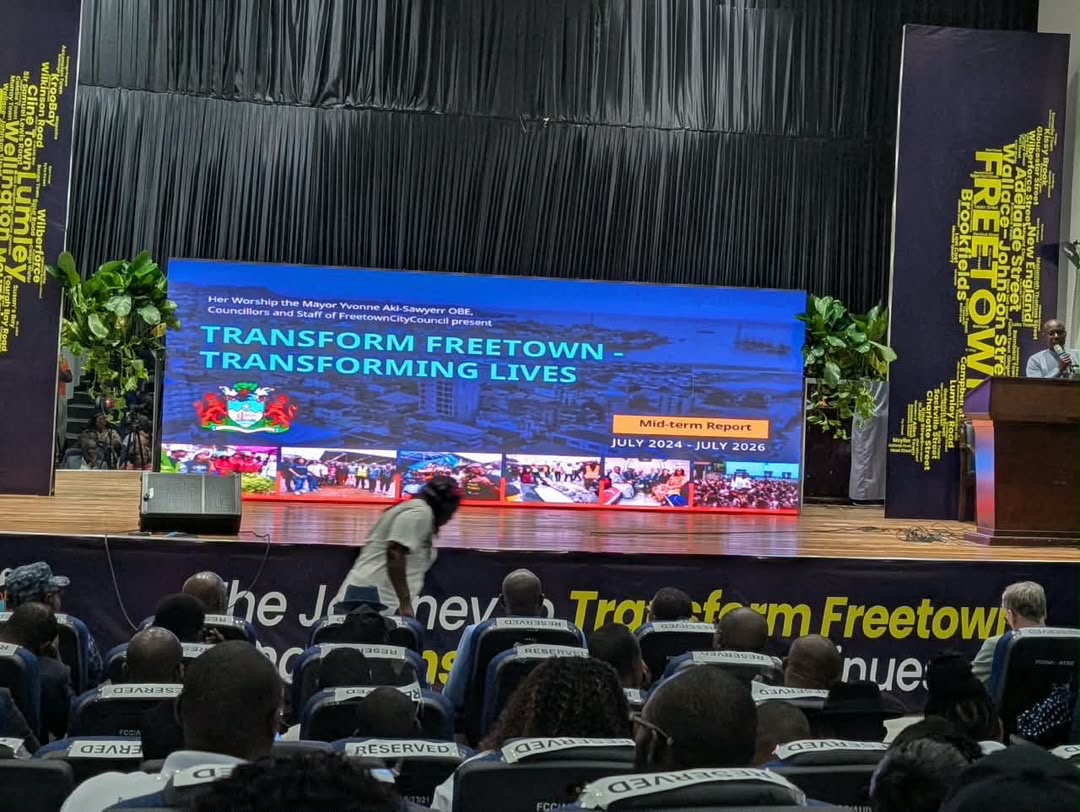
 Freetown City Council Mayor, Her Worship Yvonne Aki-Sawyerr, has launched the “Transform Freetown, Transforming Lives” Mid-Term Report 2024-2026, highlighting progress made under the Council’s second phase of its development agenda.
The report was launched at the Freetown City Council Auditorium on Lightfoot Boston Street as the Council continues its efforts to transform the capital city through targeted interventions in climate action, heritage tourism, the digital economy and human capital development.
Speaking at the launch, Mayor Aki-Sawyerr said the initiative forms part of an ongoing transformation journey that began in 2018. Following the Council’s return to office in 2023, she said the administration moved into a second phase, “Transform Freetown, Transforming Lives,” which was officially launched on July 4, 2024.

According to the mid-term report, the four development pathways have collectively reached 161,565 direct beneficiaries through 50 interventions and projects. The programmes have also created 10,590 direct jobs and 5,945 indirect jobs, while securing SLE287.63 million (US$12.51 million) in external funding and conducting 70 training programmes.

Information Minister, Solomon Jamiru Partners With Orange, Africell And NATCOM to Conduct Assessment Tour on St Edwards’s School Facilities
Man Arrested for Posing as Police Officer, Demanding Money from Kush Smokers and Conducting Traffic Duties
Ministry of Finance Hosts Dinner For New AFDB Executive Director
Climate Action recorded the largest number of interventions, with 29 projects reaching 24,882 direct beneficiaries and generating 9,375 direct and 5,342 indirect jobs. The pathway secured SLE208.13 million in external funding and delivered 37 training programmes.
Human Capital Development reached 136,449 direct beneficiaries through nine interventions, creating 936 direct and 491 indirect jobs. It secured SLE73.74 million in external funding and conducted 19 training programmes.
Heritage Tourism recorded 39 direct beneficiaries across eight interventions, creating 172 direct and 69 indirect jobs, while securing SLE5.62 million in external funding and conducting 11 training programmes.
The Digital Economy pathway reached 195 direct beneficiaries through four interventions, creating 107 direct and 43 indirect jobs. It secured SLE149.5 million in external funding and conducted three training programmes.
The Council also reported an increase in its workforce, from 524 staff members in 2025 to 530 in 2026.
Director of Planning at the Ministry of Lands, Housing and Country Planning, Ing. Sahr Mark Kanawa, stressed that transforming Freetown requires effective planning of communities, roads, drainage systems, commercial areas and public spaces.
He highlighted collaboration between the Ministry and Freetown City Council in developing Local Area Action Plans for communities including Goderich, Bay, Kolleh Town and Kroo Bay. The plans are designed to address flooding, roads, drainage, public spaces, community facilities and safe settlement.
Ing. Kanawa also disclosed that the Ministry, in partnership with the Council and other stakeholders, is at an advanced stage in preparing the Freetown Structural Plan and Western Area Structural Plan, which are expected to guide development across the wider metropolitan area.
He said the planning reforms form part of broader initiatives supported by the World Bank, including the development of a new Country Planning Act, spatial plans for eight cities and regulations to operationalise the new planning framework.
While acknowledging that the Ministry and the Council have not always agreed on planning matters, Kanawa said constructive disagreements had contributed to finding solutions in the public interest.
“Freetown is the common ground, and ultimately, the people of Freetown are the people we both serve,” he said.
He called for sustained collaboration to implement community-level planning interventions, complete the structural plans and ensure that the new planning and devolution frameworks deliver meaningful results on the ground.
A beneficiary, Agnes Kanu, Chairlady of Hagan Market, commended the Council and Mayor Aki-Sawyerr for supporting market women, particularly through the installation of a biodigester and facilities that have helped fish sellers reduce spoilage.
She called for similar interventions to be extended to fish sellers and market women in other markets across Sierra Leone.
The launch of the mid-term report provides an assessment of progress under the Council’s current development phase while highlighting the need for continued collaboration and effective planning to shape Freetown’s future.