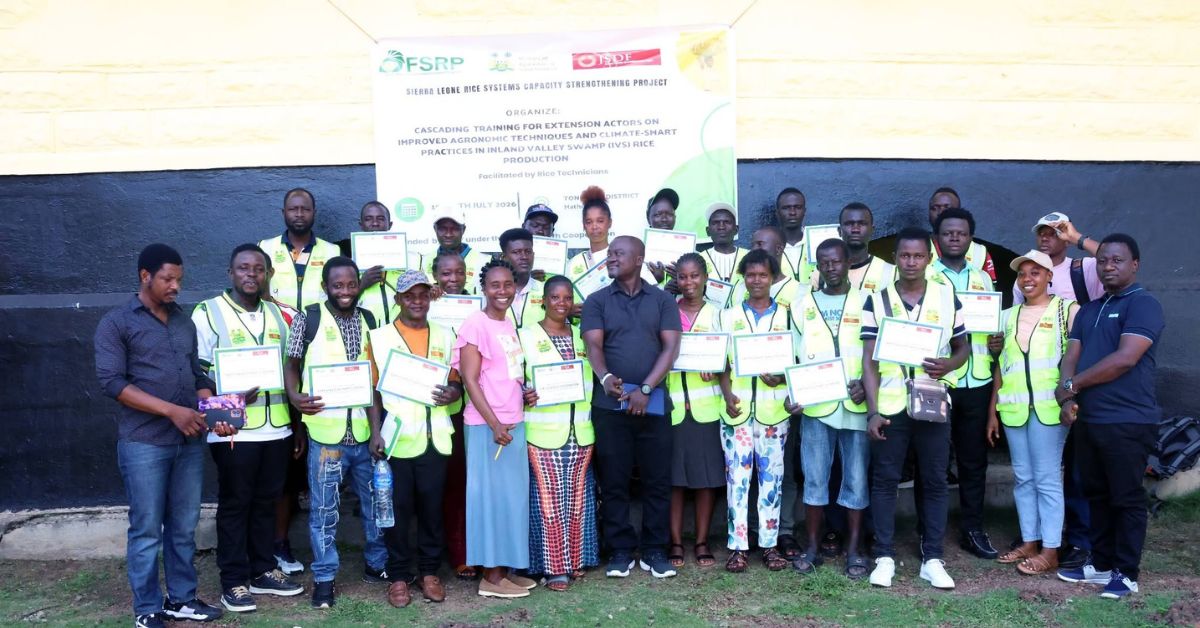
40 Extension Officers Trained to Support Climate-Resilient Rice Farming
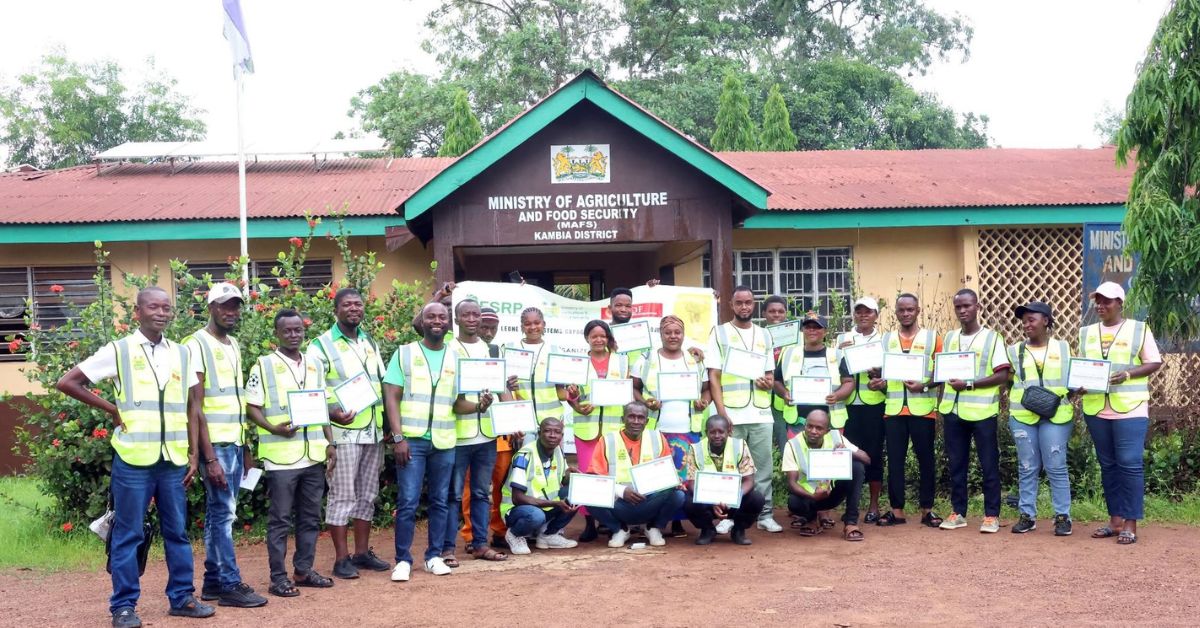
The Ministry of Agriculture and Food Security (MAFS), in collaboration with the Sierra Leone Rice Systems Capacity Strengthening Project under the Food System Resilience Program (FSRP), has concluded the second phase of a week-long training programme aimed at strengthening the capacity of extension officers in Kambia and Tonkolili districts.
The training, which brought together 40 extension officers, focused on equipping participants with practical skills and knowledge to provide sustainable, farmer-centred support aimed at improving rice production, increasing yields, and enhancing resilience to climate change.
Unlike traditional training approaches focused mainly on theory, the programme combined classroom sessions with practical field demonstrations. Participants were trained in key areas including climate-smart agriculture, soil fertility management, integrated pest management, and water conservation techniques.

Through demonstration plots, extension officers were introduced to improved farming practices such as better seed selection, timely planting, and the use of micro-dosing fertiliser methods designed to improve crop performance under changing weather conditions.



Organisers described the initiative as a link between agricultural policies and practical implementation at the community level. They explained that trained extension officers are expected to return to their respective districts to establish farmer field schools, conduct on-farm demonstrations, and provide tailored guidance to smallholder farmers.
Participants said the training had improved their ability to support farmers, particularly in helping them adapt to changing climate conditions through improved cropping calendars and affordable soil management practices.
Mohamed Deen Rogers, one of the project representatives, emphasised the importance of ensuring that the knowledge gained from the training reaches farmers through follow-up demonstrations and community outreach activities.
Project officials noted that stronger extension services could deliver both economic and environmental benefits by improving farm productivity, increasing farmers’ incomes, and reducing the impact of climate-related challenges such as droughts and floods.
They highlighted the importance of strengthening rice production systems, particularly in the Northern and North Western regions, where rice remains a key contributor to food security and local livelihoods.
The second phase of the training was funded by the Japanese Social Development Fund (JSDF) through South-South Cooperation. Implementers said support from development partners and collaboration among government institutions have been crucial in expanding agricultural capacity-building efforts across rural communities.
As part of the next steps, officials said follow-up activities will include farmer outreach programmes, monitoring of demonstration plots, and refresher training sessions for extension officers. The project will also assess adoption rates and changes in productivity to measure the impact of the intervention.
The long-term objective, according to MAFS and its partners, is to integrate improved extension approaches into the ministry’s agricultural support systems, ensuring that smallholder rice farmers continue to benefit beyond the lifespan of the project.
By focusing on practical skills, local ownership, and continuous support, the initiative seeks to transform agricultural knowledge into measurable improvements for farmers while strengthening food security and climate resilience in Sierra Leone.