

Op-Ed: From President Bio To President Faye: ECOWAS’ Rhythm of Rotation
 Sahid Bangura
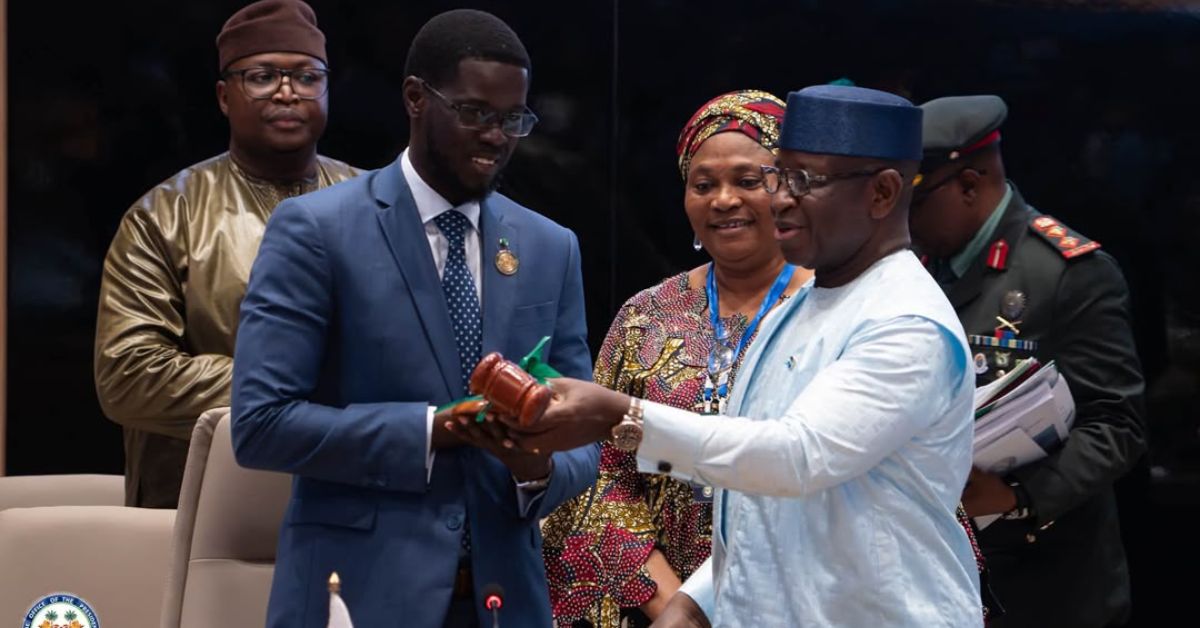
 On Sunday, July 19th, President Julius Maada Bio of Sierra Leone seamlessly transferred chairmanship of the Economic Community of West African States to President Bassirou Diomaye Faye of Senegal. It was a one year tenure full of verve, energy and results, reflective of the character of President Bio.
Taking over at a time when there were serious infractions of democracy in some of the bloc’s previous members, President Bio’s tenure was certainly one on which Sierra Leone can look and applaud.
The ouster of President Embolo of Guinea Bissau, and his frantic efforts, including a visit to the junta leader in Bissau and engaging in fruitful discussions hinging on elections, is enough show of regional leadership.

Guinea which had been suspended from the regional bloc after the military takeover in 2022, finally returned to the bloc after democratic systems were put in place and elections conducted.
Sierra Leone’s Chief Minister Kicks Off Cassava Harvest and Garri Production Scheme in Wombay Village to Strengthen Local Food Supply
APC Reports Peaceful Conduct of Constituency Elections Across Unaffected Districts
SLFA Reacts as Union of Sierra Leone Premier League Clubs Threatens Boycott of League Matches
In his term as Chairman of ECOWAS, President Bio showed diplomatic savvy and regional insights by reaching out to the leaders of the three countries that had withdrawn from ECOWAS – Mali, Burkina Faso, and Niger. Back home, as ECOWAS Chairman, President Bio oversaw the successful negotiation and reopening of the disputed Yenga town in Kailahun district, after protracted occupation by Guinean forces.
It was during his tenure, three new edifices were built in the region. The Julius Maada Bio International Conference Centre is beauty to behold like the French do the Eiffel Tower. The West Africa Depot was commissioned during his reign, but perhaps the most encompassing is the new ECOWAS headquarters in Abuja, which President Bio commissioned just last month.
So the transfer of the ECOWAS Chairmanship on Sunday to President Faye is one for which Sierra Leoneans should lift him shoulder high. The ECOWAS system is structured in a manner in which President Bio has shown maturity, and the region by extension has exhibited growth.
In the architecture of regional integration, few principles are as essential and as easily misunderstood as rotational leadership. The Economic Community of West African States (ECOWAS) has long operated on an unwritten but deeply respected understanding that its highest offices should reflect the linguistic and cultural diversity of its membership. This is not merely diplomatic courtesy but rather the bedrock of institutional legitimacy in a region where trust remains a precious and fragile commodity.
When Senegalese President Bassirou Diomaye Faye was elected Chairman of the ECOWAS Authority of Heads of State and Government at the 69th Ordinary Session in Lungi on Sunday July 2026, it was a return to the rotational logic. It was the restoration of a rhythm that had been disrupted due to political disruptions in the Francophone and Lusophone blocs in particular. It was a return to the rotational logic that has, for decades, prevented the organisation from becoming the preserve of any single bloc.
To understand the significance of Senegal’s ascension, one must look at the preceding years. Since June 2019, when Niger’s President Mahamadou Issoufou completed his tenure, the chairmanship had been held consecutively by Ghana (Anglophone), Guinea-Bissau (Lusophone), and Nigeria (Anglophone). President Bola Tinubu of Nigeria, who took over in July 2023, was subsequently re-elected for a second term. By 2025, as discussions began for his successor, the arithmetic had become uncomfortable for those who valued balance.
An Anglophone leader from Nigeria serving a third consecutive year, following Ghana’s tenure and with the Lusophone interlude notwithstanding, risked creating a perception that ECOWAS had abandoned its foundational commitment to equitable representation. The argument was not about the competence of any individual leader. It was about the health of the institution itself.
The case for a Francophone return was compelling. With the effective withdrawal of Mali, Burkina Faso, and Niger in January 2025, the Francophone bloc within ECOWAS had been significantly diminished. Of the remaining eligible French-speaking states, that is, Senegal, Togo, Benin, and Côte d’Ivoire, Senegal emerged as the natural choice. Côte d’Ivoire was approaching a critical election period, making it an impractical candidate under the bloc’s established norms. Senegal, by contrast, offered a new dimension, and diplomatic maturity that resonates with the region’s aspirations.
When President Faye was ultimately elected on Sunday July 19th 2026, succeeding Sierra Leone’s Julius Maada Bio who had held the position for a year, it represented a return to both principle and pragmatism. The principle was rotational equity. The pragmatism was the recognition that the Anglophone bloc had, through President Bio’s Chairmanship displayed regional diplomacy in the changing political climate in a region that is Francophone dominated but shrinking in number with the withdrawal of the aforementioned countries.
The events of 2026 mid-year summit, echoed a similar moment in 2017, when Ghana’s President Nana Akufo-Addo was widely and incorrectly reported to have ‘lost’ the ECOWAS chairmanship to Togo’s Faure Gnassingbé. As Ghana’s Foreign Minister then, Shirley Ayorkor Botchwey, clarified at the time, there was no vote to lose. “It had already been agreed as per ECOWAS rules of rotation that the chair of authority will be a francophone country,” she explained.
That clarification is worth revisiting. It reminds us that ECOWAS leadership is not a prize won through competitive elections in the conventional sense. It is a carefully calibrated rotation, often decided by consensus, designed to ensure that no linguistic group or nationality feels marginalised. The system is not perfect, but it is built on a recognition that in a region as diverse as West Africa, perception matters as much as reality.
The swift and seamless transfer of the Chairmanship from President Bio to President Faye is a necessary course of institutional medicine for ECOWAS. After a prolonged period of Anglophone leadership at the chairmanship level, the decision to rotate to Senegal reaffirms the bloc’s commitment to its own unwritten constitution, which is the understanding that leadership must breathe across linguistic and national lines.
In the context of West Africa, where the scars of colonial division remain fresh and where the withdrawal of three member states has exposed deep fractures, the symbolism of an inclusive chairmanship is a form of merit in itself. It signals that ECOWAS, despite its challenges, remains a community of equals.
Senegal’s tenure at the helm will be defined by the substance of its actions, its ability to mediate, to heal, and to navigate the bloc through its most difficult chapter. What is obvious, however, is that President Bio and Sierra Leone have successfully shown the world that they are capable of converging an entire region under their roof, and it will not leak on anybody.
Bravo President Bio. Kudos Sierra Leone!!