

HRCSL Submits Recommendations on Constitutional Amendment Bill 2025 to Parliament
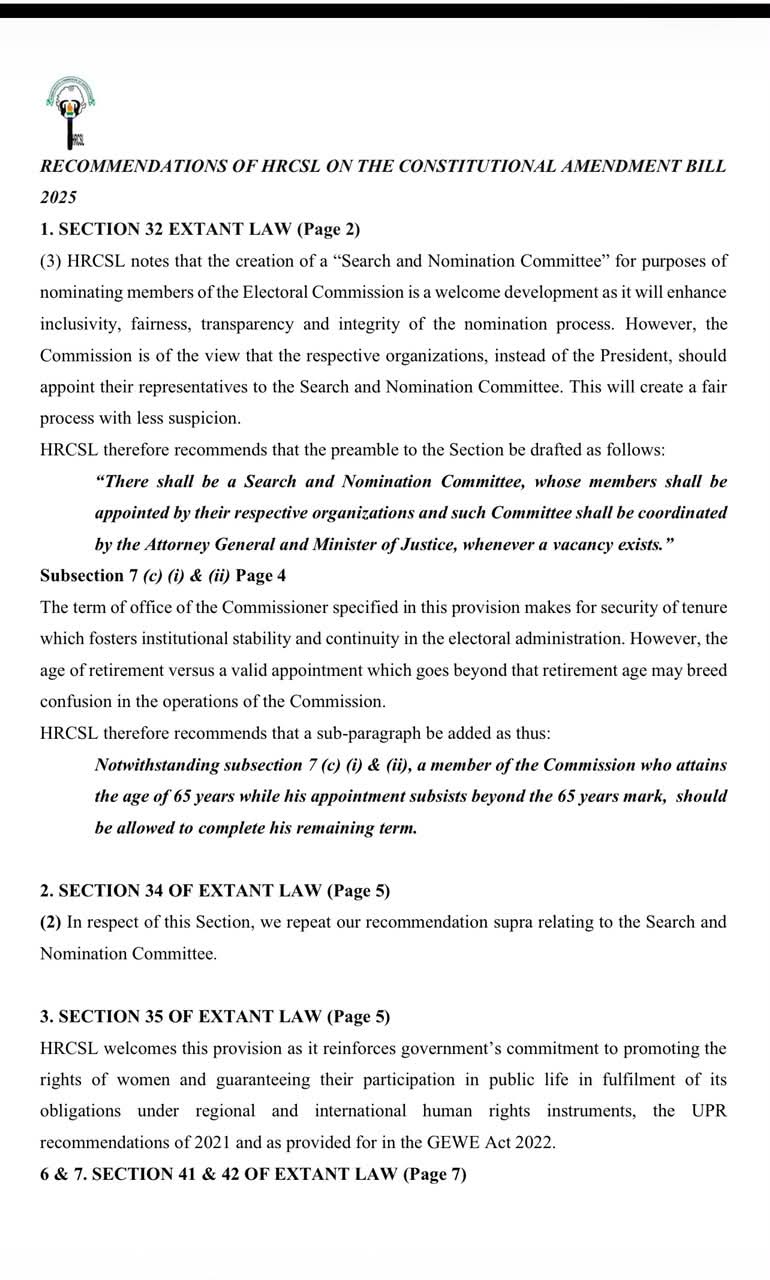
The Human Rights Commission of Sierra Leone (HRCSL) has submitted its Position Paper on the Constitution of Sierra Leone (Amendment) Bill, 2025 to Parliament, outlining observations and recommendations on key provisions aimed at strengthening electoral justice, inclusivity, democracy, human rights and the rule of law.
The submission, dated 9 June 2026, was presented in line with the Commission’s mandate as Sierra Leone’s National Human Rights Institution established under the Human Rights Commission Act No. 9 of 2004. The Act empowers the Commission to advise government on draft legislation that may affect human rights.
HRCSL welcomed several provisions in the Bill, describing them as progressive measures that seek to enhance fairness, transparency and participation in the electoral process. However, the Commission provided recommendations on specific sections for consideration by Parliament’s Legislative Committee.

The Commission referenced Sierra Leone’s international and regional human rights obligations, including commitments under the Universal Declaration of Human Rights (UDHR), the International Covenant on Civil and Political Rights (ICCPR), and the African Charter on Democracy, Elections and Governance, which guarantee citizens’ rights to participate in government, vote, contest elections and access effective remedies.

Among its recommendations, HRCSL welcomed the proposed establishment of a Search and Nomination Committee for appointing members of the Electoral Commission but recommended that representatives on the committee should be appointed by their respective institutions rather than by the President. The Commission argued that this would promote greater transparency, fairness and public confidence in the nomination process.
On the tenure of Electoral Commission members, HRCSL recommended that commissioners who reach the retirement age of 65 while still serving an approved term should be allowed to complete their tenure to ensure institutional stability and continuity.
The Commission also supported provisions promoting women’s participation in public life, noting that they align with Sierra Leone’s obligations under international and regional human rights instruments, the Universal Periodic Review (UPR) recommendations of 2021 and the Gender Equality and Women’s Empowerment (GEWE) Act 2022.
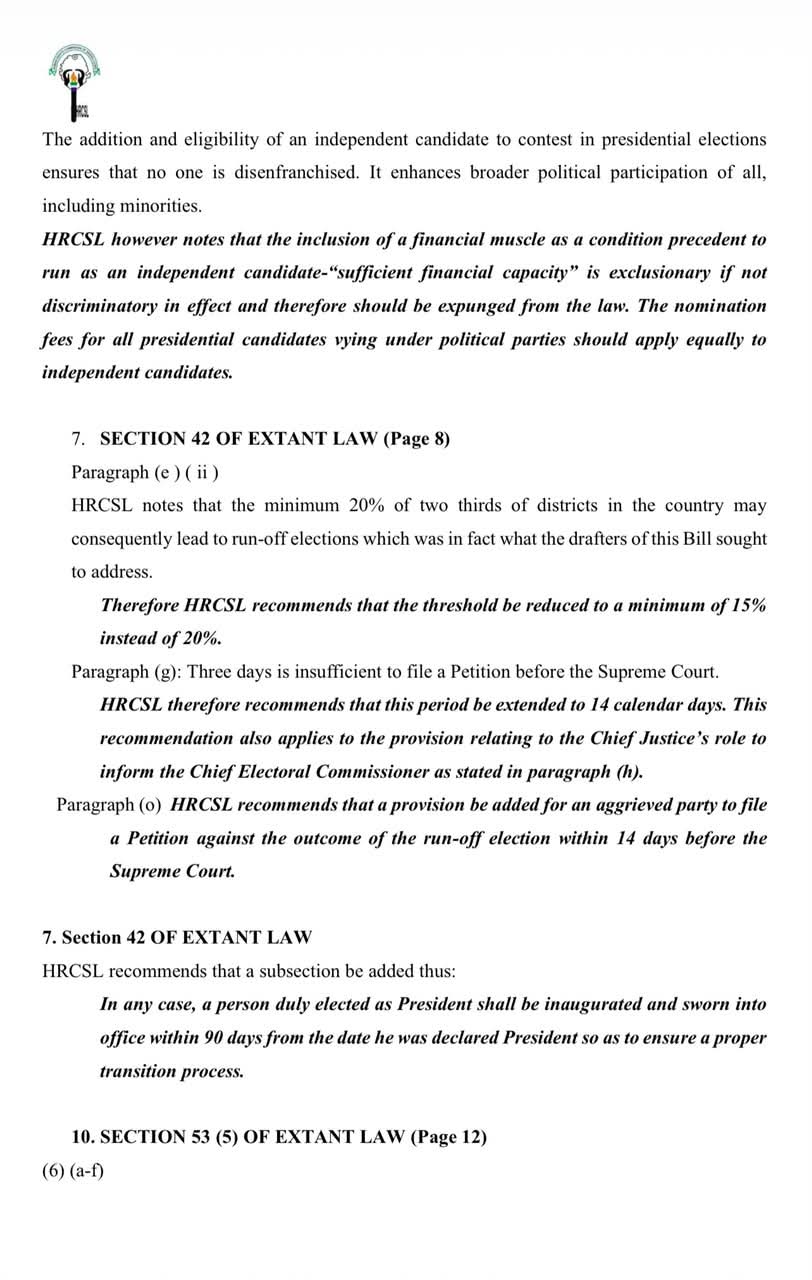
Regarding independent presidential candidates, HRCSL welcomed the inclusion of independent candidates as a measure to expand political participation. However, it raised concerns over the requirement for candidates to demonstrate “sufficient financial capacity”, describing the condition as potentially discriminatory and exclusionary. The Commission recommended that independent candidates should be subjected to the same nomination fee requirements as candidates contesting under political parties.
On presidential election thresholds, HRCSL recommended reducing the minimum requirement for winning in the first round from 20 per cent to 15 per cent in two-thirds of districts, arguing that the current threshold could increase the likelihood of run-off elections, contrary to the objective of the amendment.
The Commission further recommended extending the period for filing presidential election petitions before the Supreme Court from three days to 14 calendar days, stating that the current timeframe is insufficient. It also called for a similar 14-day period for challenging the outcome of a run-off election.
HRCSL proposed that a person declared elected as President should be inaugurated and sworn into office within 90 days of being declared President to allow for an orderly transition process.
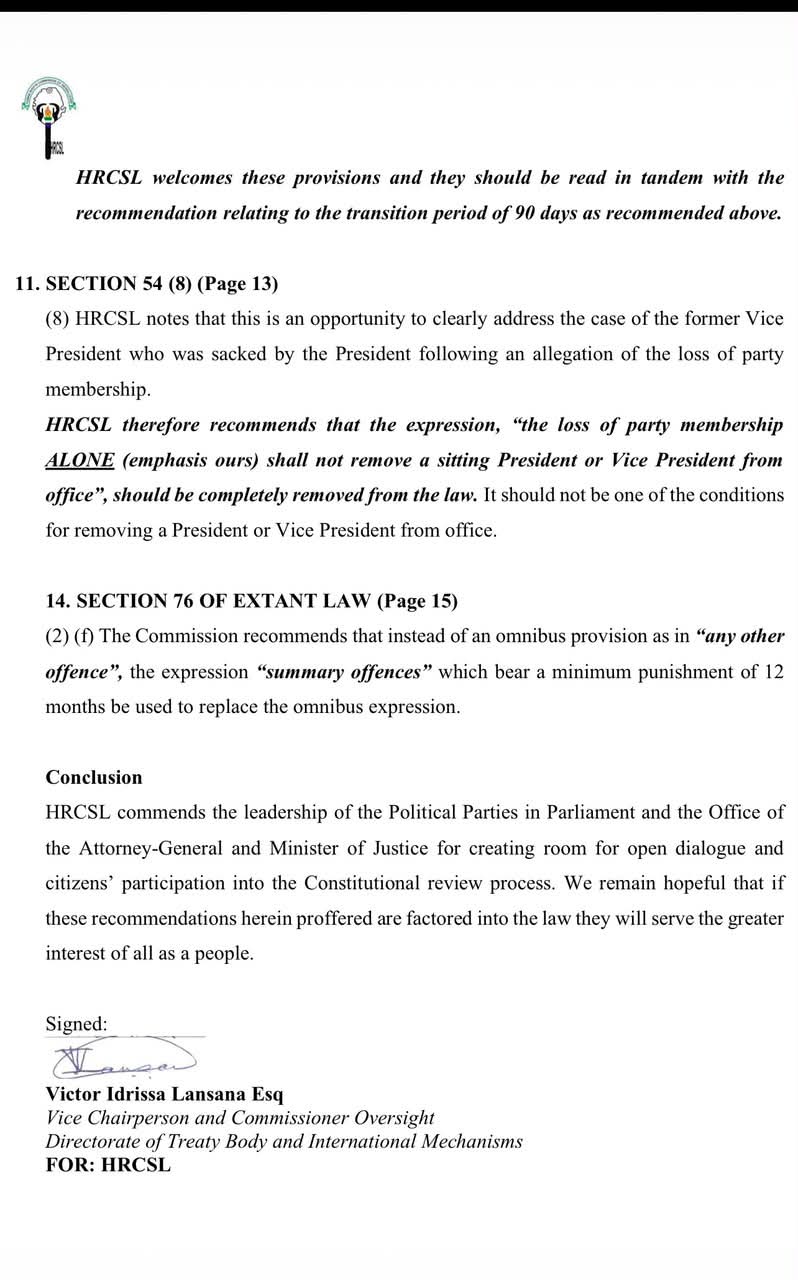
On provisions relating to the removal of a President or Vice President from office, the Commission recommended removing the phrase that “loss of party membership alone shall not remove a sitting President or Vice President from office,” arguing that party membership should not be considered as a standalone condition for removal.
The Commission also recommended replacing the broad phrase “any other offence” in relation to certain disqualifications with “summary offences” carrying a minimum punishment of 12 months, to provide greater clarity and legal certainty.
In conclusion, HRCSL commended political parties represented in Parliament and the Office of the Attorney-General and Minister of Justice for creating space for dialogue and public participation in the constitutional review process.
The Commission expressed hope that its recommendations would be considered and incorporated into the final legislation in the interest of strengthening democracy, human rights and good governance in Sierra Leone.
To help people in need
Here’s a more professional version of your CV:
CURRICULUM VITAE
James Abdulai Jusu
📍 Kenema, Sierra Leone
📞 +232 79 360 073
📧 [email protected]
Personal Profile
A dedicated and enthusiastic Bachelor of Science in Medical Laboratory Science student at Eastern Technical University of Sierra Leone. Passionate about public health, disease prevention, and environmental sustainability. Committed to promoting safe drinking water and improving community health through education and advocacy. A quick learner with strong communication, teamwork, and leadership skills.
Education
Eastern Technical University of Sierra Leone
Bachelor of Science (B.Sc.) in Medical Laboratory Science
Current Level: Year One, Second Semester
Key Skills
Medical laboratory safety awareness
Excellent communication skills
Teamwork and collaboration
Leadership and community engagement
Microsoft Word, Excel, and PowerPoint
Time management
Problem-solving
Volunteer Experience
Safe Drinking Water Advocate
Community Environmental Awareness Programme
2025 – Present
Conduct awareness campaigns on the importance of safe drinking water in rural schools.
Educate communities on hygiene and sanitation practices.
Participate in environmental clean-up and public health activities.
Work with community members and volunteers to improve health awareness.
Languages
English
Krio
Interests
Medical Laboratory Science
Public Health
Environmental Conservation
Community Development
Health Education
References
Available upon request.
This version is suitable for internship, volunteer, scholarship, and entry-level job applications.