

Sierra Leone, Harvard Explore Research, Health and Education Partnerships
 Aaron Parker
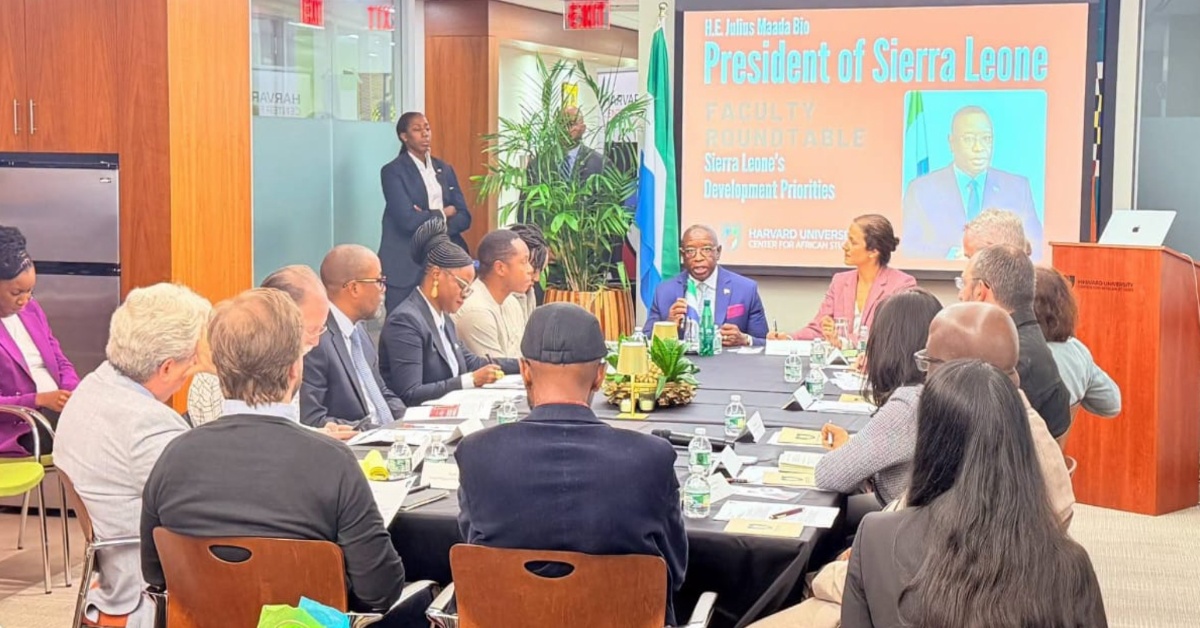
 Sierra Leone’s Chief Minister, David Moinina Sengeh, has highlighted ongoing collaboration between the Government of Sierra Leone and Harvard University, following an interactive engagement between senior Harvard faculty and members of Cabinet.
According to Sengeh, more than a dozen senior faculty members from across Harvard University engaged with a cross-section of Cabinet Ministers on knowledge, research, projects and their impact on national development.
The session was co-chaired by Zoe Marks, Oppenheimer Faculty Director of Harvard’s University-wide Center for African Studies and a Lecturer in Public Policy at Harvard Kennedy School.

Speaking on health, Vanessa Kerry of the Harvard T.H. Chan School of Public Health highlighted work being undertaken through Seed Global, including the Triple Zero Campaign. Sengeh said the initiative has contributed to a more than 60 percent reduction in maternal mortality in Bo and Makeni, compared to a reported 30 percent reduction nationally.


He also noted progress in vaccination coverage and said the Government would continue working through its national health compact based on the principles of “one plan, one budget, one report.”
On education, professors Fernando Reimers and Rob Jenkins of the Harvard Graduate School of Education highlighted Sierra Leone’s efforts to move beyond access to focus on learning outcomes.
Sengeh said the Government remains committed to documenting best practices, expanding the use of technology in classrooms and supporting efforts to share Sierra Leone’s experiences globally.
Professor Eliana La Ferrara, who heads the Master in Public Administration in International Development (MPA-ID) programme at Harvard Kennedy School, also encouraged more Sierra Leoneans to apply for opportunities at Harvard.
Sengeh said the Government had committed to expanding opportunities for qualified Sierra Leoneans, while noting La Ferrara’s research in Sierra Leone on the relationship between social roles, culture and economic development.
The engagement also featured discussions on scientific research and innovation in Sierra Leone. Sengeh highlighted a partnership involving Sentinel, the National Public Health Agency and Kenema Government Hospital, which he said has resulted in the complete sequencing of the yellow fever virus genome.
Other discussions focused on strengthening domestic revenue mobilisation, with Anders Jensen addressing opportunities to expand Sierra Leone’s tax-to-GDP ratio, which Sengeh put at six percent.
He further highlighted the country’s efforts to combat cervical cancer, noting that more than 34,000 women have been screened, while girls within the recommended age group are receiving HPV vaccinations.
Artificial intelligence was also discussed, with John Mugane of Harvard’s African Languages department highlighting the potential for developing language models for Africa’s local languages.
Sengeh described Sierra Leone as an incubator for knowledge development, research deployment and impact through partnerships with leading global institutions.
He said collaborations involving Harvard and the Massachusetts Institute of Technology (MIT) demonstrate the potential of such partnerships, attributing the continued engagement with these institutions to President Julius Maada Bio’s leadership and commitment to international academic and research collaboration.