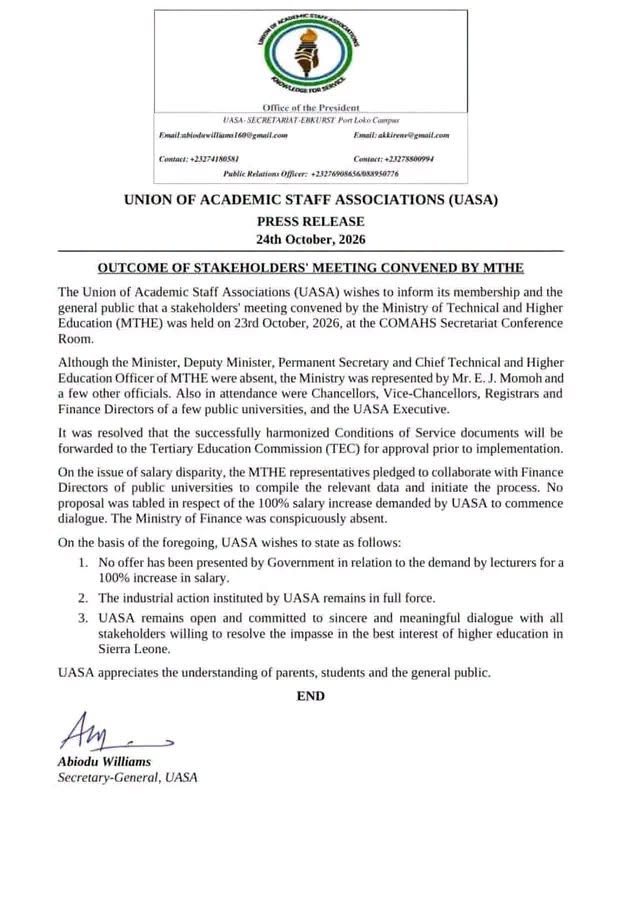
UASA Says No Government Offer Made on 100% Salary Increase Demand

 Aminata Koroma
The Union of Academic Staff Associations (UASA) said it has presented lecturers’ demand for a 100 per cent salary increase and that its ongoing industrial action remains in full force.
In a press release, UASA disclosed that a stakeholders’ meeting convened by the Ministry of Technical and Higher Education (MTHE) was held on 23rd October 2026 at the COMAHS Secretariat Conference Room.
According to the union, the Minister, Deputy Minister, Permanent Secretary and Chief Technical and Higher Education Officer of MTHE were absent from the meeting. However, the Ministry was represented by Mr E. J. Momoh and a few other officials.

The meeting was also attended by Chancellors, Vice-Chancellors, Registrars and Finance Directors from some public universities, alongside members of the UASA Executive.


UASA stated that one of the resolutions reached was for the successfully harmonised Conditions of Service documents to be forwarded to the Tertiary Education Commission (TEC) for approval before implementation.
On the issue of salary disparities, the union said MTHE representatives pledged to work with Finance Directors of public universities to compile the relevant data and initiate the process of addressing the matter.
However, UASA noted that no proposal was presented regarding its demand for a 100 per cent salary increase, which it said was necessary to commence dialogue.
The union also pointed out that the Ministry of Finance was absent from the meeting.
In view of these developments, UASA reiterated that the Government had not made any offer concerning lecturers’ demand for a 100 per cent salary increase and maintained that its industrial action would continue.
Despite the ongoing impasse, the union reaffirmed its willingness to engage in sincere and meaningful dialogue with all stakeholders prepared to work towards a resolution in the best interest of higher education in Sierra Leone.
UASA concluded by expressing appreciation to parents, students and the general public for their understanding.