

 4 Comments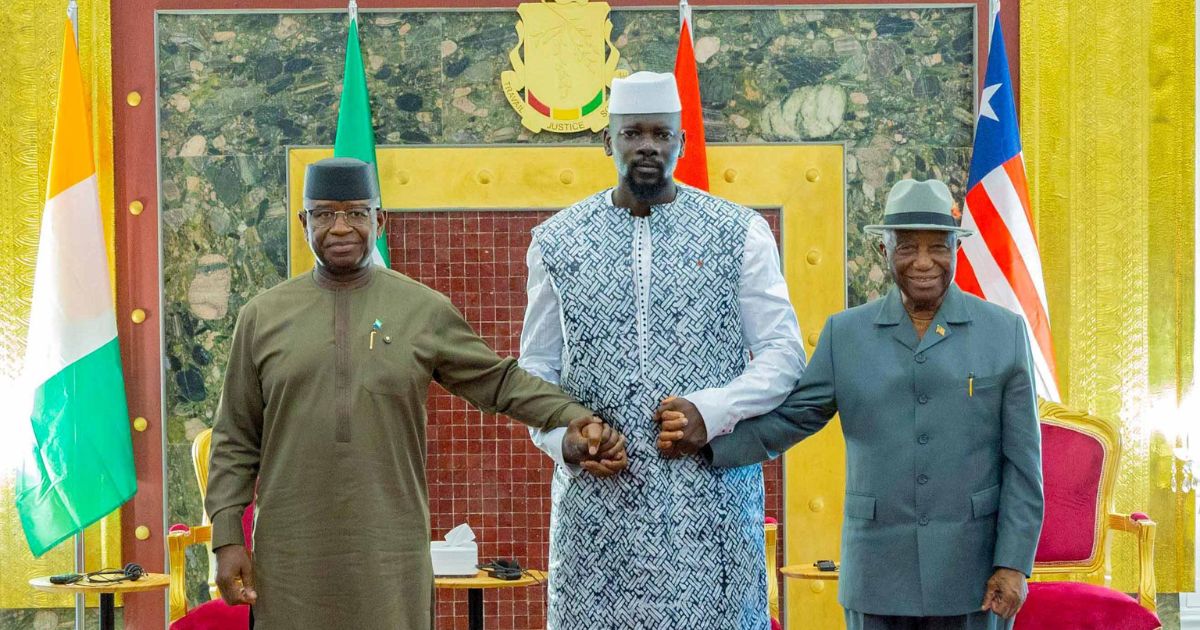
Presidents from three West African nations have committed to resolving simmering border disputes through diplomatic channels, following an emergency summit in the Guinean capital convened to address escalating tensions along the Mano River Union frontiers.
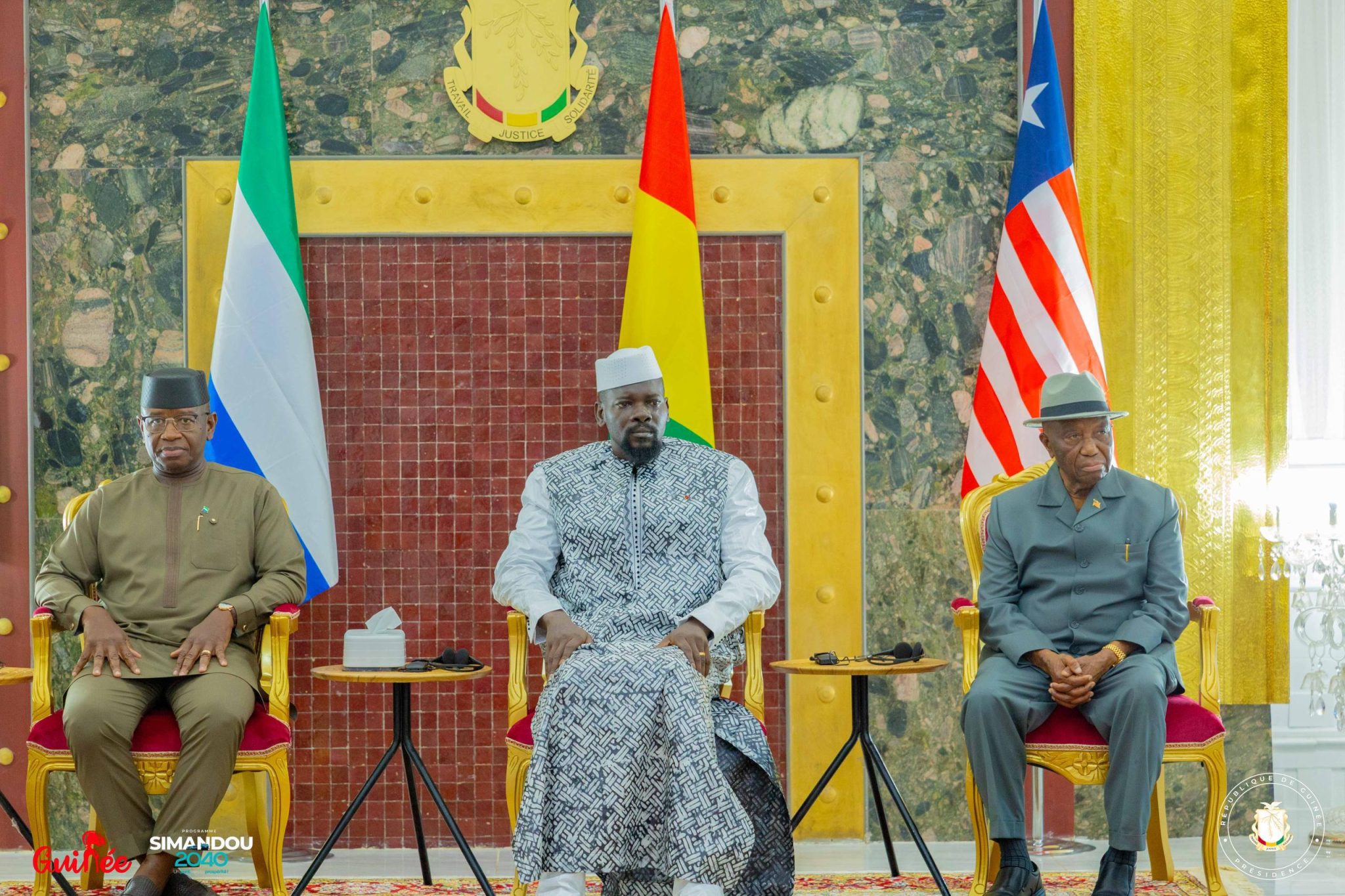
Guinea’s President Mamadi Doumbouya hosted his counterparts President Julius Maada Bio of Sierra Leone and President Joseph Nyuma Boakai of Liberia for closed-door talks on Monday, amid growing concerns over territorial incursions that have raised the specter of conflict in the region. Côte d’Ivoire participated as a “witness country,” reflecting broader regional interest in preserving stability along the interconnected borders.
The summit came just one day after Guinea deployed troops to its border with Liberia, with military images showing convoys of armored vehicles and heavily armed soldiers departing for the frontier. President Doumbouya was seen presenting the national flag to departing troops, declaring: “I, Mamady Doumbouya, assure the people of Guinea that no portion of the land bequeathed to us by our ancestors will be conquered by anyone”.
Following the meeting, the three leaders issued a joint statement broadcast on Guinean state television affirming their commitment to “resolve border incidents through dialogue and diplomatic mechanisms.” They “reaffirmed their commitment to preserve peace and stability in the Mano River region and avoid any escalation of tensions at the borders”.
The leaders also announced the creation of joint technical commissions to examine issues related to border delimitation and management, signaling a move toward institutional mechanisms for addressing longstanding territorial disagreements.
The summit addressed multiple flashpoints that have emerged in recent weeks along the porous borders of the three nations.
Tensions between Guinea and Sierra Leone flared in late February, with each side accusing the other’s military of crossing the frontier. Sierra Leone additionally alleged that Guinean troops detained its soldiers and police officers for several days following the clashes. The disputed Yenga border area, a longstanding source of friction between the two countries dating back to the region’s civil wars, remains a particular concern.
Meanwhile, the Liberia-Guinea border has seen more dramatic developments. According to multiple reports, Guinean soldiers crossed into Liberian territory in the Sorlumba area of Foya District, Lofa County, where they reportedly removed the Liberian flag and hoisted their own at the Sorlumba Port of Entry—an act described by many Liberians as a “brazen violation of sovereignty”. The incursion also resulted in the seizure of heavy road-pavement machinery, halting a critical infrastructure project in the region.
Local authorities reported confrontations between Guinean soldiers and Liberian civilians near the disputed border, with one Liberian official, Edward T. Lebbie, wounded by gunfire during a confrontation near the Makona River. The tensions have forced the closure of several schools in Foya District as residents flee deeper into Liberian territory.
Last week, the Liberian government called on its citizens living along the border with Guinea to remain calm and avoid escalation after clashes injured one person.
The Economic Community of West African States (ECOWAS) had issued a stern warning ahead of the summit, urging maximum restraint and announcing the deployment of a high-level technical assessment mission to the Mano River Basin. In a statement from its Abuja headquarters on March 12, the regional body warned that growing misunderstandings among Mano River Union countries could threaten regional peace if not addressed with caution and diplomacy.
ECOWAS emphasized that no country should take unilateral actions that could worsen the situation or harm longstanding bilateral relations.
The current tensions are rooted in long-standing disagreements over colonial-era boundaries and control of mineral-rich areas The Mano River Union, established in 1973 to facilitate free trade and economic cooperation among Guinea, Liberia, and Sierra Leone (later joined by Côte d’Ivoire), has a troubled history of cross-border conflict.
During the 1990s and early 2000s, the region was devastated by interconnected civil wars, with conflicts spilling across borders and creating massive humanitarian crises. The Yenga area has been a particular flashpoint for over two decades, following the 2001 civil wars when Guinean forces first occupied the territory.
These dormant disputes have resurfaced in recent months as nations seek to formalize border posts and secure artisanal mining sites along their shared frontiers.
The Conakry summit represents a critical test for West African diplomacy. While the creation of joint technical commissions offers a path toward de-escalation, the success of these efforts hinges on the willingness of all three nations to prioritize regional integration over territorial nationalism.
President Bio, who also serves as Chairman of the ECOWAS Authority of Heads of State and Government, arrived in Conakry accompanied by a high-level Sierra Leonean delegation. He was received by Guinea’s Prime Minister Amadou Oury Bah and Foreign Minister Morissanda Kouyaté upon arrival.
The leaders are expected to continue diplomatic engagements in the coming weeks, with the newly announced technical commissions tasked with developing concrete recommendations for border delimitation and management. The international community remains watchful, recognizing that a peaceful resolution is essential not only for affected border communities but for the collective security of the entire ECOWAS region.


Diplomacy and thoughtful leadership have helped us avoid going into war. Thank you, sirs.
Wrong tittle Sierraload
My people never even talked about Africa unity. NONE. WOW. where are we in this world. Africa is civilized but some of our presidents will remain in colonial masters slavery mentality until they die. 3 heads of state struggling about border disputes and they never mentioned anything about unity. It very sad and shameful. I feel like divorcing from Africa, but God is hearing our crying out for united Africa. By the grace of God, it will come to pass. Amen.
A giant straddled by two dwarfs…literally. Is this a “gentleman’s agreement” to resolving the border dispute? APC, shoo…