
Chief Justice Kamanda Urges Stronger Judicial Protection of Women’s Reproductive Rights
 Daniel Amara
 The Chief Justice of Sierra Leone, His Lordship Justice Komba Kamanda, has urged African judiciaries to strengthen the interpretation and enforcement of laws protecting women’s health and sexual and reproductive rights.
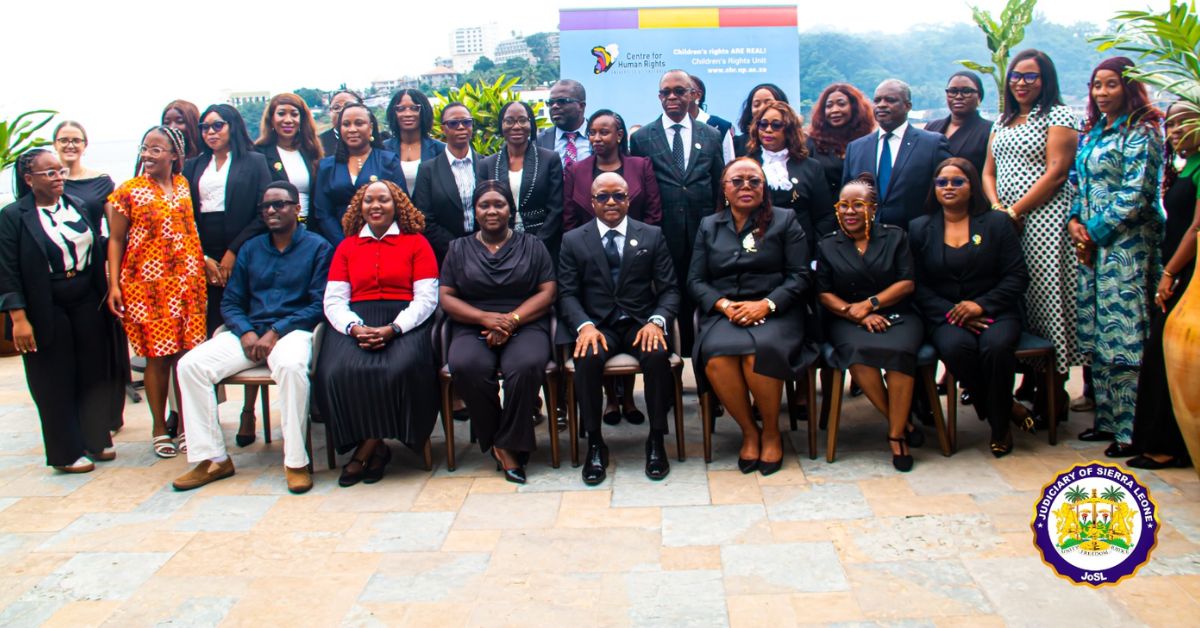
Chief Justice Kamanda made the call on Monday, September 7, while delivering the keynote address at a Regional Judicial Colloquium held at The Lead Hotel in Freetown.
The colloquium was organised by the Africa Judges and Jurists Forum (AJJF) in collaboration with the Center for Human Rights of the University of Pretoria, South Africa. The meeting focused on the judicial enforcement of Article 14 of the Maputo Protocol, which guarantees women’s sexual and reproductive health rights.

In his keynote address, Chief Justice Kamanda encouraged courts across Africa to ensure that rights provided for under African and international human-rights instruments are translated into tangible benefits for citizens rather than remaining mere “aspirational promises.”


He emphasised the importance of interpreting Article 14 of the Maputo Protocol alongside Article 16 of the African Charter on Human and Peoples’ Rights, which provides for the right to the best attainable state of physical and mental health.
The Chief Justice further urged judges to carefully examine the real-life impact of laws and judicial decisions on women and girls, particularly those experiencing economic hardship, unequal bargaining power, violence, stigma and limited access to healthcare or legal services.
He cautioned judicial officers against allowing stereotypes relating to motherhood, marriage, sexuality, family responsibilities and traditional gender roles to influence judicial reasoning or the assessment of evidence and credibility.
“True impartiality,” he stated, “requires the court to approach each case without stereotypes or preconceived assumptions.”
Justice Kamanda also called for judicial decisions concerning women’s rights to be guided by the principles of human dignity, equality and non-discrimination. He stressed that Article 14 of the Maputo Protocol should be regarded as an enforceable human-rights obligation.
He further advocated for effective remedies for victims, enhanced judicial training in gender-sensitive adjudication and African human-rights law, as well as greater exchange of judicial knowledge and progressive jurisprudence among African countries.
According to the Chief Justice, access to justice must go beyond the existence of courts and laws. He said it should include access to information, affordable legal representation, simple and understandable procedures, protection against intimidation and retaliation, gender-sensitive judicial officers and decisions that can be effectively enforced.
Justice Kamanda also highlighted Sierra Leone’s efforts to improve legal and institutional protections for women and girls, noting that the judiciary has an important responsibility to ensure that these commitments result in meaningful access to justice.
Speaking at the event, Programs Director of the Africa Judges and Jurists Forum, Honourable Dr. Justice Alfred Mavedzenge, said the colloquium offered an important platform for examining how courts can give practical effect to Article 14 through gender-responsive interpretation and adjudication.
He noted that although legal recognition of women’s rights is important, it does not automatically guarantee their enjoyment, pointing to persistent legal, institutional, socio-cultural and economic barriers affecting access to sexual and reproductive healthcare.
Chief Justice Kamanda subsequently declared the colloquium officially open, calling on participants to strengthen judicial jurisprudence, improve courtroom practices and enhance cooperation among African judiciaries in advancing women’s rights.
Also speaking at the event, the President of Legal Access through Women Yearning for Equality, Rights and Social Justice (LAWYERS), Madam Menisa Sesay, expressed appreciation to the Africa Judges and Jurists Forum and the Center for Human Rights of the University of Pretoria for organising what she described as a timely discussion on women’s health and reproductive rights.
Madam Sesay stressed that women’s health and reproductive rights are fundamental human rights that require strong legal and institutional protection.
The Executive Director of the Center for Human Rights at the University of Pretoria, Professor Nkatha Murungi, also addressed the gathering virtually. She provided participants with an overview of the work and mandate of the Centre and highlighted the importance of strengthening human-rights protection through judicial and institutional action.