

Charles Mambu Hails Constitutional Amendment Passage As Victory For Sierra Leone
 Sahid Bangura
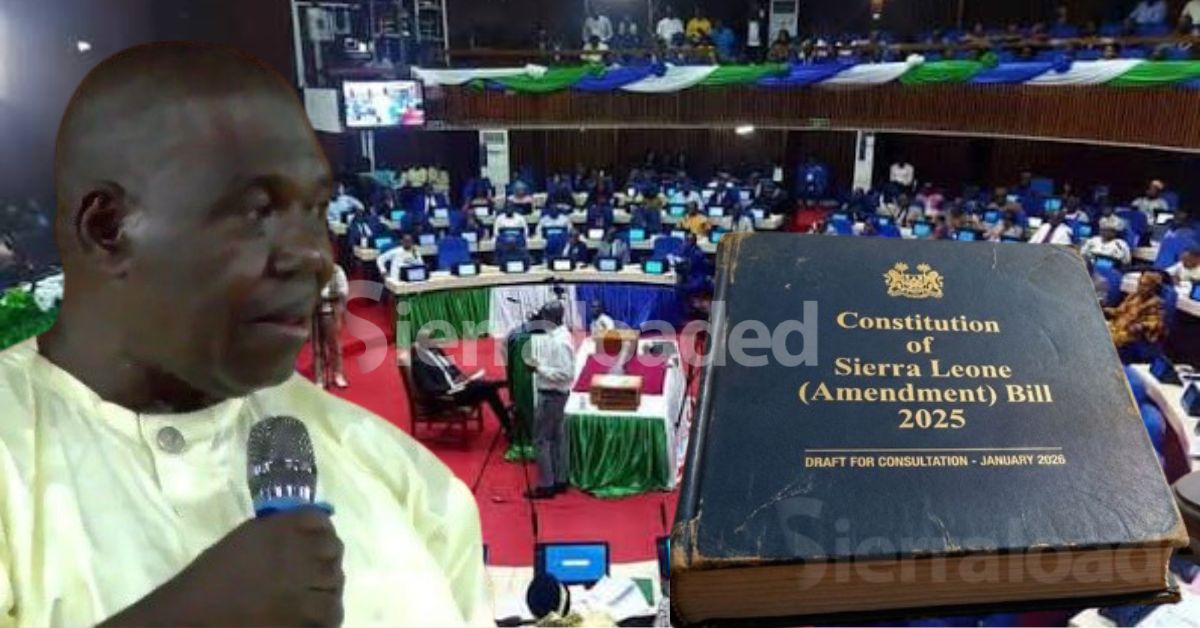
 Executive Chairman of the Coalition of Civil Society Organizations (CSOs), Charles Mambu, has described Parliament’s passage of the proposed constitutional amendments as a victory for Sierra Leone, while cautioning that the reform process is not yet complete.
Speaking during the government weekly press conference in Freetown on Tuesday, August 11, 2026, Mambu said the passage marked a major milestone in a constitutional review process that has spanned more than two decades, but stressed that the country must now focus on the remaining stages, including presidential assent, possible judicial interpretation and effective implementation.
Speaking on the conclusion of the parliamentary process, Mambu said the constitutional review had been a long and difficult journey, noting that successive governments had initiated reform efforts but failed to bring them to completion.

He traced the process to the first Constitutional Review Committee chaired by Dr. Peter Tucker, on which he served after being appointed by former President Ahmad Tejan Kabbah.

According to Mambu, the process continued under former President Ernest Bai Koroma, who subsequently established a broader constitutional review committee after receiving the Peter Tucker Committee’s report.
He said the subsequent committee conducted extensive consultations and comparative studies both within Sierra Leone and abroad, including visits to the United Kingdom and the United States.
Mambu argued that many of the reforms eventually approved by Parliament were therefore not the product of one political administration, but the outcome of work undertaken by successive governments, constitutional review bodies and civil society organisations over many years.
He specifically referenced the work of the 80-member Constitutional Review Committee chaired by the late Justice Edmund Cowan, saying several of its recommendations were reflected in the amendments recently passed by Parliament.
Against that background, Mambu said he would not have advised the opposition All People’s Congress (APC) Members of Parliament to walk out of the constitutional review proceedings, arguing that the party’s own administration had played a significant role in initiating earlier stages of the reform process.
However, he commended the APC MPs for conducting their withdrawal peacefully and without confrontation, describing it as a legitimate expression of disagreement within a democratic system.
“Democracy allows people to agree and disagree,” Mambu said, stressing that political disagreements should remain peaceful and orderly.
He said the conduct of MPs from both the APC and the ruling Sierra Leone People’s Party (SLPP) demonstrated that political disagreement does not necessarily have to result in hostility, noting that members of both parties continued to interact cordially after the parliamentary vote.
Mambu maintained that the outcome should not be viewed as a victory for either political party.
“No single person or party won yesterday. Sierra Leone won,” he said, while acknowledging that the process remains subject to any constitutional interpretation that may ultimately be required.
He further pointed out that parliamentary approval does not, by itself, bring the constitutional reform process to a complete conclusion, noting that the bill must still receive presidential assent.
He also acknowledged the constitutional role of the Supreme Court, saying the country may have to rely on the court for interpretation if questions arise concerning the amendments or the process through which they were adopted.
Mambu, however, warned against treating the passage of the amendments as the end of constitutional reform in Sierra Leone.
He said the parliamentary debate had concentrated largely on electoral and governance-related provisions, while other recommendations and provisions of the 1991 Constitution still require attention.
He therefore called on civil society organisations, the media and the wider public to maintain pressure for continued constitutional reform and public oversight.
According to Mambu, monitoring should remain a central part of the process, particularly after the amendments are signed into law.
He argued that the effectiveness of constitutional reform would ultimately depend not only on the laws that are passed, but also on how those laws are implemented.
Mambu said Sierra Leone’s past challenges have often been linked to weak monitoring and implementation, warning that newly enacted provisions must be properly enforced to achieve their intended objectives.
He urged the government and relevant institutions to ensure that implementation of the constitutional amendments protects Sierra Leone’s peace, unity and democratic development.
While commending Parliament, civil society organisations, the media and citizens who followed the lengthy proceedings, Mambu said civil society would continue monitoring the process until the reforms are fully implemented.
He reiterated that the constitutional review should ultimately be measured not by which political party claims victory, but by whether the reforms serve the interests of the people of Sierra Leone.