

 Post a comment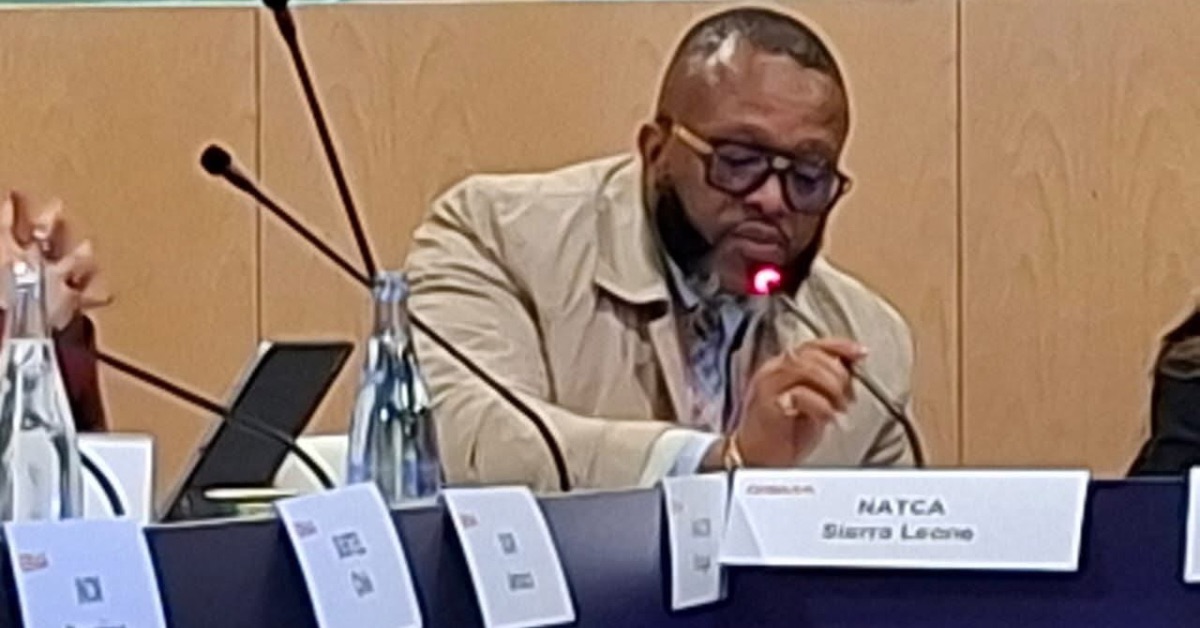
The Director-General of the National Communications Authority (NatCA), Amara Brewah, has called for predictable spectrum policies, balanced licensing frameworks, and stronger regional cooperation to accelerate digital investment and expand connectivity to underserved communities.
Speaking during two high-level ministerial roundtables at the Mobile World Congress Barcelona 2026 Ministerial Programme in Spain, the NatCA Director-General said sustainable spectrum management is critical to supporting long-term telecom investment and bridging connectivity gaps across emerging markets.
The sessions, which brought together regulators, ministers and industry leaders from around the world, focused on spectrum pricing, license renewals and inclusive policies aimed at connecting unserved populations.
During the roundtable on “Spectrum Pricing and Renewals for Sustainable Investments” held on March 2, the NatCA chief stressed that investment certainty is fundamental for digital transformation, particularly in developing economies.
He said telecom operators require longer license durations to justify large-scale infrastructure investments.

“Fifteen to twenty-year license durations are essential to justify long-term 4G and 5G investments,” the Director-General told the forum. He warned that shorter licensing cycles of five to ten years weaken investor confidence and slow the expansion of networks into rural areas.
The NatCA boss also cautioned that excessive upfront spectrum fees can significantly limit operators’ ability to invest in network rollout and modernization.
According to him, governments should adopt balanced models that allow staggered payments and reasonable annual spectrum usage fees in order to align national revenue objectives with the financial sustainability of telecom operators.
He also underscored the importance of transparency in licensing frameworks, noting that renewal conditions should be clearly defined from the outset to minimize uncertainty and enable long-term planning by investors.
The Director-General further highlighted the need for greater efficiency in network infrastructure deployment, noting that parallel infrastructure built by multiple operators increases costs across the sector.
He said limited infrastructure sharing reduces efficiency and delays rural coverage, while harmonized spectrum renewal policies across countries in the sub-region would strengthen cross-border regulatory consistency and increase investor confidence.
Drawing on developments in Sierra Leone, the NatCA chief pointed to several reforms undertaken by the authority, including the introduction of guidelines for non-geostationary satellite services and the adoption of technology-neutral regulatory frameworks.
He also cited the deployment of a modern Automated Spectrum Management System developed by LS Telcom as part of efforts to improve spectrum monitoring and efficiency.
According to him, Sierra Leone is also reviewing its radio spectrum and licensing regulations through a stakeholder consultation process aimed at strengthening the regulatory framework.
At a second roundtable on March 3 focusing on “Inclusive Spectrum Policies to Connect the Unconnected,” the NatCA Director-General emphasized the importance of spectrum strategies that prioritize rural connectivity.
He said low-band spectrum must be prioritized to support wider coverage in remote areas, while coverage obligations imposed on operators should be realistic and aligned with national development priorities.
The NatCA boss added that governments can play a key role in reducing deployment costs by removing administrative barriers and providing incentives such as access to land for telecom infrastructure.
He also stressed that infrastructure sharing and harmonized approaches to low-band spectrum across border regions can accelerate connectivity in areas that remain deeply underserved.
The Director-General highlighted Sierra Leone’s progress in expanding rural access through the Universal Access Development Fund, which has supported community-based telecom sites powered by solar energy and equipped with omni-directional antennas to extend coverage in remote communities.
He said the initiative has helped improve connectivity for health facilities, schools, farming and fishing communities, and isolated settlements across the country.
The NatCA chief also noted the impact of satellite broadband services provided by Starlink, which has been licensed in Sierra Leone and has now been operating in the country for two years.
According to him, the service has enabled remote clinics to access medical support, schools to participate in online learning, and farmers to connect with digital markets.
Across both ministerial discussions, the Director-General delivered a consistent message that spectrum policy must balance government revenue expectations with long-term connectivity goals.
He urged governments, regulators and industry stakeholders to adopt predictable, transparent and collaborative regulatory frameworks that encourage investment, expand digital inclusion and support the transition to next-generation technologies.
The NatCA chief also reaffirmed Sierra Leone’s commitment to promoting these principles within the sub-region and the wider global telecommunications regulatory community.


