

 Post a comment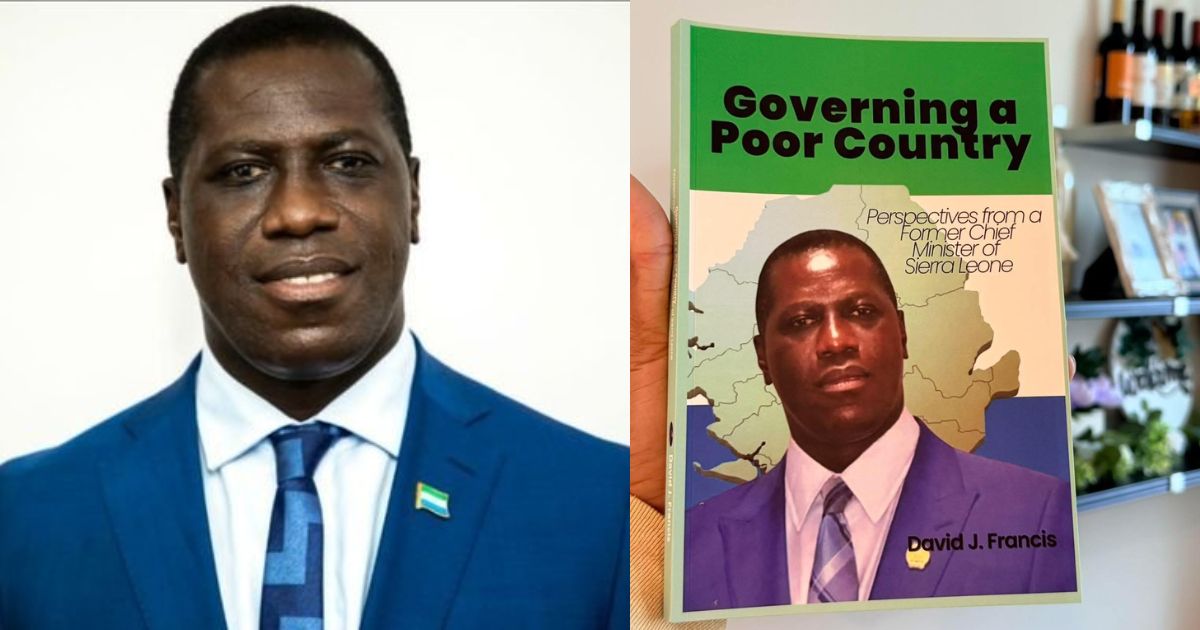
On Tuesday, March 10, 2026, the Institute of Public Administration and Management (IPAM) Centre for Entrepreneurship and Innovation became the stage for an unusually reflective moment in Sierra Leone’s governance discourse. Scholars, students, and policymakers gathered for the launch of Governing a Poor Country: Perspectives from a Former Chief Minister of Sierra Leone, a new book by Professor David J. Francis—former Chief Minister and now a distinguished professor of international politics and diplomacy. While book launches in Sierra Leone often pass as ceremonial gatherings marked by speeches and polite applause, this one carried a deeper intellectual weight. It invited the audience to confront a question that has lingered over the country since independence: why does governing a poor country remain so persistently difficult?
Professor Francis’s book enters this debate with the authority of experience. Drawing on his tenure in the highest coordinating office of government under the administration of His Ecxcellency, President Julius Maada Bio, the author offers an insider’s reflection on the realities of governing a fragile state. Yet the significance of the book extends beyond the memoir of a former public official. It touches a more uncomfortable national question—one that has haunted Sierra Leone for decades: if every government inherits poverty, why does poverty itself continue to outlive successive governments?
Professor Francis’s book is not merely a memoir of political office. It is an insider’s reflection on the mechanics of governance in a fragile state. Drawing from his tenure as Chief Minister between 2018 and 2021 under the administration of His Excellency, President Julius Maada Bio, Francis attempts to explain the institutional constraints that shape governance in Sierra Leone and, by extension, in many developing countries.
At the heart of the book lies a simple but important argument: the central problem of governance in poor countries is not always the absence of policy, but the failure of coordination.
According to Professor Francis, ministries in Sierra Leone often operate in bureaucratic silos. Each institution pursues its own mandate, often disconnected from broader national priorities. The result is familiar: duplication of programs, policy confusion, and chronic inefficiency.
The creation of the Office of the Chief Minister in 2018 was intended to address this structural weakness. The office was conceived as a coordinating nerve centre of government, ensuring that ministries aligned their activities with the administration’s development agenda.
This diagnosis is not entirely new. Scholars of public administration have long argued that state capacity depends less on the number of policies governments produce and more on the ability of institutions to implement them coherently. Development plans without coordination mechanisms often remain little more than aspirational documents.
Professor Francis deserves credit for bringing this institutional perspective into the public conversation. Too often, governance debates in Sierra Leone are reduced to simplistic accusations of corruption or partisan blame. While corruption certainly exists and deserves scrutiny, governance failures frequently stem from deeper structural problems within the state itself.
Yet Francis’s book also invites a more critical reflection—one that goes beyond the internal logic of government administration.
For while coordination problems are real, they are not the only obstacles to effective governance. Politics itself remains a powerful determinant of how institutions function.
In many developing states, bureaucracies are shaped not only by administrative inefficiency but also by patronage networks, political loyalty systems, and elite competition for power and resources. These political dynamics can undermine even the most carefully designed institutional reforms.
The book touches on some of these issues but does not interrogate them as deeply as it perhaps could. Insider narratives often face this dilemma: the closer one stands to power, the more difficult it becomes to fully critique the structures that sustain it. Still, the book performs an important intellectual service by reminding readers that governing a poor country is fundamentally different from governing a wealthy one.
In affluent societies, governance debates revolve around policy choices—tax levels, welfare systems, environmental regulation. In poor countries, governance is often a struggle over the management of scarcity itself.
Limited revenues constrain public investment. Weak institutions slow the implementation of reforms. Meanwhile, citizens—many of whom live in conditions of economic hardship—expect rapid improvements in public services following electoral transitions. This tension between political promise and administrative capacity lies at the centre of the development dilemma.
Professor Francis describes what development scholars often call the “implementation gap.” Governments frequently design ambitious reform programs, but translating these policies into tangible outcomes proves far more difficult.
Without reliable administrative data, skilled personnel, and effective monitoring systems, even well-intentioned policies can fail during execution.
This is a reality that many African governments confront daily. But the deeper question raised by the book—and perhaps unintentionally left unanswered—is this: is poverty merely a constraint on governance, or is it partly the consequence of governance itself?
In other words, do poor countries struggle to govern because they are poor, or do they remain poor because governance systems fail to transform economic potential into national prosperity? This question is not unique to Sierra Leone. It echoes across much of the Global South, where decades of development plans have produced uneven results.
The answer likely lies somewhere in between. Poverty limits state capacity, but weak governance can also perpetuate poverty. Breaking this cycle requires more than institutional coordination. It demands political courage, administrative discipline, and a willingness to confront entrenched systems of power.
Professor Francis’s book does not claim to provide all the answers. But it performs an important intellectual function: it opens a conversation that Sierra Leone urgently needs.
For too long, governance in this country has been discussed either in technocratic language that obscures political realities or in partisan rhetoric that prevents serious analysis.
What Governing a Poor Country offers instead is a starting point for a more mature debate about the future of state institutions in Sierra Leone. And perhaps that is the real value of the book. Because the ultimate question confronting this country is not simply how to govern a poor state. It is how to build a state that no longer has to govern poverty at all. Until Sierra Leone can answer that question—with honesty, institutional reform, and visionary leadership—the title of Professor Francis’s book will remain less a reflection on the past than a description of our present.
Chernor M. Jalloh is a Lecturer of Governance & Development Studies at University of Sierra Leone (USL), Institute of Public Administration and Management (IPAM),


