

ECOWAS Court Rules Sierra Leone Violated Rights by Failing to Criminalize FGM

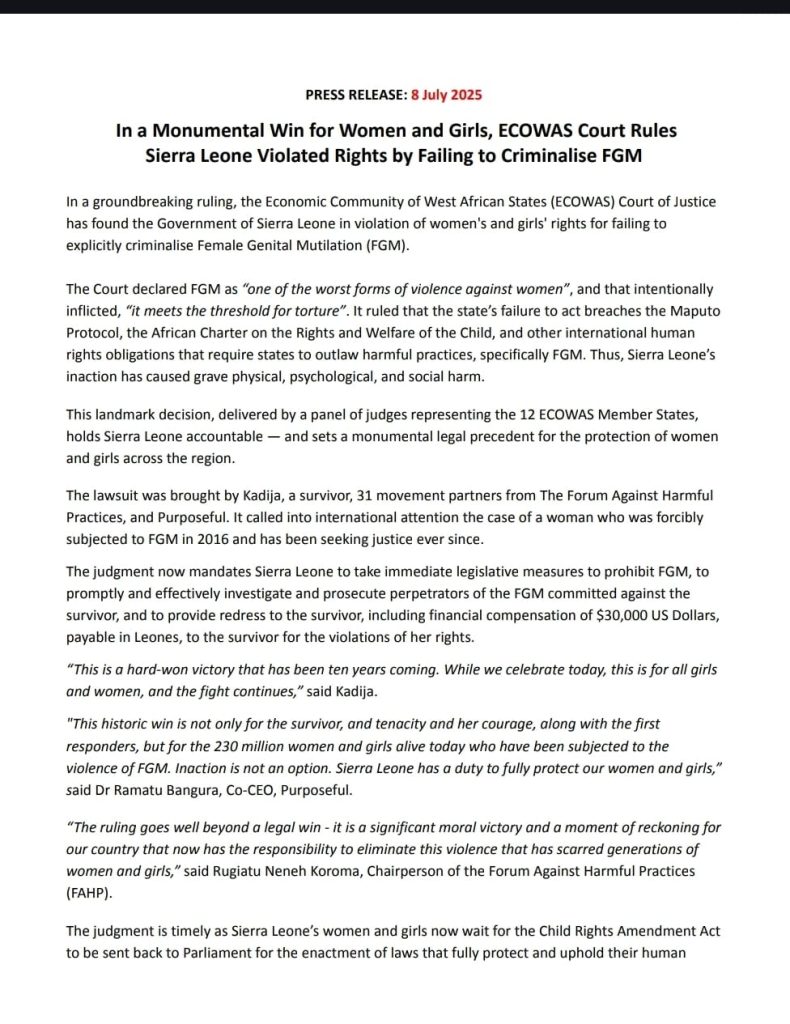
The Economic Community of West African States (ECOWAS) Court of Justice has delivered a landmark ruling against the Government of Sierra Leone, finding it in violation of women’s and girls’ rights due to its failure to explicitly criminalize Female Genital Mutilation (FGM).
The court’s decision, issued on July 8, 2025, sets a significant legal precedent for the protection of women and girls across the West African region.
The court declared FGM as “one of the worst forms of violence against women” and stated that when intentionally inflicted, it “meets the threshold for torture.” It ruled that Sierra Leone’s inaction constitutes a breach of the Maputo Protocol, the African Charter on the Rights and Welfare of the Child, and other international human rights obligations that mandate states to outlaw harmful practices like FGM. The court highlighted that this inaction has caused severe physical, psychological, and social harm.

The lawsuit was initiated by Kadija, an FGM survivor, alongside 31 movement partners from The Forum Against Harmful Practices (FAHP) and Purposeful. The case brought international attention to a woman who was forcibly subjected to FGM in 2016 and has since been seeking justice.



As a result of the judgment, Sierra Leone is now mandated to take immediate legislative measures to prohibit FGM. The ruling also requires the government to promptly and effectively investigate and prosecute perpetrators of the FGM committed against the survivor, and to provide her with redress, including financial compensation of $30,000 USD (payable in Leones).
Kadija, the survivor, hailed the decision as a “hard-won victory that has been ten years coming.” She emphasized that while it’s a moment of celebration, “this is for all girls and women, and the fight continues.”
Dr. Ramatu Bangura, Co-CEO of Purposeful, underscored the broader impact of the ruling. “This historic win is not only for the survivor, and tenacity and her courage, along with the first responders, but for the 230 million women and girls alive today who have been subjected to the violence of FGM,” she stated. “Inaction is not an option. Sierra Leone has a duty to fully protect our women and girls.”
Rugiatu Neneh Koroma, Chairperson of the Forum Against Harmful Practices (FAHP), described the judgment as more than just a legal win, calling it “a significant moral victory and a moment of reckoning for our country that now has the responsibility to eliminate this violence that has scarred generations of women and girls.”
This ruling comes just days after Sierra Leone’s parliament passed the Child Rights Act 2025 into law on July 7, 2025, which includes provisions to ban harmful practices affecting children.
However, parliament issued a statement yesterday clarifying that the new law does not contain specific punitive measures targeting FGM, drawing criticism from human rights advocates who argue this omission undermines efforts to protect girls.
Oh mama salone!
Good move ECOWAS to condemned and terminate the so-called FGM.
You are talking about fgm what about electoral justice
Is this court doing the right thing for Sierra leonean people
Please ask them, deviating from your culture and u called it human right violation.
Ooh Sierra Leonean when our eyes 👀 are going to open
Let’s religious leaders say something about it now, which Bible or Quran verses stated anything concerning fgm. It’s an injury to women that leads to so many unwanted s*x for some women. Because it’s a healed wounds in between a sensitive areas, an old wounds scratches sometimes. In the case of FGM wounds scratches many times in the wrong time especially during the hot seasons it’s makes a lot of women going insane which leads to adultery and and unexpected pregnancies. Further it has break up a lot of marriages due to some women need more than their men can go, as their own men can’t go extra mile they will find an extra agent to make sure they scratches them properly. So FGM is not healthy for the human society maybe for dogs is good to produce more dogs for those eating them. Though it too late yet better than no law to stop the nonsense.
Oh, this is a good one.
It’s high time we do away with this evil practice people call culture.
It’s nothing but wickedness!!!