


 2 Comments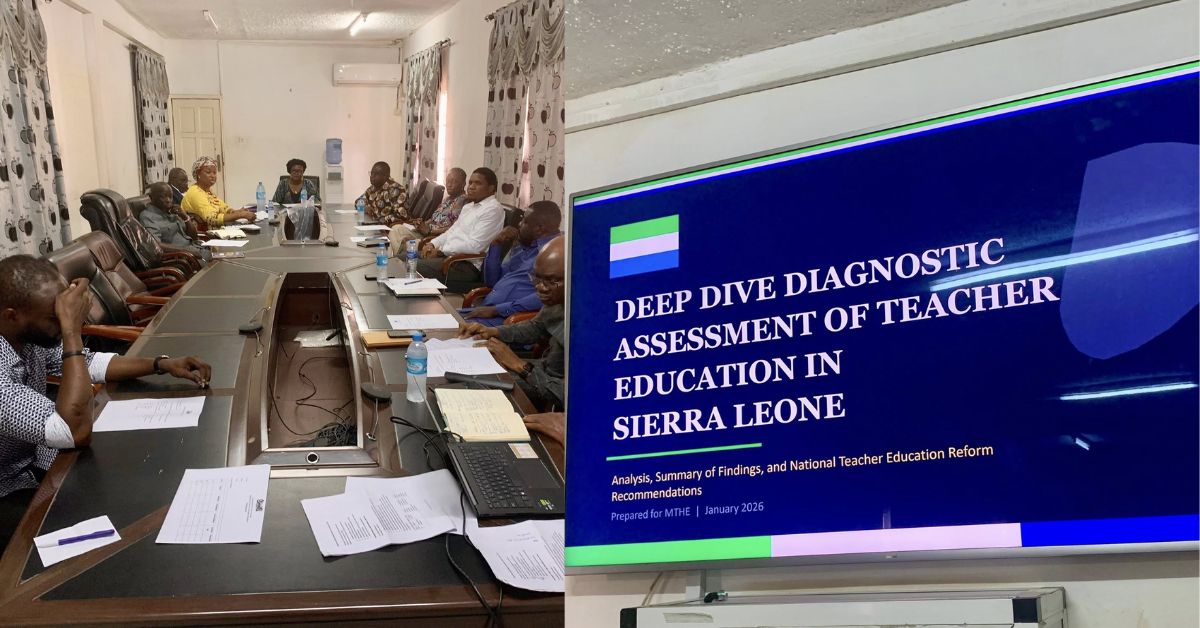
The Ministry of Technical and Higher Education (MTHE) has called for urgent reforms in teacher education after a nationwide diagnostic assessment revealed declining standards across teacher training institutions in Sierra Leone. The findings were presented during a high-level meeting with Transforming Teaching, Education and Learning (T-TEL), which conducted the assessment.
Opening the session, Deputy Chief Technical and Higher Education Officer Sia Fasululu emphasized that the assessment, commissioned last year at the Minister’s request, provides a clear view of the challenges facing the teaching profession. “If we are serious about quality education, we must first examine the foundation—the teachers themselves,” she said.
T-TEL Chief Technical Advisor Akwasi Addae-Boahene presented the report, highlighting systemic weaknesses in seven teacher training institutions. The assessment examined curriculum design, faculty capacity, teaching practice, and student experience, revealing gaps that could affect learning outcomes nationwide.

Permanent Secretary Mohamed Sheick Kargbo expressed concerns about distance learning programmes, particularly for teachers in remote areas. Consultant Mohamed Salefu noted that current models rely on outdated correspondence methods, which are costly and inefficient. Addae-Boahene stressed that universities face financial constraints in sustaining such programmes, advocating for blended, technology-driven approaches to expand access.
Officials also voiced concern over the diminishing quality of teacher education. Kargbo lamented the closure of institutions dedicated solely to teacher training and highlighted the importance of ethics and motivation among teachers. Chief Technical and Higher Education Officer Dr. Josephus Brimah reinforced that “no education system can rise above the quality of its teachers,” calling for stronger practical training, supervision, and mentorship.
Acting Director of Research, Planning and Development Idrissa Sannoh urged better coordination among regulatory bodies and recommended implementing continuous professional development (CPD) linked to career progression. Mohamed Barrie of Leh We Lan emphasized the need for efficient resource allocation to support teacher development effectively.
In her closing remarks, Minister Dr. Haja Ramatulai Wurie described the findings as candid and necessary, stressing that decisive action is required. “We must be honest about the challenges and take ownership of the solutions,” she said, calling for the modernization of curricula, strengthened regulatory frameworks, and the restoration of the teaching profession’s value. She also cautioned against politicizing education, noting that sustainable reforms require consistency and commitment.
Dr. Wurie further emphasized the importance of improved data systems, enhanced teacher motivation, and structured career progression tied to performance and professional development.
The final report from T-TEL is expected in April 2026, after which it will be submitted to the Local Education Group (LEG). A broader national consultation with teacher training institutions and stakeholders will follow, shaping the implementation of reforms aimed at revitalizing teacher education in Sierra Leone.
document.getElementsByTagName(‘head’)[0].appendChild(script);


That’s a very good idea
Not everyone wants to enter class room now, because the government has little or no respect for the profession.