

Zainab Sheriff Speaks From the Dock as Court Dismisses No-Case Submission
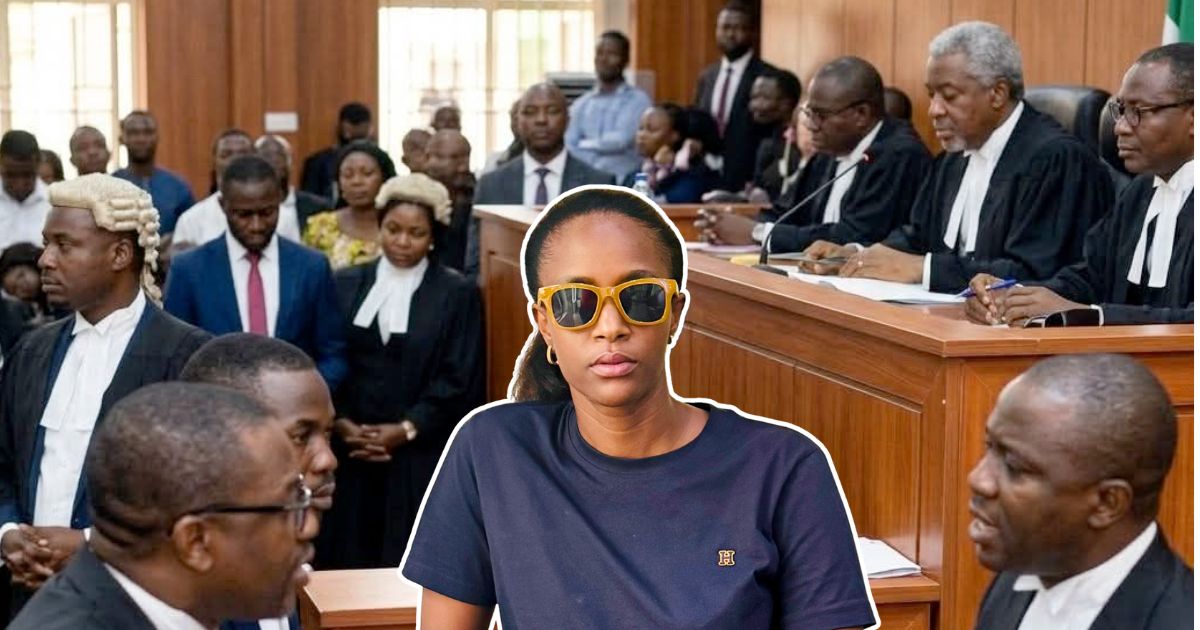
Magistrate Mustapha Brima Jah ruled that the prosecution established a prima facie case against the entertainer and APC figure. She then chose to make an unsworn statement, telling the court her words were a call against vote-stealing — not a call to violence.
The Magistrate Court sitting at Pademba Road, Freetown, on the 31st March, 2026, dismissed a no-case submission filed on behalf of Zainab Sheriff, the well-known entertainer, model, and All People’s Congress (APC) opposition figure, paving the way for the defence to open its case in a trial that has gripped the public attention of the public since February, 2026.
Sheriff faces two counts charge – incitement contrary to law, and Threatening Language contrary to Section 3(ii) of the Public Order Act 1965. The charges arise from remarks she is alleged to have made at an APC rally at the Brima Attouga Mini Stadium in Freetown on the 31st January 2026, during which, the prosecution contended, she made statements capable of inciting public disorder. She has pleaded not guilty to both counts and has been held on remand at the Female Correctional Facility since the 23rd February 2026, following repeated denial of bail.

At the close of the prosecution’s case, which rested on two witnesses, documentary and forensic exhibits including video footages, a transcription, and forensic analysis of a pen drive and an iPhone, lead defence counsel R.S.V. Wright Esq. mounted a no-case submission on two fronts, that the charges were invalid in form and content, and that the prosecution’s evidence had in any event failed to prove the essential elements of either offence.
On the charges themselves, Wright argued that Count One — “incitement contrary to law” — was fatally deficient because incitement must be charged as incitement to commit a stated offence, such as incitement to murder. Citing Archbold at paragraph 409 and the English Court of Appeal in R v Michael L. Smith (2004), counsel submitted that without identifying who was incited and to commit what specific crime, the charge was a nullity. On Count Two, counsel relied on the Sierra Leonean case of Cummins v Mohamed Ibrahim D2140/2025 to argue that threatening language must identify the person or persons threatened, and that the count’s failure to do so was fatal.
On the merits, the defence pressed what it described as the prosecution’s own self-destruction. Prosecution Witness 2, an investigating officer, had admitted under cross-examination that after watching the video he himself did not feel incited. Prosecution Witness 1 further conceded that no member of the public had come forward as a complainant or victim, that no one had reported being incited, and that the proceedings had been initiated by the Cyber Unit on the direction of the Inspector General of Police, not in response to any public complaint.
The defence also challenged the substance of the video itself. Sheriff’s words — “anyone who steals or rigs election should be killed” — named no individual. The prosecution’s suggestion that she was referring to the President was, in counsel’s submission, speculation, and there was no portion of the video that could support that inference. Counsel drew on the United States Supreme Court’s reasoning in Hess v. Indiana 414 U.S. 105 (1973), which held that words directed at no person or group in particular, and advocating illegal action only at some indefinite future time, do not constitute incitement. The defence further characterised the remarks as political speech — an analogy between electoral fraud and treason — rather than a call for vigilante violence, citing the Scottish authority of Baxter v HM Advocate 1998 JC 219 on the need for serious intention to incite.
In reply, State Counsel Y.I. Sesay Esq. submitted that the charges were properly framed under Section 49(1) and (2) of the Criminal Procedure Act 2024 (Act No. 8 of 2024) and in accordance with the First Schedule thereto. He argued that the defence had failed to demonstrate any actual breach of the statute and that international authorities cited by the defence were merely persuasive, not binding. He relied on the Court of Appeal’s decision in Suluku Jamiru Bockarie v The State (2008), which held that a conviction may stand on a defective charge where the offence is disclosed and the accused is not prejudiced.
On the standard for the no-case submission, State Counsel invoked R v Galbraith (1981) and the Practice Direction of Lord Parker (1962), submitting that the evidence before the court was sufficient to require the defendant to answer. He further argued that incitement need not be directed at a specific individual but may be directed at the public at large, and that advice, suggestion, or encouragement to commit a crime are each capable of constituting the offence.
Applying the Practice Direction of Lord Parker and the principles in R v Galbraith, Magistrate Mustapha Brima Jah dismissed the no-case submission and found that a prima facie case had been established requiring the defendant to answer.
On the defects in the charges, the Magistrate held that the court was bound by Sierra Leonean law and by the decisions of the High Court, Court of Appeal, and Supreme Court — not by the foreign authorities advanced by the defence. He found that the prosecution had complied with the rules set out in the First Schedule of the Criminal Procedure Act 2024, and that Section 49 of that Act insulates a charge from objection on grounds of defect in form where it is framed in accordance with those rules. Even if the charges were defective, the Magistrate reasoned, the law in Sierra Leone as confirmed by Suluku Jamiru Bockarie v The State (2008) permits such defects to be cured where the offence is clearly disclosed and the accused is not misled or prejudiced, which he found to be the case here.
On the evidence, the Magistrate was satisfied that the prosecution had adduced sufficient material at its highest to require a response from the defence.
Following the ruling, Sheriff was put to her election — the procedural step at which a defendant chooses how to respond to the prosecution’s case. She elected to make an unsworn statement from the dock, a course that does not expose her to cross-examination.
In her statement, Sheriff described herself as a patriotic Sierra Leonean and said that her comments at the January rally were intended to deter election rigging, not to incite violence. She noted that no complainant or victim had come forward, and argued that the case rested on nothing more than the police’s interpretation of her video. She maintained that she does not support violence.
Sheriff was declared wanted by the #SierraLeone Police on 13 February 2026, arrested on 20 February 2026 outside a gym (LOR) in Freetown, and first appeared in court on the 23rd February 2026. She has been remanded in custody since her first appearance, with six bail applications being denied. Another accused person from the same rally, APC Secretary-General Lansana Dumbuya, faced similar charges but was granted bail.
The matter has been adjourned to the 7th April 2026 for the continuation of proceedings. Zainab Sheriff remains in remand custody at the Female Correctional Facility in Freetown.