

Three-Day Training for Commercial Seed Producers Kicks Off in Taiama
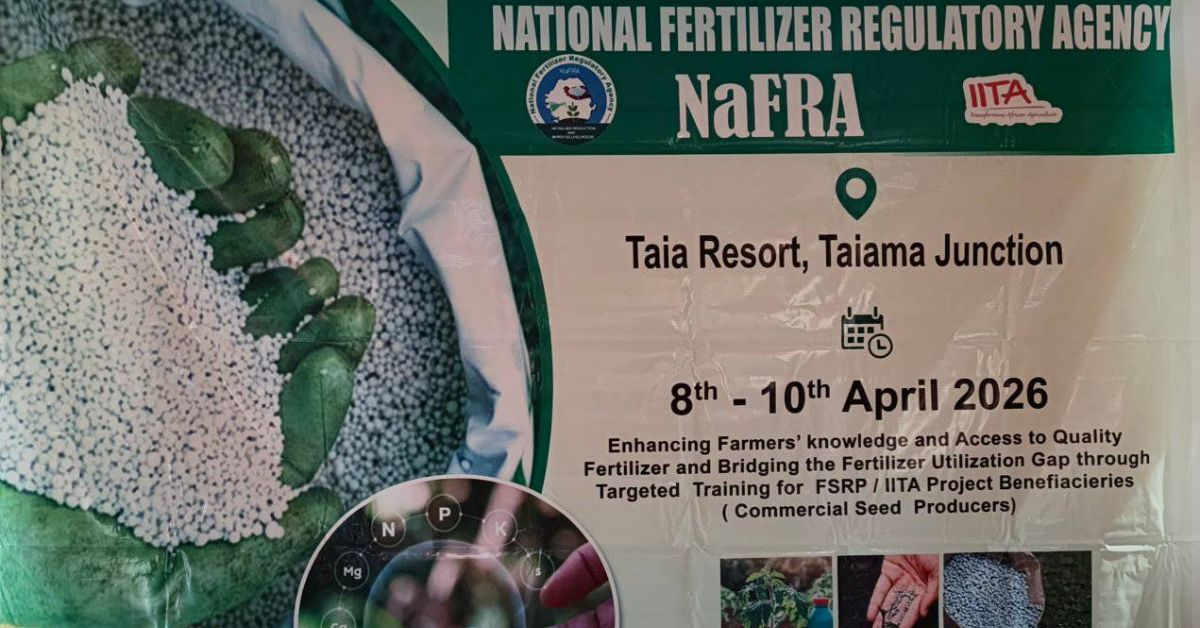
A three-day intensive training programme for commercial seed producers officially opened today at Taia Resort, Taiama Junction.
The initiative is led by the National Fertilizer Regulatory Agency (NaFRA) in collaboration with the Food Security and Resilience Project Sierra Leone, the International Institute of Tropical Agriculture, the Ministry of Agriculture and Food Security, and the Sierra Leone Agricultural Research Institute.
Running from April 8–10, 2026, the training is themed “Enhancing Farmers’ Knowledge and Access to Quality Fertilizer and Bridging the Fertilizer Utilization Gap through Targeted Training for FSRP/IITA Project Beneficiaries Commercial Seed Producers.”

The programme aims to equip commercial seed producers with practical, science-based skills for selecting, handling, and applying fertilizers correctly. Organisers said the initiative is expected to improve fertilizer use efficiency, boost crop yields, and strengthen Sierra Leone’s seed production segment, contributing to the broader FSRP/IITA World Bank project goals of increasing agricultural productivity and enhancing food security.



Participants include commercial seed producers and FSRP/IITA project beneficiaries drawn from multiple districts, while trainers comprise technical staff from NaFRA, IITA, SLARI, and the Ministry of Agriculture and Food Security.
The sessions are highly interactive, encouraging participants to share experiences and test techniques through field demonstrations. Practical exercises include calibrating application equipment, interpreting soil test reports, and planning fertilizer regimes for seed production cycles. Peer learning and group problem-solving form a core part of the methodology, allowing farmers to adapt lessons to local conditions.
The training also focuses on reducing the fertilizer utilization gap by promoting best practices and connecting producers to regulated, quality inputs.
Addressing the opening ceremony, Minister of Agriculture and Food Security, Dr. Henry Musa Kpaka, reaffirmed the government’s commitment to ensuring farmers have access to quality inputs and the knowledge to use them effectively. “This training is a vital step toward sustainable productivity gains,” he said.
A NaFRA representative added, “Proper regulation and farmer education go hand in hand. By improving fertilizer use, we protect soils, increase yields, and support resilient livelihoods.”
Following the training, organisers plan follow-up field visits and technical support to reinforce new practices. Monitoring will track changes in fertilizer use and yields among participants, with lessons learned informing plans to scale similar trainings to additional districts.