ILRAJ Demands Full Disclosure on Government Printing Department Modernisation Deal
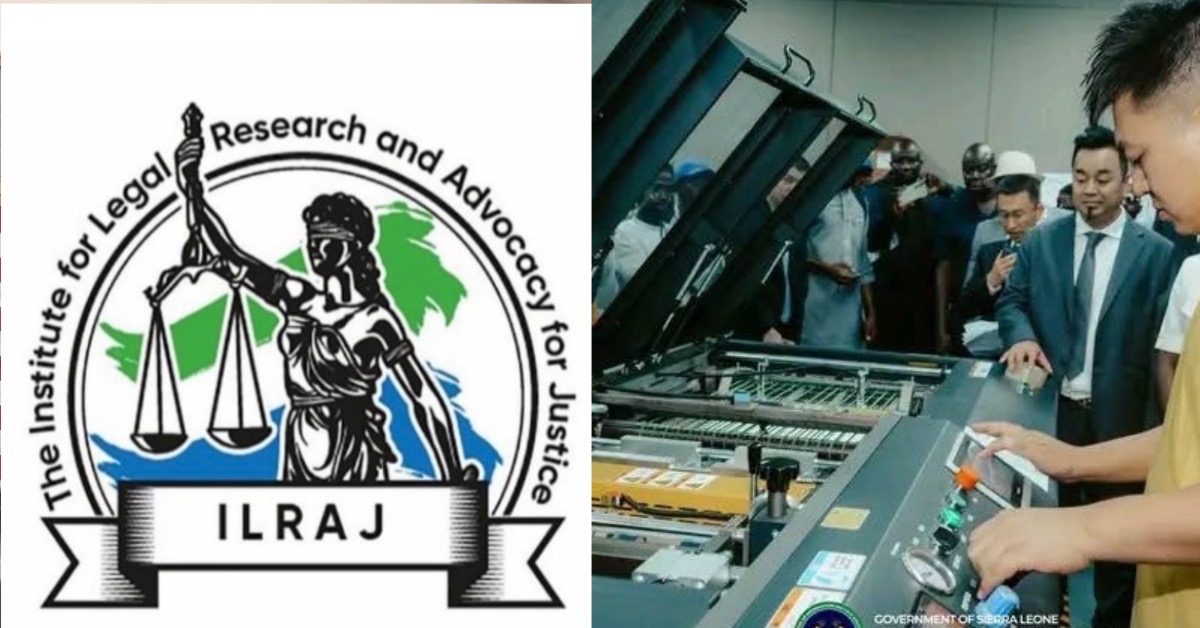
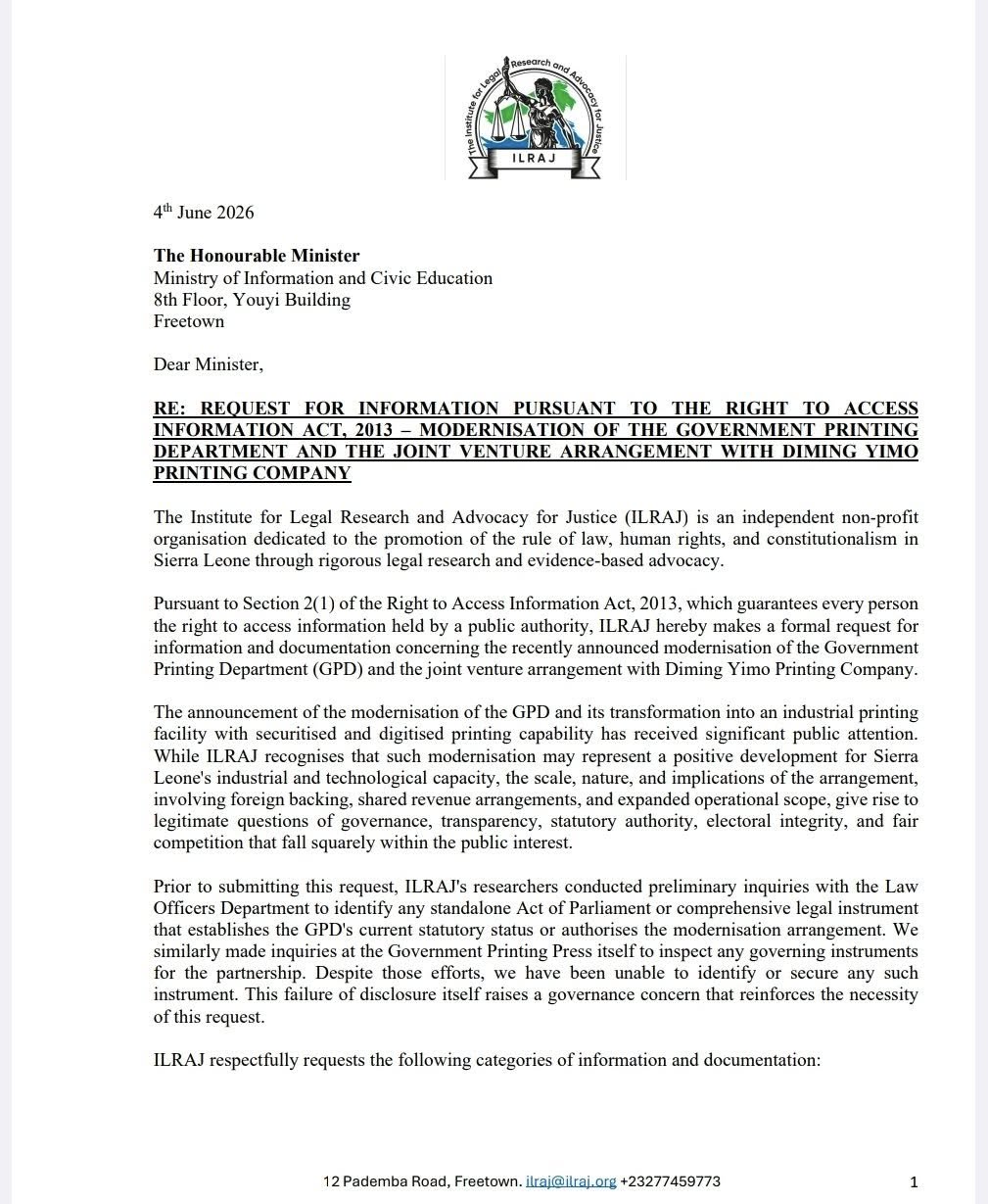
The Institute for Legal Research and Advocacy for Justice (ILRAJ) has written to the Minister of Information and Civic Education, Chernor Bah, demanding full disclosure on the modernisation of the Government Printing Department (GPD) and its reported partnership with Diming Yimo Printing Company.
In a letter dated June 4, 2026, ILRAJ acknowledged that the proposed transformation of the Government Printing Department into a modern, digitised and secure industrial facility could enhance Sierra Leone’s technological and institutional capacity. However, the organisation raised concerns over what it described as a lack of transparency surrounding the agreement.
ILRAJ noted that preliminary inquiries conducted by its researchers at both the Law Officers’ Department and the Government Printing Press reportedly failed to produce any legal instrument authorising the partnership.

“This failure of disclosure itself raises a governance concern that reinforces the necessity of this request,” said ILRAJ Chief Executive Officer, Basita Michael, in the letter.


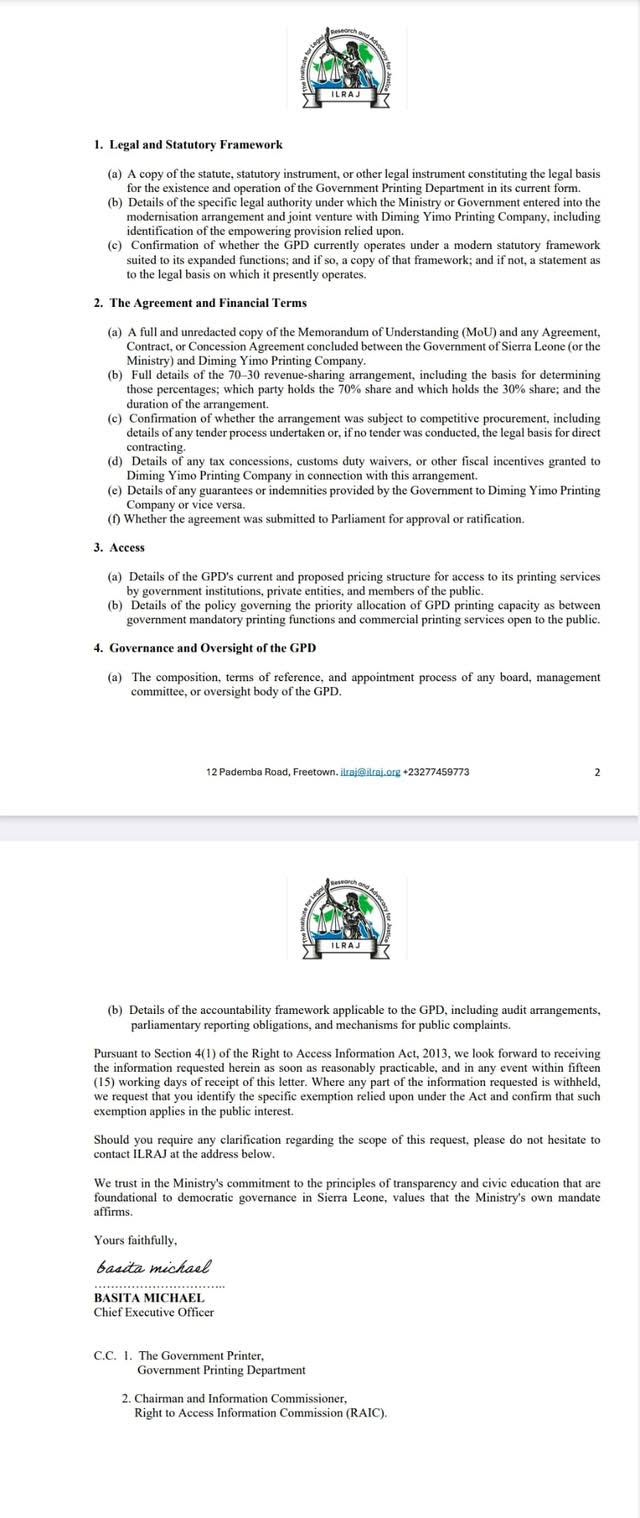
The organisation is now demanding comprehensive documentation on the deal, structured around four key areas.
On the legal framework, ILRAJ is requesting proof of the statutory authority under which the Ministry entered into the joint venture arrangement.
Regarding financial terms, the group is seeking a full, unredacted copy of the Memorandum of Understanding (MoU), including detailed clarification of the reported 70–30 revenue-sharing structure, identification of the majority stakeholder, and the duration of the agreement.
On procurement and concessions, ILRAJ is asking whether the contract underwent a competitive public tender process, and whether any tax exemptions or government guarantees were granted to Diming Yimo Printing Company.
The organisation is also seeking clarity on oversight and pricing, including the composition of the Government Printing Department’s governing board, if any exists, as well as the proposed pricing framework for both public and government use of the facility.
ILRAJ emphasised that under Section 4(1) of the Right to Access Information Act, the Ministry is legally required to respond within fifteen (15) working days. It further stated that if any information is withheld, the Ministry must specify the legal exemptions relied upon in the interest of public accountability.
The letter was also copied to the Government Printer and the Chairman of the Right to Access Information Commission (RAIC), signalling the group’s intention to ensure full compliance with transparency and governance standards.