


 Post a comment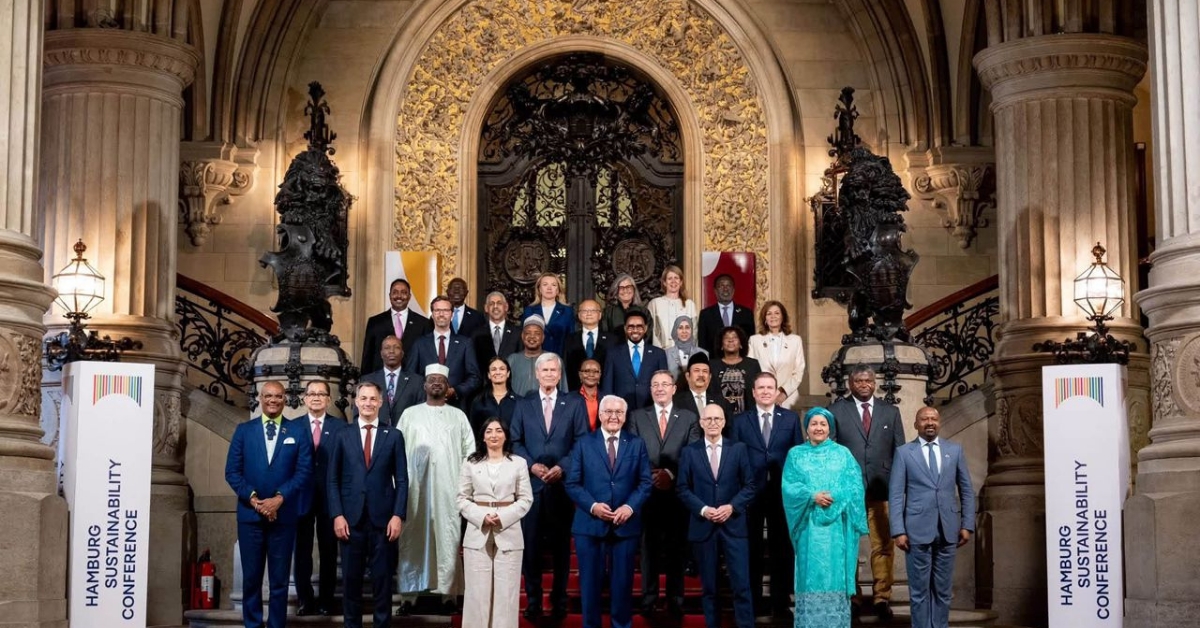
Sierra Leone’s Vice President, Dr Mohamed Juldeh Jalloh, has joined international leaders in calling for urgent global action to protect developing countries from the economic consequences of disruptions to shipping through the Strait of Hormuz.
Speaking at the Hamburg Sustainability Conference, Vice President Jalloh joined representatives from Germany, the United Kingdom and the United Nations in launching a joint declaration aimed at supporting vulnerable countries facing rising energy, food and fertiliser costs linked to the crisis.
The declaration was presented by Germany’s Federal Minister for Economic Cooperation and Development, Reem Alabali-Radovan, and was co-initiated by Vice President Jalloh, alongside senior officials from the United Nations Development Programme (UNDP) and the United Kingdom.

The joint statement calls for a coordinated international response to cushion the impact of the disruption on developing nations, particularly those in Africa and Asia. It outlines measures to mobilise financial, humanitarian and agricultural assistance while strengthening food security and economic resilience.
As part of the initiative, Germany announced an emergency support package worth €280 million. The funding includes €250 million for the World Food Programme and other United Nations agencies to respond to growing food insecurity, while €30 million will be invested in strengthening agricultural systems and reducing dependence on imported fertilisers.
The declaration also commits governments and development partners to promote coordinated multilateral action, support smallholder farmers and vulnerable communities, and accelerate reforms aimed at building more resilient agri-food systems capable of withstanding global supply chain disruptions.
Addressing the conference, Vice President Jalloh described the Strait of Hormuz disruption as more than an energy crisis, stressing that it poses a significant development challenge for countries in the Global South.
“We do not import instability. Yet we pay for it,” he said, noting that countries such as Sierra Leone continue to face the economic consequences of conflicts beyond their borders through higher fuel prices, increased food costs and disrupted supply chains.
He called on the international community to establish faster and more responsive financing mechanisms to help vulnerable economies manage external shocks before they escalate into wider development crises. He also proposed the creation of a Global South Shock Absorption Facility to support developing countries facing future geopolitical and supply chain disruptions.
Concluding his remarks, Vice President Jalloh reaffirmed the central message of the Hamburg declaration, stating that the Global South should no longer bear the burden of crises it did not create.
According to Germany’s Federal Ministry for Economic Cooperation and Development, prolonged disruption to shipping through the Strait of Hormuz could push an estimated 45 million more people into hunger and over 30 million into extreme poverty, underscoring the need for swift and coordinated international action.


