

Constitutional Amendment In Sierra Leone: What Does “Two-Thirds Of The Members Of Parliament” Mean?
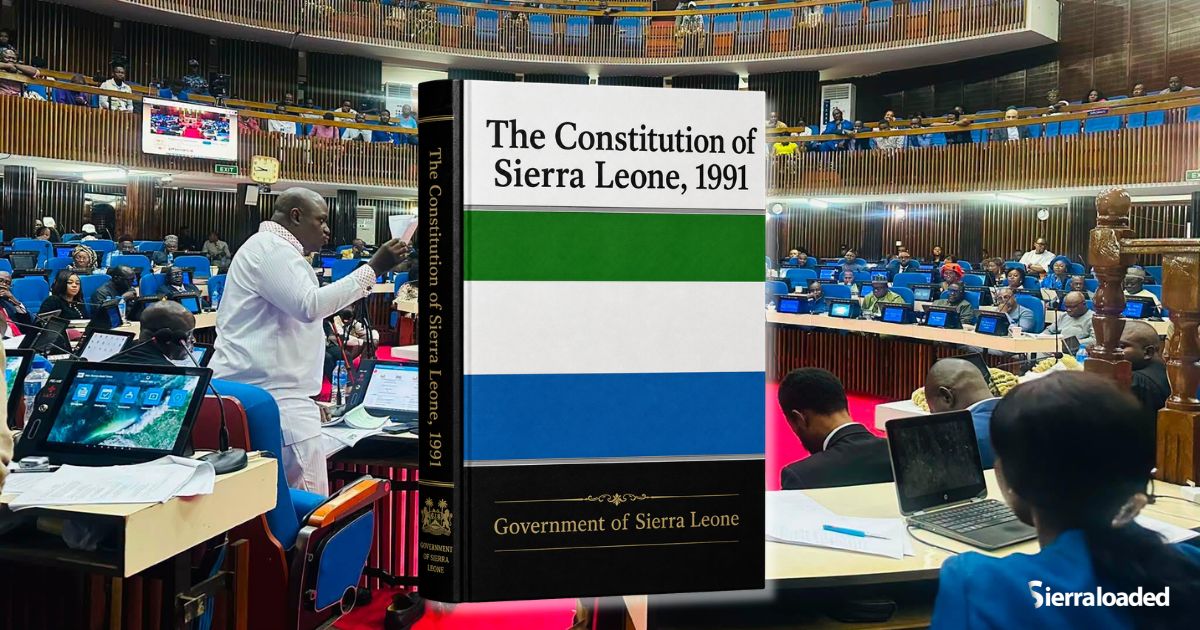
A scholarly commentary on sections 89, 91, 94 and 108 of the 1991 Constitution, comparative Commonwealth jurisprudence, and the question now before the Supreme Court
The controversy surrounding Parliament’s reported passage of the Constitution of Sierra Leone (Amendment) Bill, 2025 on 10 August 2026 raises a narrow but profoundly important constitutional question: when section 108(2)(b) requires the support of “not less than two-thirds of the Members of Parliament”, does that mean two-thirds of the Members present and voting, or two-thirds of the total legally existing membership of Parliament?
That question is now appropriately one for the Supreme Court, which possesses final authority over constitutional interpretation in Sierra Leone. The Court’s task is not to determine whether the proposed electoral reforms are politically desirable. Its responsibility is more fundamental: to determine the conditions under which Parliament may exercise the constituent power conferred upon it by the Constitution. The Supreme Court is the final appellate court and has exclusive constitutional jurisdiction over questions of constitutional interpretation.
The immediate political dispute is well captured in Edward Margao’s commentary of 10 August 2026. Margao correctly identifies the distinction between the ordinary voting rule under section 91 and the special constitutional amendment machinery under section 108, and equally correctly cautions that the opposition walkout did not itself deprive Parliament of the capacity to transact business.


The critical issue is therefore not whether Parliament had a quorum. It is whether the constitutional Bill obtained the special majority that the supreme law requires.
The text of the Constitution: section 91 begins with an exception
The starting point must be section 91(1). It provides:
“Except as otherwise provided in this Constitution, any question proposed for decision in Parliament shall be determined by a majority of the votes of the Members present and voting.”
Those opening words—“Except as otherwise provided in this Constitution”—are decisive. Section 91 is therefore not an absolute voting rule. It expressly subordinates ordinary majority voting to any special voting requirements elsewhere in the Constitution.
Section 108 is precisely such a provision.
Section 108(1) permits Parliament to alter the Constitution, but only “subject to the provisions of this section.” Section 108(2)(b) then states that a constitutional amendment Bill shall not be passed unless:
“the Bill is supported on the second and third readings by the votes of not less than two-thirds of the Members of Parliament.”
The syntax is important. Unlike section 91, section 108 does not say “two-thirds of the Members present and voting.” It says “two-thirds of the Members of Parliament.”
That difference cannot easily be treated as accidental.
Constitutional interpretation proceeds from the presumption that different formulations appearing in the same instrument were chosen deliberately. Where the Constitution intends the denominator to consist of those present and voting, it knows how to say so—section 91 does exactly that. Where section 108 omits those words and instead refers simply to “the Members of Parliament”, the natural reading is that the denominator is the membership of Parliament, not merely those remaining in the chamber.
The official Standing Orders make this even clearer. Standing Order 44(3), expressly implementing section 108(2)(b), provides that a constitutional amendment Bill must receive, at second and third readings:
“the votes of not less than two-thirds of all the Members of the House.”
That is powerful contemporaneous institutional evidence of Parliament’s own understanding of the constitutional text.
Quorum and voting threshold answer different questions
Much of the public debate has confused quorum with the majority necessary to pass a particular measure.
Section 89 provides that Parliament may transact business unless objection is taken that fewer than one-quarter of all Members are present, in which case the sitting must be adjourned. The quorum rule therefore answers one question:
Is Parliament legally constituted to conduct business?
Section 108 answers another:
Has a constitutional amendment obtained sufficient affirmative votes to alter the supreme law?
These are entirely distinct inquiries.
A Parliament may have enough Members present to sit lawfully and yet lack enough votes to amend the Constitution. Margao puts the distinction well: a political walkout does not amount to an automatic constitutional veto, but neither can absence reduce the special threshold prescribed by section 108.
This distinction is familiar across constitutional democracies. A quorum establishes the minimum attendance necessary for institutional action; a supermajority defines the minimum affirmative consensus necessary for a particular constitutional decision.
Thus, if Parliament has 149 legally existing voting Members, for illustration, the fact that only 90 remain in the Chamber does not necessarily transform a constitutionally required two-thirds majority into 60 votes. On the stronger textual reading of section 108, the relevant denominator remains the legally existing membership of the House.
Absence is therefore neither an “Aye” nor a “Nay”. It is simply a failure to contribute an affirmative vote. Where the Constitution demands a fixed minimum number of affirmative votes, that absence may make the threshold harder to achieve—but it does not alter the threshold itself.
This answers the mathematical objection that absent MPs must somehow be classified as voting for or against the Bill. They need not be classified at all. A supermajority requirement is not necessarily calculated as a percentage of ballots actually cast. It may instead prescribe a minimum number of affirmative votes derived from the membership of the institution.
Section 94 does not rescue a deficient supermajority
Section 94 is also relevant but should not be overstated. It allows Parliament to regulate its procedures and recognises that parliamentary proceedings are not automatically invalidated merely because of vacancies in membership.
That is sensible. Parliament cannot cease functioning every time a seat falls vacant.
But a vacancy provision does not convert a constitutionally prescribed special majority into a majority of those present. The better approach is to distinguish between a vacant seat and an absent Member who continues legally to hold office.
The Constitution itself contains interpretive language elsewhere indicating that where an “all Members” majority is required, the legally relevant membership is the number of persons “actually and validly existing as Members of Parliament at the relevant time.” (Parliament of Sierra Leone)
That formulation suggests that genuine vacancies may reduce the denominator. A boycott does not. An MP who walks out remains a Member of Parliament.
This distinction is particularly important. Otherwise, a party could manipulate constitutional thresholds merely through coordinated absence—or, conversely, a governing majority could benefit from opposition absence by recalculating the constitutional denominator downwards. Neither result sits comfortably with the purpose of entrenchment.
The purpose of entrenchment
The language of section 108 must also be interpreted in light of its constitutional function.
An entrenched amendment procedure exists because the Constitution is not an ordinary Act. Parliament exercises ordinary legislative power under the Constitution, but when amending the Constitution it exercises a special constituent authority delegated to it by the Constitution itself.
That authority is conditional.
The classic Commonwealth authority is the Privy Council decision in Bribery Commissioner v Ranasinghe [1965] AC 172. Lord Pearce stated the principle with enduring clarity: a legislature cannot ignore the conditions of law-making imposed by the constitutional instrument from which its authority derives. Where the Constitution requires a special majority or special procedure, legislation enacted without compliance is invalid. The House of Lords later reaffirmed that principle in Jackson v Attorney General [2005] UKHL 56. (BAILII)
The principle could scarcely be more relevant to Sierra Leone. Parliament may amend the Constitution because section 108 authorises it to do so. But the same section prescribes the manner in which that power must be exercised. Parliament cannot invoke the grant of power while disregarding the conditions attached to it.
Kenyan jurisprudence reaches the same conclusion. In Onyango & 11 others v Attorney General & others [2005] KEHC 3204, the High Court distinguished ordinary legislative power from constituent power and held that, under a rigid constitution, a constitutional amendment undertaken contrary to a prescribed special procedure is void.
The lesson is straightforward: the amending rule is part of the Constitution, not merely parliamentary etiquette.
Kenya: “two-thirds of all the members”
The Kenyan Constitution provides a particularly useful comparison because its language removes all ambiguity. Article 256 provides that a constitutional amendment Bill is passed only when each House approves it at second and third readings by:
“not less than two-thirds of all the members of that House.”
Kenyan courts treat that as a fixed membership-based threshold, not a proportion of those present.
In Commission for the Implementation of the Constitution v National Assembly of Kenya [2013] KEHC 6919, the High Court reiterated that Parliament’s amendment authority exists only in accordance with Article 256 and reproduced the requirement of two-thirds of all members.
Sierra Leone’s Standing Order 44(3) is materially similar, expressly translating section 108 into “two-thirds of all the Members of the House.”
South Africa: special majorities protect constitutional supremacy
South African constitutional jurisprudence provides even stronger conceptual support.
Section 74 of the South African Constitution requires most constitutional amendments to receive at least two-thirds of the members of the National Assembly, while particularly foundational provisions attract an even higher 75 per cent threshold. (SAFLII)
In the First Certification Judgment, Certification of the Constitution of the Republic of South Africa [1996] ZACC 26, the Constitutional Court expressly contrasted ordinary legislation—decided through ordinary voting procedures—with constitutional amendment, which requires a two-thirds majority of all members of the National Assembly. The Court characterised that special majority as an essential constitutional safeguard.
In Matatiele Municipality v President of the Republic of South Africa (No 2) [2006] ZACC 12, the Constitutional Court again insisted upon strict compliance with the constitutional amendment procedure, treating prescribed procedural safeguards as integral to constitutional validity rather than optional parliamentary formalities.
South African constitutional thought thus reinforces an important point: supermajority provisions are designed precisely to ensure that a temporary parliamentary majority cannot alter the foundational law as easily as it passes ordinary legislation.
India: a useful textual contrast
India provides perhaps the clearest demonstration of why constitutional wording matters.
Article 368 deliberately combines two different denominators. A constitutional amendment must receive:
- a majority of the total membership of each House; and
- not less than two-thirds of the Members present and voting.
The Indian Constitution therefore expressly uses “present and voting” when that is what it intends.
This comparison is instructive for Sierra Leone. Had the framers wished section 108 to require two-thirds only of those present and voting, they could readily have adopted language comparable to section 91—or India’s Article 368. They did not.
The omission strongly favours the interpretation that the two-thirds requirement is membership-based.
The parliamentary precedent of December 2024
There is nevertheless a domestic complication.
The Lawyers’ Society points to the December 2024 Auditor-General removal proceedings, during which the Speaker reportedly treated a two-thirds requirement as calculable by reference to Members present and voting. He rightly cautions, however, that this parliamentary ruling concerned a different constitutional provision and cannot itself amend section 108.
That precedent deserves respectful consideration because consistency in parliamentary interpretation matters. But parliamentary precedent is not constitutional supremacy.
The key question is not what Parliament previously understood another provision to mean, but what the Constitution properly construed requires in the specific context of section 108.
Indeed, the Standing Orders significantly weaken the argument derived from the 2024 precedent. Parliament’s own Standing Order 44(3) specifically applicable to constitutional amendments says “two-thirds of all the Members of the House.” (Parliament of Sierra Leone)
Where a general or context-specific parliamentary practice conflicts with an express Standing Order implementing an entrenched constitutional provision, the latter should carry substantially greater weight.
Does an opposition walkout amount to a veto?
This question requires nuance.
Critics of the “total membership” interpretation may argue that it allows a minority to frustrate amendment merely by walking out. That concern is real, but it does not justify rewriting the constitutional threshold.
Entrenchment is deliberately designed to make constitutional amendment difficult. A supermajority requirement necessarily gives minorities greater blocking power than they possess in ordinary legislation. That is not an accidental defect. It is often the point.
The South African Constitutional Court has recognised that special amendment majorities protect the Constitution against ordinary political majorities. (SAFLII)
The proper political response to a high constitutional threshold is therefore negotiation, consensus-building and compromise—not denominator reduction.
A Constitution requiring two-thirds of Parliament is effectively telling political actors: you may amend the fundamental rules, but only if you can construct a broader consensus than that necessary to govern ordinarily.
If the framers had wanted constitutional amendment to depend solely on whoever remained in the Chamber, they could have adopted the “present and voting” formula.
A further complication: which amendments require a referendum?
The present debate also risks conflating the parliamentary two-thirds requirement under section 108(2) with the separate referendum requirement under section 108(3).
Every constitutional amendment must satisfy section 108(2).
But only amendments affecting provisions specifically entrenched by section 108(3) must additionally proceed to referendum.
The proposed alteration of the presidential first-round threshold from 55 per cent to 50 per cent plus one appears to amend section 42(2)(e), which currently requires a presidential candidate to obtain at least 55 per cent of valid votes. Section 42 is not among the provisions expressly listed in section 108(3). On the constitutional text alone, therefore, that amendment appears to require the section 108(2) parliamentary supermajority but not necessarily a referendum.
The proposed permanent adoption of proportional representation for parliamentary elections may present a different problem depending upon the exact provisions amended. Section 108(3) specifically entrenches sections 74(2) and 74(3). Accordingly, if the Bill alters those provisions, the referendum requirement is triggered. Margao correctly stresses that the answer must turn upon the exact text being altered rather than the political label attached to the reform.
This distinction should feature prominently in the Supreme Court’s analysis.
My considered interpretation
On the present constitutional text, I find the interpretation advanced by Joseph Fitzgerald Kamara, Edward Margao and the Lawyers’ Society substantially more persuasive than the proposition that section 108 means two-thirds merely of those present and voting.
Five considerations lead me to that conclusion.
First, text: section 91 expressly uses “present and voting”; section 108 does not.
Second, structure: section 91 expressly yields where the Constitution “otherwise provides”, and section 108 plainly otherwise provides.
Third, parliamentary implementation: Standing Order 44(3) interprets section 108 as requiring two-thirds of all Members of the House.
Fourth, constitutional purpose: entrenchment exists precisely to distinguish constitutional amendment from ordinary majority law-making.
Fifth, comparative jurisprudence: Commonwealth constitutional courts consistently treat special amendment procedures as mandatory conditions of constituent authority rather than optional procedural preferences. Ranasinghe, Kenya’s amendment jurisprudence and the South African Certification cases all strongly support that proposition.
Accordingly, the better interpretation is that section 108(2)(b) requires affirmative votes equal to not less than two-thirds of the legally existing membership of Parliament at the relevant time, subject to genuine vacancies recognised by law. Members who remain legally in office but absent themselves from the vote do not cease to be Members and should not be removed from the denominator.
This does not mean that their absence counts as a vote against the Bill. It means simply that the Constitution requires a specified level of affirmative support before its own text may be altered.
What the Supreme Court should clarify
The Court now has an opportunity to provide authoritative guidance on several matters that have remained unnecessarily uncertain.
It should clarify the relationship between sections 89, 91, 94 and 108; distinguish quorum from special voting thresholds; explain whether “Members of Parliament” in section 108 means legally existing membership or Members present and voting; clarify the effect of vacancies as opposed to voluntary absence; determine the legal weight of Standing Order 44(3); and explain the extent, if any, to which the 2024 Auditor-General parliamentary ruling bears upon constitutional amendments.
More fundamentally, the Court should reaffirm that constituent power is not ordinary legislative power.
The Constitution gives Parliament authority to alter the supreme law—but only on the conditions prescribed by the supreme law itself.
That principle was elegantly captured decades ago in Bribery Commissioner v Ranasinghe: a legislature cannot validly exercise a constitutional power while ignoring the manner and form through which the Constitution requires that power to be exercised.
Conclusion
The question before the Supreme Court is therefore not fundamentally mathematical.
It is constitutional.
Those arguing that two-thirds must mean two-thirds of Members present and voting understandably focus on the practical difficulty of treating absent Members as part of the calculation. But that approach imports into section 108 language that appears only in section 91.
The Constitution itself draws the distinction.
For ordinary parliamentary questions, the majority is calculated from Members present and voting. For constitutional amendment, section 108 requires the votes of not less than two-thirds of the Members of Parliament.
The Standing Orders then make the implication explicit: two-thirds of all Members of the House.
That higher threshold is not an inconvenience to be mathematically managed away. It is an instrument of constitutional entrenchment.
A government able to command an ordinary majority may govern.
But a government seeking to alter the supreme law must do more: it must assemble the broader constitutional consensus demanded by section 108.
That is the distinction between majoritarian government and constitutional democracy.
The Supreme Court should therefore approach the present reference not from the politics of 10 August 2026, but from the institutional consequences of its interpretation for every Parliament and every government yet to come.
For today’s majority will one day be a minority, and today’s opposition may one day govern.
The constitutional rule must remain the same for both.
Political power is temporary. The amendment procedure of the Constitution must endure.
Dr Owen M.M. KaiCombey is a Sierra Leonean legal scholar and Barrister and Solicitor. He holds a PhD in Human Rights and Public Law from the University of Galway. His doctoral research examined law, constitutional governance and decolonisation in postcolonial Sierra Leone. He made an individual submission to the Justice Cowan Constitutional Review Commission.
This commentary does not prejudge the Supreme Court proceedings and is offered as an independent scholarly interpretation of the constitutional text and comparative jurisprudence.