
SAHID’S LENS: Beyond SLPP and APC: Sierra Leone’s Constitution Is Not a Political Weapon
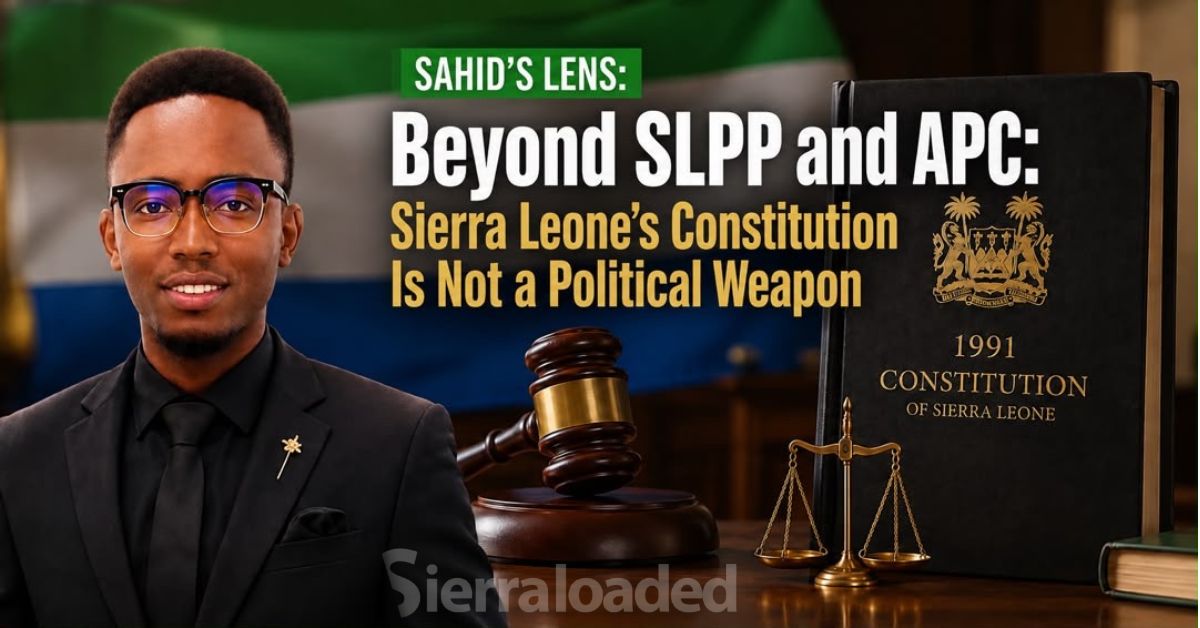
 Sahid Bangura
 Sierra Leone is once again at an important constitutional crossroads. Parliament’s recent consideration and purported passage of the Constitution of Sierra Leone (Amendment) Bill, 2025 has generated strong political and legal disagreement, particularly between the ruling Sierra Leone People’s Party (SLPP), the opposition All People’s Congress (APC), and legal practitioners challenging the procedure adopted by Parliament.
The debate should, however, be approached beyond party politics. The central question is not simply whether the proposed amendments are good or bad. It is whether they were considered and passed in accordance with the 1991 Constitution itself.
The 1991 Constitution is the supreme law of Sierra Leone. Section 171(15) makes clear that any law inconsistent with the Constitution is void to the extent of the inconsistency. This principle applies equally to Parliament, the Executive and every other institution of State.

That is where the present controversy becomes serious.



Reform Is Necessary, But the Constitution Must Be Respected
The SLPP Government has presented the proposed reforms as part of Sierra Leone’s continuing democratic development. Attorney-General and Minister of Justice Alpha Sesay has described the initiative as an attempt to move the country from a “constitution of survival” towards a “constitution of prosperity.”
There is merit in the argument that the 1991 Constitution should not be treated as untouchable.
The Constitution was adopted in a particular historical and political environment. Sierra Leone has since experienced significant changes in its democratic institutions, electoral system and social expectations. Some constitutional provisions may therefore require updating.
I also find merit in proposals aimed at increasing women’s participation in politics and expanding political participation for qualified Sierra Leoneans holding dual citizenship. Even the APC has expressed support for some of these provisions. (Sierra Leone Monitor)
However, the desirability of a constitutional amendment does not determine its legality.
A good amendment passed through an unconstitutional process remains constitutionally problematic.
The APC Is Right to Question the Process
The APC has rejected the purported passage of the Bill and raised concerns about several substantive provisions, including the proposed change to the presidential electoral threshold and the move away from the traditional constituency-based electoral arrangement.
The party has also supported retaining the existing 55 percent presidential threshold and the First-Past-the-Post system. (Sierraloaded)
On this issue, I believe the APC has a reasonable argument.
The 55 percent threshold requires a presidential candidate to secure a broad national mandate. Reducing it to 50 percent plus one may make elections administratively simpler, but constitutional design should not be driven primarily by convenience.
In a country where regional and political divisions remain sensitive, the constitutional framework should encourage presidential candidates to build broad national support.
That does not mean the 55 percent threshold can never be changed. It means such a change deserves particularly careful consideration because it directly affects how presidential legitimacy is established.
The APC’s position on First-Past-the-Post, however, is not automatically conclusive. Proportional representation can also promote broader political inclusion. The real question is which system best balances representation, accountability and national cohesion.
The electoral system should therefore be designed for Sierra Leone—not for whichever party happens to control Parliament.
The Legal Challenge Cannot Be Dismissed as Politics
The most serious issue concerns the procedure used by Parliament.
Law firm Nicol-Wilson & Co., Malaika Chambers, has argued that the constitutional amendment process was unlawful and that the purported passage of the Bill on 10 August 2026 did not satisfy the requirements of section 108 of the 1991 Constitution. The firm has specifically questioned the application of the constitutional voting threshold and argued that Parliament cannot rely on ordinary parliamentary procedure to bypass constitutional requirements. (The Sierra Leone Telegraph)
This argument deserves serious consideration.
Section 91(1) provides the general rule for parliamentary voting, but it expressly operates subject to other provisions of the Constitution.
Section 108 provides the special procedure for constitutional amendment. Among other requirements, it provides for a two-thirds parliamentary threshold for constitutional alteration.
That distinction matters.
A constitutional amendment is not an ordinary Bill. Parliament is exercising a special power when it seeks to change the supreme law. It must therefore comply with the special constitutional safeguards attached to that power.
If the Constitution requires a particular majority for constitutional amendment, Parliament cannot simply rely on a general voting provision to reduce that protection.
That would defeat the purpose of section 108.
But the Supreme Court Must Have the Final Word
Although I find the legal challenge compelling enough to warrant judicial determination, I would not declare the amendment null and void before the Supreme Court has ruled on the matter.
That responsibility belongs to the Court.
The Speaker’s interpretation may have a legal basis, just as Nicol-Wilson & Co.’s interpretation may have a legal basis. The important point is that the dispute involves competing interpretations of constitutional provisions and should therefore be settled by the institution constitutionally mandated to interpret the supreme law.
This is precisely why the Supreme Court matters.
If the Court concludes that Parliament complied with section 108, the decision should be accepted.
If the Court concludes that Parliament failed to meet the constitutional threshold, that decision should equally be respected.
Either outcome would strengthen constitutional democracy because the country would have an authoritative interpretation rather than competing political declarations.
The SLPP Must Not Confuse Political Majority With Constitutional Authority
The SLPP is the governing party and therefore has the parliamentary strength necessary to advance legislation.
But political majority is not the same as constitutional authority.
The Constitution places limits on what a parliamentary majority can do.
This is one of the fundamental purposes of constitutionalism: government must operate within rules that are higher than the government itself.
The SLPP may sincerely believe that the proposed amendments are in the national interest. It may also be correct that some of the reforms are overdue.
But if there is a credible constitutional question about the manner in which Parliament approved them, the Government should welcome judicial clarification rather than treat the challenge as merely an opposition strategy.
A government demonstrates its respect for constitutional democracy not only by exercising power, but also by accepting limits on that power.
The APC Must Also Put the Constitution Above Partisan Interest
The same principle applies to the APC.
Its opposition to the Bill should not be dismissed simply because it is the opposition. At the same time, the APC must ensure that its defence of constitutional safeguards is based on principle rather than political advantage.
The party cannot reasonably argue that constitutional rules should be respected only when they favour it.
The APC, like the SLPP, must accept that constitutional democracy requires adherence to rules even when the outcome is politically inconvenient.
The Constitution must therefore be defended consistently, regardless of who benefits from its application.
The Bigger Question Is the Future of Sierra Leone
The present dispute should force Sierra Leoneans to think beyond the immediate political contest.
Today, the SLPP may benefit from a particular constitutional provision.
Tomorrow, the APC may benefit from another.
The political parties will change, Presidents will change, Members of Parliament will change and electoral circumstances will change.
The Constitution will remain.
That is why constitutional amendments should never be designed principally around the interests of the government of the day or the opposition of the day.
The rules must be capable of serving governments that Sierra Leoneans have not yet elected.
My position is straightforward.
Sierra Leone needs constitutional reform, but constitutional reform must itself be constitutional.
I support reforms that strengthen political inclusion, women’s participation, democratic representation and effective governance. I also believe that some provisions of the 1991 Constitution can and should be modernised.
But I do not support any process that weakens the constitutional safeguards established for altering the supreme law.
Section 108 exists for a reason.
It makes constitutional amendment more difficult than ordinary legislation because the Constitution is more important than ordinary legislation.
If Parliament complied with section 108, the Supreme Court should say so clearly.
If Parliament did not comply with section 108, the Supreme Court should equally say so clearly.
The country needs certainty, not prolonged political argument.
Conclusion
The present constitutional dispute should therefore not be viewed simply as an SLPP-versus-APC confrontation.
It is a test of Sierra Leone’s commitment to constitutional government.
The SLPP is right that the Constitution can be reformed.
The APC is right that constitutional safeguards must be respected.
The lawyers challenging the process are right to insist that Parliament must follow the Constitution when changing it.
But none of these institutions or political parties should have the final word.
The Constitution should have the final word, and where its meaning is disputed, the Supreme Court should provide that word.
Sierra Leone does not need a Constitution that is impossible to change. It needs one that is difficult to manipulate and impossible to bypass unlawfully.
The ultimate principle should therefore be simple:
Reform the Constitution when the nation needs reform-but never reform the Constitution by disregarding the Constitution.