

Court Sentence Young Man to 80 Years Imprisonment for Selling Kush
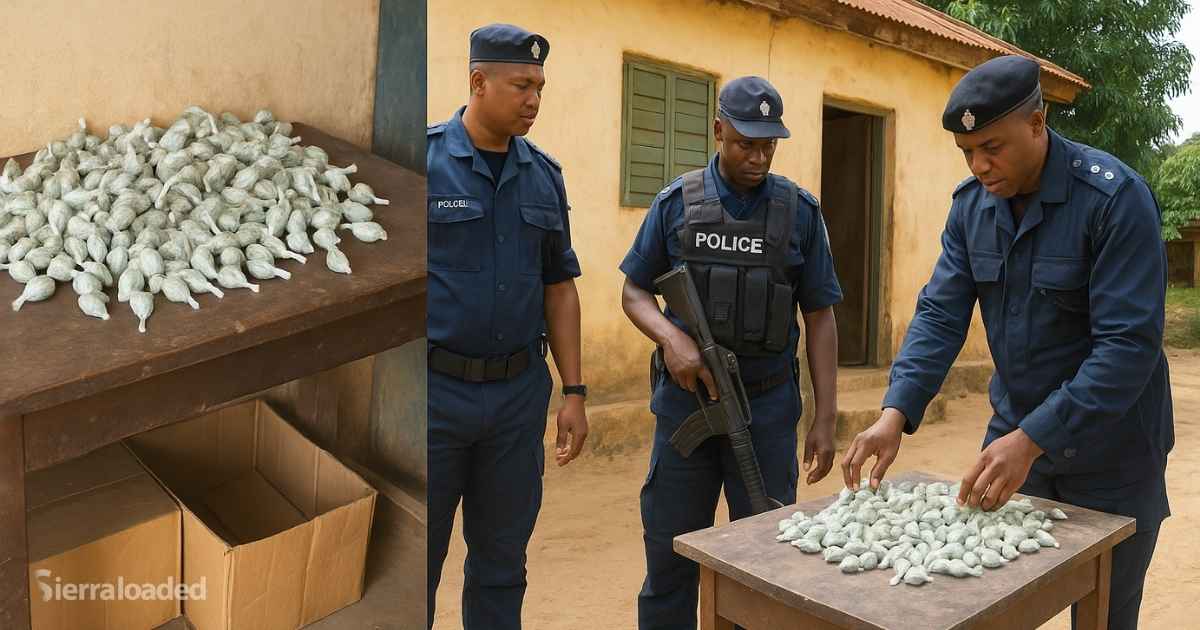
Hon. Justice Mark Ngegba of High Court No. 3 in Freetown has sentenced Abdul Rahman Conteh to a total of 80 years imprisonment after finding him guilty of unlawful possession, dealing in, and selling a prohibited drug, namely kush.
The sentence was handed down after the prosecution successfully proved its case beyond reasonable doubt.
The convict was arraigned on three counts. Count One charged him with unlawful possession of drugs contrary to Section 8(a) of the National Drugs Control Act, 2008 (Act No. 10 of 2008). Counts Two and Three charged him with dealing in and selling a prohibited drug contrary to Section 7(c) of the same Act.

According to the particulars of offence, on 29th October 2025, at Freetown in the Western Area of the Republic of Sierra Leone, the defendant was found in possession of 560 wraps of kush weighing 600.0 grams and was also found dealing in and selling the prohibited drug without lawful authority.
On 8th December 2025, the accused was arraigned before the court and pleaded not guilty to all three counts.
In delivering his judgment, Justice Ngegba stated that the standard of proof applicable in criminal cases is proof beyond reasonable doubt. He noted that it was the responsibility of the prosecution to discharge that burden by presenting sufficient evidence to establish each element of the offences charged.
The judge emphasized that any reasonable doubt arising from the prosecution’s case must be resolved in favour of the defendant. However, he held that the prosecution had successfully proved the charges against the accused.
To discharge its burden, the prosecution called three witnesses, all of whom testified on oath and were cross-examined by defence counsel.
Assistant Superintendent of Police Joseph Stevena, attached to the Transnational Organised Crime Unit (TOCU) as a Forensic Analyst, testified as Prosecution Witness One (PW1). He informed the court that his duties include analysing drugs and other chemical substances submitted for expert examination.
PW1 testified that on 30th October 2025, he received a laboratory request from Detective Inspector Steven Alpha Turay to analyse 560 wraps of dried leaves suspected to be kush. He conducted both chemical analysis and microscopic crystal examination on the substance after carrying out a presumptive test in the presence of the defendant.
The witness stated that the substance tested positive for synthetic cannabinoids. He tendered the Laboratory Request Form as Exhibit “A” and the Laboratory Report as Exhibits “B1-B2”.
Detective Police Sergeant Sahr Koyoma Sundu of TOCU testified as Prosecution Witness Two (PW2). He told the court that on 29th October 2025, while on duty, he received the transferred case and inquiry file relating to the unlawful possession of 560 wraps of suspected kush for further investigation.
PW2 tendered the defendant’s Voluntary Caution Statement as Exhibits “C1-C7”, the Charge Statement as Exhibits “D1-D3”, and the Arresting Officer’s Report as Exhibit “E”.
The third prosecution witness, Detective Police Constable 13682 John Umaru, attached to the Crime Writer’s Office at TOCU, testified that his responsibilities include registering case and inquiry files, taking custody of exhibits, and producing them in court when required.
He stated that on 19th November 2025, D/Sgt. Sundu handed over 560 wraps of suspected kush to him. He subsequently registered the exhibits in the Book of Court Exhibits under Serial No. 150/2025. Following laboratory examination, ten wraps were taken for analysis, while the remaining 550 wraps were tendered before the court as Exhibits “F1-F550”.
The prosecution also tendered the committal warrant from the bar, which was marked as Exhibits “K1-K3”.
At the close of the prosecution’s case, the defendant elected to make an unsworn statement.
In his defence, Abdul Rahman Conteh denied ownership of the exhibits tendered in court and maintained that he was not arrested with any drugs in his possession. He told the court that he had gone to watch a football training session at Calaba Town when police officers conducted a drug raid in the area.
According to him, the actual seller of the drugs fled the scene, and the police arrested several young men, including himself.
He claimed that others were later released because they were known in the community, while he remained in custody because he was a stranger. He further alleged that he was beaten and taken to TOCU without being given the opportunity to explain himself.
Justice Ngegba, however, analysed the defendant’s Voluntary Caution Statement tendered as Exhibits “C1-C7”. The court noted that on page two of the statement, the defendant admitted that he was engaged in selling narcotic drugs, specifically kush. He further narrated how he was arrested by plain-clothes officers while attempting to sell 560 wraps of kush for the sum of Eight Thousand New Leones (NLe 8,000).
The judge held that the defendant’s own admission clearly established that he was in possession of, dealing in, and selling a prohibited drug.
The court also relied on the testimony of PW1 and the Laboratory Report tendered as Exhibits “B1-B2”, which confirmed that the substance recovered from the defendant was kush.
Justice Ngegba referred to Section 57 of the National Drugs Control Act, 2008, which provides that where a sample taken from a substance is proven to possess particular properties, it shall be presumed that the entire substance possesses the same properties unless the contrary is proved.
The judge held that since the sample tested positive for a prohibited substance and no evidence was presented to challenge the findings, it was safe to conclude that all the wraps contained kush.
He further observed that the defendant’s statements to the police were sufficient to establish the offences of dealing in and selling prohibited drugs. The court also found that the defendant failed to discharge the burden imposed by Section 17 of the National Drugs Control Act, 2008, to show that he lawfully possessed the prohibited substance.
Justice Ngegba stated that the prosecution had proved all the essential ingredients of the offences charged and that the evidence before the court overwhelmingly established the defendant’s guilt.
Consequently, he convicted Abdul Rahman Conteh on all three counts and sentenced him to ten years imprisonment on Count One and thirty-five years imprisonment each on Counts Two and Three, bringing the total sentence to eighty years imprisonment.
The prosecution was led by A. Jalloh and E. Deen, while M.K. Dauda represented the convict.