Post a comment
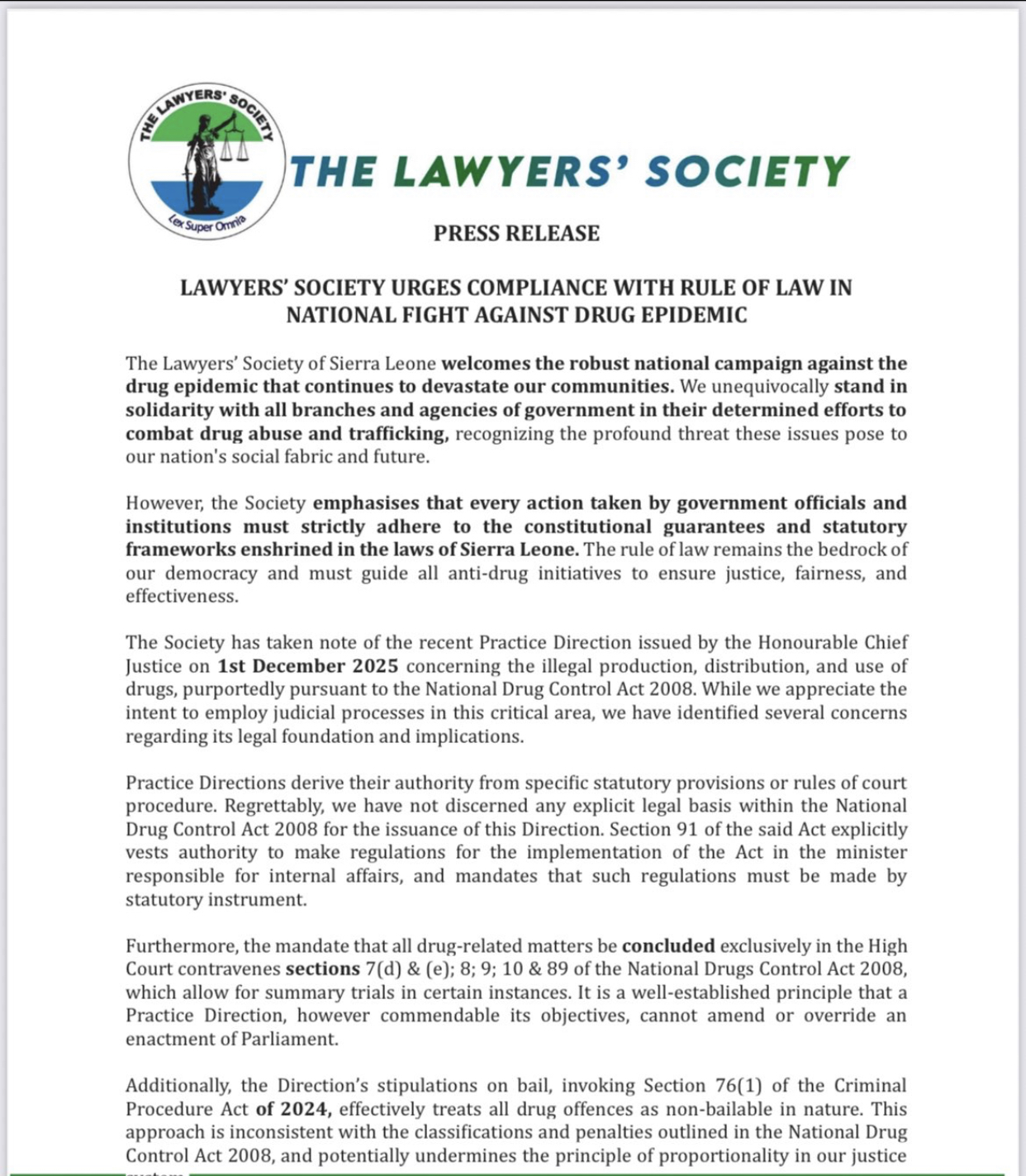
The Lawyers’ Society of Sierra Leone has urged state authorities to ensure that all measures taken in the ongoing national fight against drug abuse and trafficking strictly comply with constitutional and statutory requirements.
The call was issued in a press release dated 2 December 2025, in which the Society expressed support for the nationwide campaign against the drug epidemic while raising concerns over the legality of a new Practice Direction issued by the Chief Justice.
The Society said it “welcomes the robust national campaign against the drug epidemic that continues to devastate our communities” and declared that it “unequivocally stands in solidarity with all branches and agencies of government in their determined efforts to combat drug abuse and trafficking.”
The Society further stressed that government actions must remain grounded in the rule of law, which it described as the “bedrock of our democracy.”
The statement noted the Practice Direction issued by the Honourable Chief Justice on 1 December 2025 concerning the illegal production, distribution, and use of drugs. The Direction was reportedly issued pursuant to the National Drug Control Act 2008, but the Society questioned its legal foundation. According to the release, Practice Directions must draw authority from clear statutory provisions or court procedure rules.
The Society said it “has not discerned any explicit legal basis within the National Drug Control Act 2008 for the issuance of this Direction,” pointing out that Section 91 of the Act grants the Minister of Internal Affairs the power to make regulations by statutory instrument.
The Society also argued that the directive requiring all drug-related cases to be handled exclusively by the High Court conflicts with established law. It cited sections 7(d) and (e), 8, 9, 10, and 89 of the National Drug Control Act 2008, which permit summary trials in some instances. “A Practice Direction, however commendable its objectives, cannot amend or override an enactment of Parliament,” the release stated.
Further concerns were raised regarding bail conditions. The Society said the Direction’s reliance on Section 76(1) of the Criminal Procedure Act of 2024 effectively renders all drug offences non-bailable, a position it described as inconsistent with the classifications and penalties set out in the National Drug Control Act 2008. It warned that such an approach could undermine proportionality within the justice system.
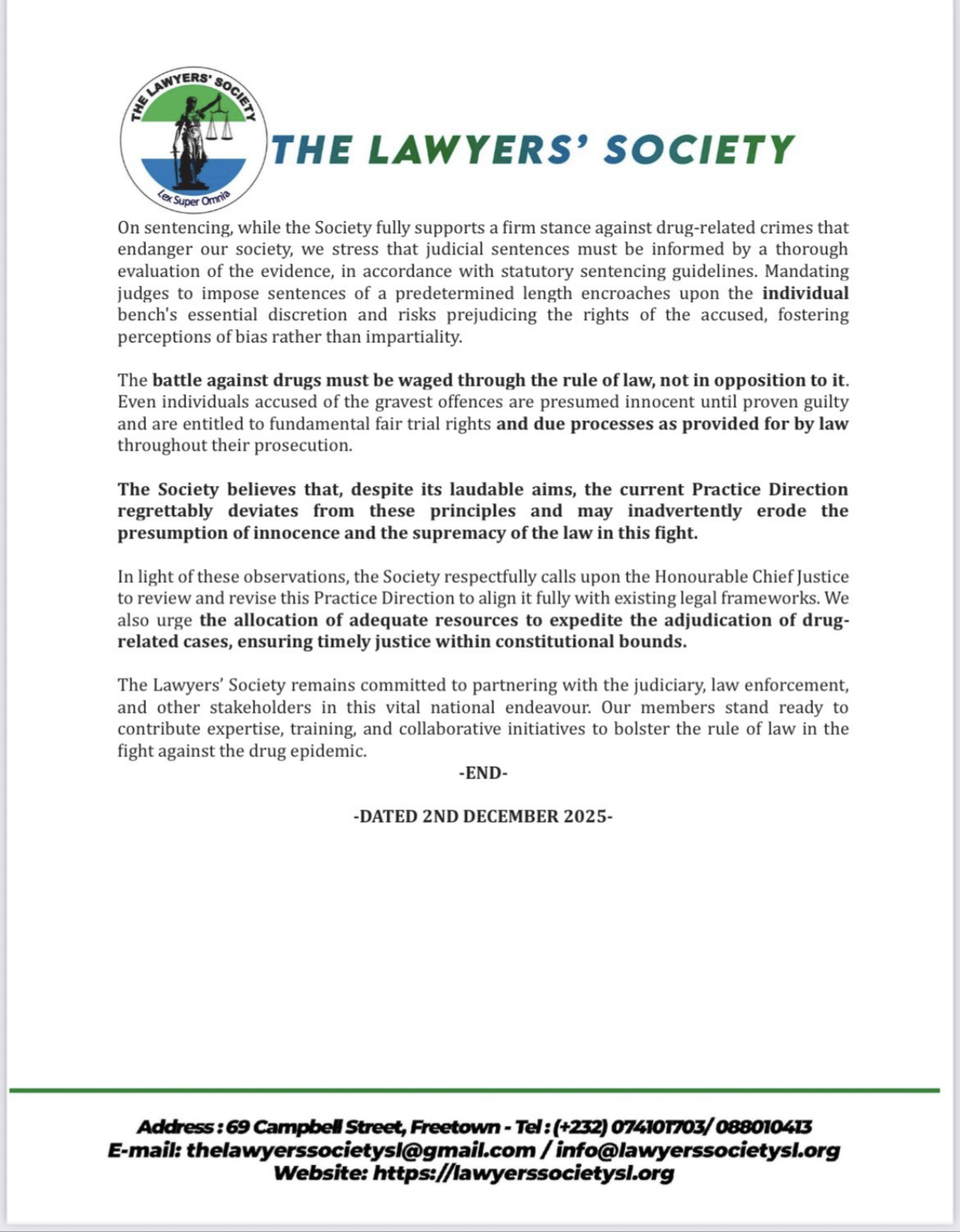
On sentencing, the Society reaffirmed its support for strong action against drug-related crimes but cautioned against predetermined sentencing requirements. It said judicial officers must have the discretion to evaluate evidence and apply statutory sentencing guidelines.
“Mandating judges to impose sentences of a predetermined length encroaches upon the individual bench’s essential discretion and risks prejudicing the rights of the accused,” the statement said.
The Society underscored that even those accused of serious offences remain presumed innocent until proven guilty and must enjoy full fair-trial guarantees. It warned that elements of the Practice Direction “may inadvertently erode the presumption of innocence and the supremacy of the law.”
In its concluding call, the Lawyers’ Society urged the Chief Justice to review and amend the Practice Direction to ensure alignment with existing legal frameworks. It also called for increased resources to help the judiciary expedite drug-related cases in accordance with constitutional standards.
The Society reaffirmed its commitment to working with the judiciary, law enforcement, and other stakeholders, with members ready to provide legal expertise, training, and support to strengthen the rule of law in the national anti-drug effort.