
APC Takes 2 Constitutional Cases to Supreme Court Over Disputed Bill
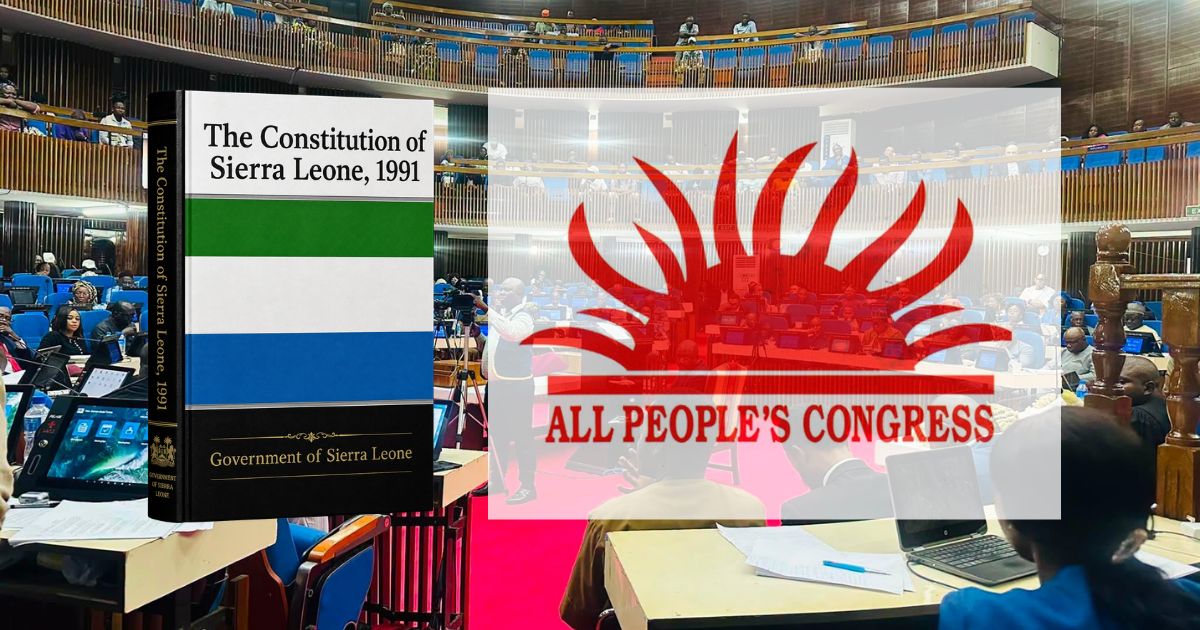
The All People’s Congress (APC) has filed two separate legal actions before Sierra Leone’s Supreme Court challenging the disputed passage of the Constitution of Sierra Leone (Amendment) Bill, 2025.
The two cases seek different forms of judicial intervention: one asks the Supreme Court to interpret key constitutional provisions governing amendments, while the other directly challenges the constitutionality of actions taken by the Speaker of Parliament during the August 2026 proceedings.
APC legal representative Ady Macaulay confirmed the filings during a Liberty TV interview on September 1. He explained that although both cases arise from the same parliamentary controversy, they involve different parties, raise distinct legal questions and seek different forms of relief.

The APC, Minority Leader Hon. Abdul Kargbo, and Deputy Minority Leader Hon. Daniel Koroma filed one of the actions jointly.
The defendants named in the case include the Speaker of Parliament, Hon. Segepoh Thomas, the Attorney-General and Minister of Justice, and the Clerk of Parliament.
The case focuses on the interpretation and application of several provisions of the 1991 Constitution, particularly Sections 108, 91 and 51. The applicants are asking the Supreme Court to guide how these provisions should be applied during the constitutional amendment process.
The second case was brought by Hon. Osman Abdal Timbo in his personal capacity as a Member of Parliament. He is represented by former Attorney-General and Minister of Justice Hon. Joseph Fitzgerald Kamara.
That application challenges specific actions and interpretations adopted by the Speaker during Parliament’s consideration of the Amendment Bill, questioning whether those actions were consistent with the requirements of the 1991 Constitution.
The legal challenge follows the parliamentary sitting of August 10, 2026, when opposition MPs walked out before the vote on the Amendment Bill.
The Speaker subsequently declared the Bill passed, based on an interpretation that the required support was a majority of members present and voting rather than the two-thirds of Parliament’s total membership required under Section 108(2)(b).
Parliament has 149 members. If the two-thirds requirement under Section 108(2)(b) applies to the full membership, the threshold would be 100 affirmative votes.
The APC and other critics, including independent legal practitioners, have disputed the interpretation used by the Speaker and argue that the special procedure for constitutional amendments requires the higher threshold.
The Speaker has since referred the constitutional question concerning the voting threshold to the Supreme Court for determination.
The parliamentary process has also attracted scrutiny from legal practitioners.
Lawyer Melron Nicol-Wilson has argued that the process was invalid and that the purported passage of the Bill therefore has no legal effect.
The Lawyers’ Society has similarly raised concerns about the interpretation of Section 108(2)(b), maintaining that the provision requires a constitutional amendment to receive the support of at least two-thirds of the total membership of Parliament.
The competing interpretations have placed the constitutional amendment process at the centre of an increasingly significant legal and political dispute.
The Constitution (Amendment) Bill, 2025 contains several proposed changes to Sierra Leone’s constitutional and electoral framework.
Among the most closely watched proposals is a change to the presidential election threshold. The Bill seeks to reduce the requirement for winning a presidential election in the first round from 55 percent of valid votes to 50 percent plus one.
The proposed legislation also seeks to make proportional representation the permanent electoral system for ordinary Members of Parliament.
Another proposal would introduce a constitutional minimum quota of 30 percent for women in political nominations, while provisions on dual citizenship would expand eligibility for dual citizens to contest parliamentary seats and hold public office.
These proposals have generated significant political and public debate, particularly because of their potential implications for future elections and political representation.
The two legal actions now place questions surrounding the parliamentary procedure, voting threshold and interpretation of the Constitution before Sierra Leone’s highest court.
While the cases arise from the same disputed parliamentary process, the separate filings mean the Supreme Court will be asked to consider distinct legal questions brought by different applicants.
A hearing date is expected to be set in the coming weeks, when the court will have the opportunity to consider the competing interpretations of the constitutional provisions governing the amendment process.