Post a comment
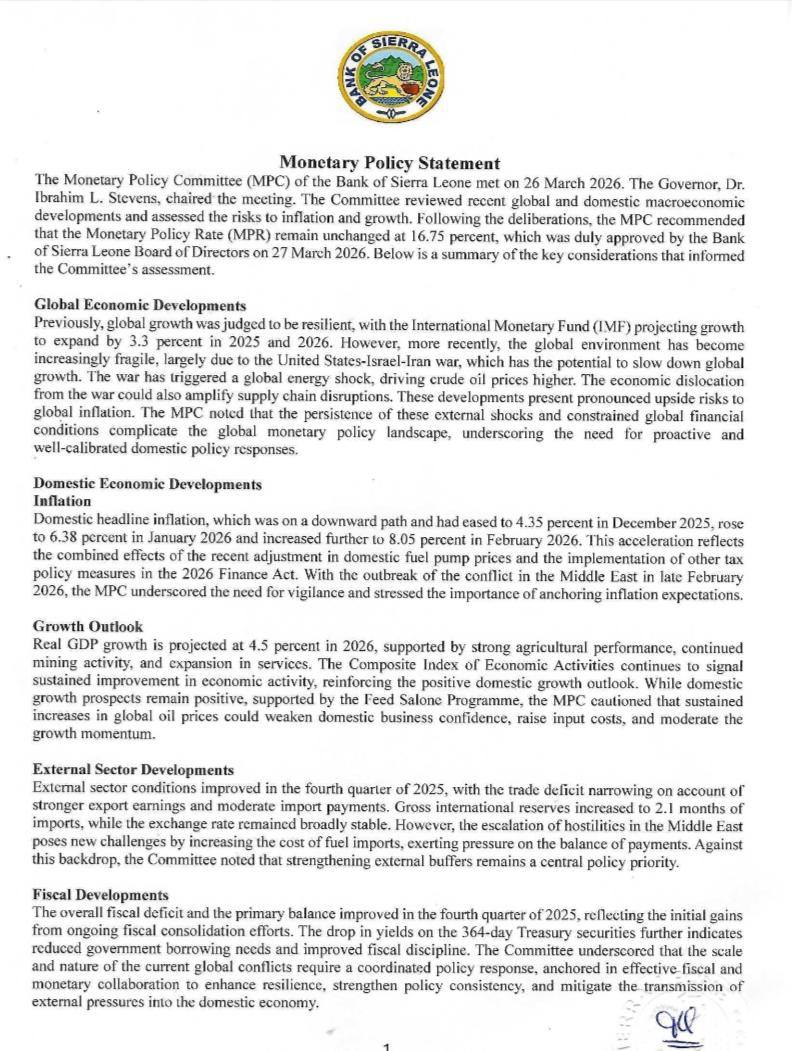
The Bank of Sierra Leone has kept its Monetary Policy Rate (MPR) unchanged at 16.75 percent, citing rising inflation and growing external risks from the ongoing United States-Israel-Iran war, while noting continued resilience in the domestic economy.
The decision, recommended by the Monetary Policy Committee (MPC) on March 26, 2026, and approved by the Bank’s Board of Directors on March 27, took effect on March 31, 2026. The MPC was chaired by Governor Dr. Ibrahim L. Stevens.
The Committee noted that the global environment has become increasingly fragile, largely due to the conflict in the Middle East, which has triggered a global energy shock and driven crude oil prices higher. The war also threatens to amplify supply chain disruptions, presenting pronounced upside risks to global inflation.
Previously, the International Monetary Fund had projected global growth of 3.3 percent for both 2025 and 2026. However, the MPC cautioned that the current hostilities could slow global growth and complicate monetary policy landscapes worldwide, underscoring the need for proactive domestic responses.
Domestic headline inflation, which had eased to 4.35 percent in December 2025, rose to 6.38 percent in January 2026 and further accelerated to 8.05 percent in February 2026.
The Bank attributed this uptick to the combined effects of a recent adjustment in domestic fuel pump prices and new tax policy measures introduced under the 2026 Finance Act. With the outbreak of the Middle East conflict in late February 2026, the MPC stressed the need for vigilance in anchoring inflation expectations.
Despite external headwinds, real GDP growth is projected at 4.5 percent in 2026, supported by strong agricultural performance under the Feed Salone Programme, continued mining activity, and expansion in services.
The Composite Index of Economic Activities continues to signal sustained improvement. However, the MPC cautioned that sustained increases in global oil prices could weaken business confidence, raise input costs, and moderate growth momentum.
External sector conditions improved in the fourth quarter of 2025, with the trade deficit narrowing on account of stronger export earnings and moderate import payments. Gross international reserves increased to 2.1 months of imports, while the exchange rate remained broadly stable.
However, the escalation of hostilities in the Middle East poses new challenges by increasing the cost of fuel imports and exerting pressure on the balance of payments. The Committee noted that strengthening external buffers remains a central policy priority.
Fiscally, the overall deficit and primary balance improved in the fourth quarter of 2025, reflecting gains from ongoing consolidation efforts. Reduced yields on Treasury securities indicate lower government borrowing needs and improved fiscal discipline.
Reserve money grew by 12.77 percent, remaining within the IMF-ECF programme target of 14.55 percent. Credit to the private sector grew by 48.99 percent, driven largely by business services, commerce and finance, and construction.
The MPC noted that credit remains concentrated in a few sectors, limiting its broader macroeconomic impact, and emphasised the need to diversify credit allocation to underserved sectors.
The banking system remains stable, supported by strong capital positions and improved asset quality. Non-performing loans have declined to levels below the regulatory threshold of 10 percent.
However, the persistent appetite of banks for holding government securities continues to constrain private sector credit growth. The MPC warned that geopolitical and fuel price-driven shocks could potentially increase domestic liquidity and credit risks.
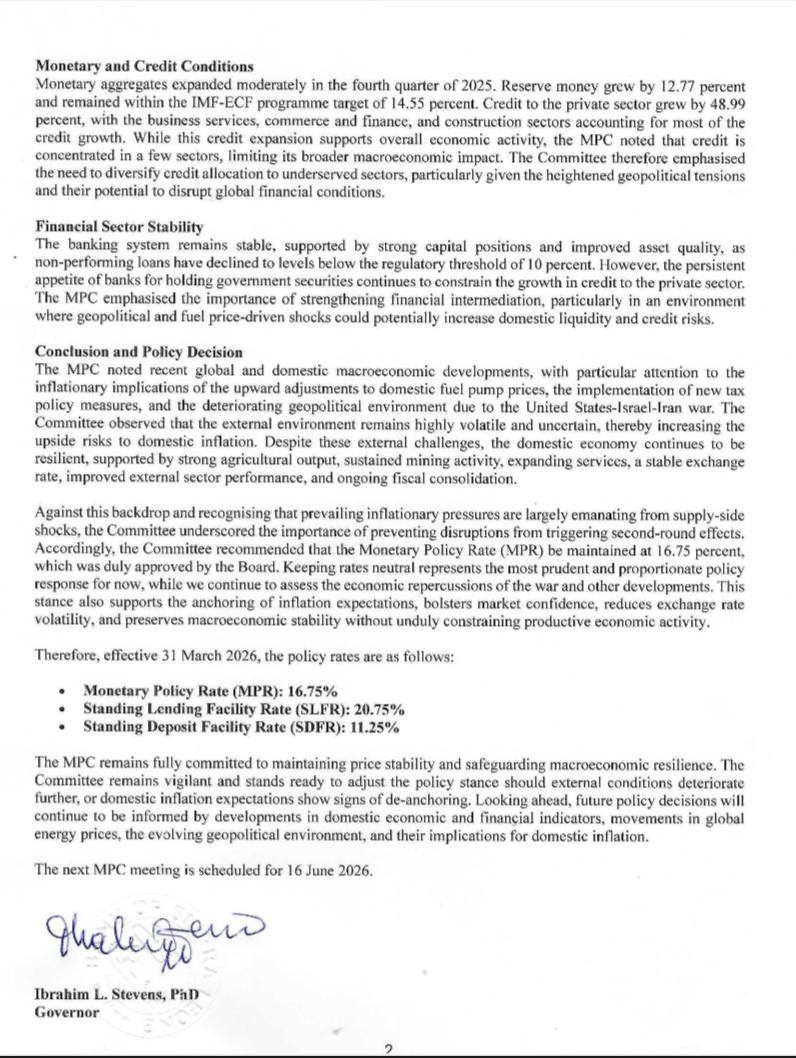
Effective March 31, 2026, the policy rates are as follows:
Monetary Policy Rate (MPR): 16.75 percent
Standing Lending Facility Rate (SLFR): 20.75 percent
Standing Deposit Facility Rate (SDFR): 11.25 percent
The MPC described the decision to keep rates neutral as the most prudent and proportionate response for now, allowing the Bank to continue assessing the economic repercussions of the war while anchoring inflation expectations and reducing exchange rate volatility.
The Committee added that it stands ready to adjust the policy stance should external conditions deteriorate further or domestic inflation expectations show signs of de-anchoring.
The next MPC meeting is scheduled for June 16, 2026.