Post a comment
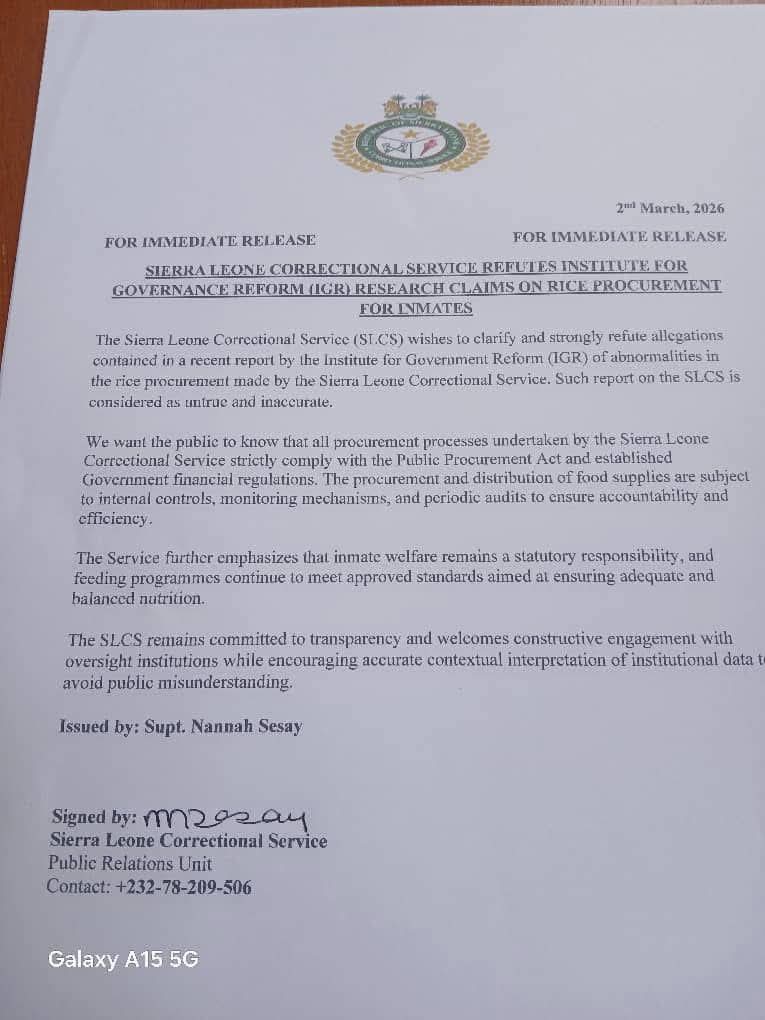
The Sierra Leone Correctional Service (SLCS) has strongly refuted allegations of financial impropriety in its rice procurement contracts, pushing back against a recent report by the Institute for Governance Reform (IGR) that suggested millions of Leones may have been misspent on feeding inmates.
In a statement issued to the press, the SLCS described the IGR’s findings as “untrue and inaccurate,” insisting that all its procurement processes strictly comply with the Public Procurement Act and established government financial regulations.
The controversy began with the release of IGR’s February 2026 edition of Critical Perspectives of Governance, titled “Di Hade Pa Di Case II – Prison Rice and the Case for a New Politics.” The report analyzed 552 procurement contracts awarded by the SLCS between 2016 and 2023, revealing that a total of NLe211.3 million was spent on rice for inmates over the eight-year period.
IGR’s analysis raised red flags by comparing the procured quantities to realistic dietary needs. The report found that procurement records indicated an average allocation of 10.2 cups of rice per prisoner per day—peaking at 15 cups in 2017—far exceeding the two to three cups per day that nutritional benchmarks suggest for a typical adult. Based on this discrepancy, IGR calculated that between NLe144 million and NLe189 million of the total expenditure could not be justified, questioning whether taxpayers’ money was spent efficiently.
Beyond the financial analysis, the IGR report also pointed to political influence in the awarding of contracts, noting that over 60 percent of prison contractors were replaced following the 2018 change in government, a pattern it linked to entrenched patronage networks.
In its official response, the SLCS pushed back against these conclusions. The Service emphasized that all procurement and distribution of food supplies are subject to internal controls, monitoring mechanisms, and periodic audits to ensure accountability and efficiency.
“The Service further emphasizes that inmate welfare remains a statutory responsibility, and feeding programmes continue to meet approved standards aimed at ensuring adequate and balanced nutrition,” read the statement issued by Superintendent Nannah Sesay of the SLCS Public Relations Unit.
The Correctional Service stated its commitment to transparency and said it welcomes constructive engagement with oversight institutions. However, it urged for “accurate contextual interpretation of institutional data to avoid public misunderstanding.”
The IGR report had previously warned that the issue was not solely fiscal, but also raised potential human rights concerns if the high levels of reported expenditure did not translate into adequate food for inmates, citing reports that in some facilities, a single basin of rice is served for both lunch and dinner.
The IGR has recommended a comprehensive review of food procurement practices in all public institutions and an accelerated digitalisation of procurement systems to strengthen oversight.