

 Post a comment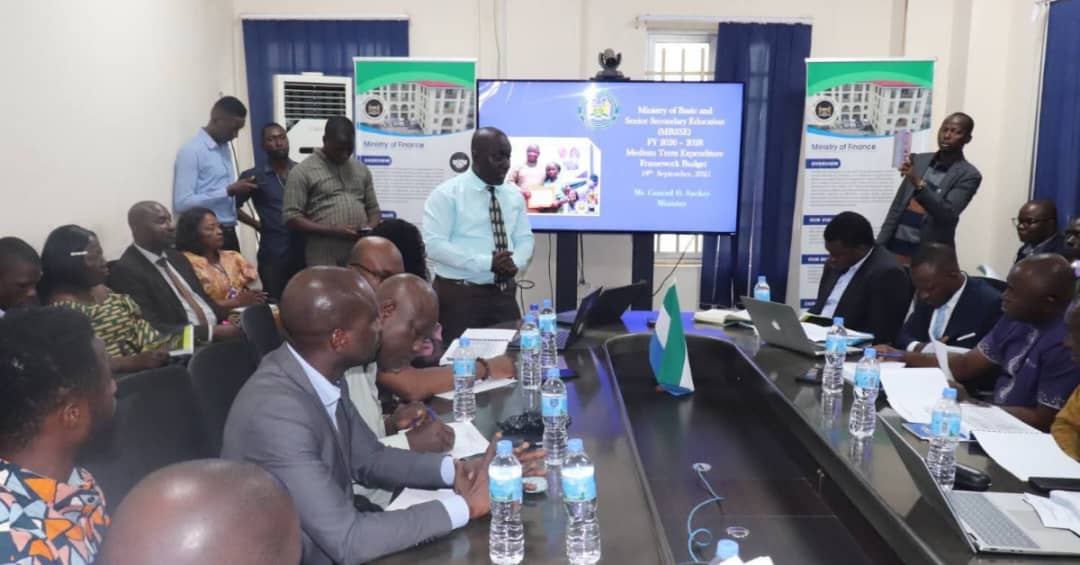
The Ministry of Finance officially launched the FY 2026 Bilateral Budget discussions with Ministries, Departments, and Agencies (MDAs) in Freetown on Thursday, September 18, 2025, marking a crucial step toward shaping the country’s fiscal policy for the coming year.
The FY 2026 Bilateral Budget Discussions will enable stakeholders to discuss and agree on policies that will guide the theme and policy direction of the just concluded National Policy hearing on enhancing traditional and innovative sources of domestic revenue mobilization to finance the Big Five Game Changer.
Financial Secretary, Matthew Dingie, admonished MDAs to be innovative in their 2026 budget by exploring alternative sources of domestic revenue generation to finance the Big Five Agenda.
The bilateral discussions started with the Ministries of Agriculture under Feed Salone and the Ministry of Basic and Senior Secondary Education under Human Capital Development. The Ministry of Agriculture and Food presented a budget estimate of Nle115,548,100 for the fiscal year 2026.
Presenting the budget, the Chief Agriculturist Professor Abdulai Jalloh noted that the mandate of the Ministry is to be the engine for socio-economic growth and development in achieving food security, employment opportunities, and poverty reduction.
He added that the Feed Salone Program, anchored on six strategic pillars, aims to increase productivity, enhance value addition, and empower farmers to develop rice production hubs in areas such as Ketchum, Mambolo, the Tomabom rice project, etc.
The Chief Agriculturist Officer also noted that they planted 23,437.903 hectares of rice across the country, 4,500 hectares of irrigation infrastructure were developed, 200 rice mills, 142 rice threshers, and 144 combine harvesters were distributed nationwide.
He stated that so far, they have achieved 24,295 hatches of boliland and riverine cultivated across the 15 districts, 20 tractors produced by three private sector businesses, 174 youths trained as tractor operators, drone and GIS Operators, and farm machine mechanics, and many more.
Furthermore, In another development, the Ministry of Basic and Senior Secondary Education requested NLE 1,422,435.70 for the FY2026-2028 Medium-Term expenditure framework.
The Deputy Director of Education, John Ansumana, clarified that the mandate of the Ministry of Basic and Secondary Education (MBSSE) is to plan, oversee, and implement educational policies and regulations across all levels—from pre-primary to senior secondary education.
He also highlighted that the Ministry collaborates with statutory bodies such as the West African Examination Council (WAEC) to ensure effective policy implementation.
Mr. Ansumana reported that in 2024 and 2025, the Ministry recruited a total of 2,198 teachers through a new deployment protocol aimed at promoting equity in teacher distribution nationwide.
He noted that schools equipped with Science Laboratories have increased, and the phased removal of the double-shift system has resulted in a higher number of students benefiting from improved educational conditions.
He further shared that 42 schools have been connected to the internet through the GIGA Project, and 2,000 out-of-school girls were integrated into formal schools across four districts.
Additionally, fifteen districts benefited from the school feeding program, and 59 Early Childhood Centres were constructed to support early education.
Mr. Ansumana also mentioned that teacher licensure examinations were conducted for over 17,878 teachers across all 16 districts, with a pass rate of 46%. Furthermore, 201 schools have been connected to solar mini-grid power, among other notable achievements.
Looking ahead to the 2026 fiscal year, he outlined several planned initiatives: providing teaching and learning materials to 10,827 public and community schools; expanding the school feeding program to benefit one million students in government and government-assisted schools; continuing mini-grid power electrification and internet connectivity projects to enhance digital literacy for 500 schools; and supplying furniture to additional classrooms to eliminate double-shift schooling in 100 schools.
Finally, the bilateral discussions will continue until September 27, 2025, involving Civil Society, District Oversight Committee Members, non-state actors, and the media, to scrutinize the budgets of various MDAs.


