Post a comment
The National Public Procurement Authority (NPPA) has reiterated its statutory mandate in regulating the selection, appointment, and career management of procurement officers across Ministries, Departments, and Agencies (MDAs) in Sierra Leone, in line with the Public Procurement Act, 2016.
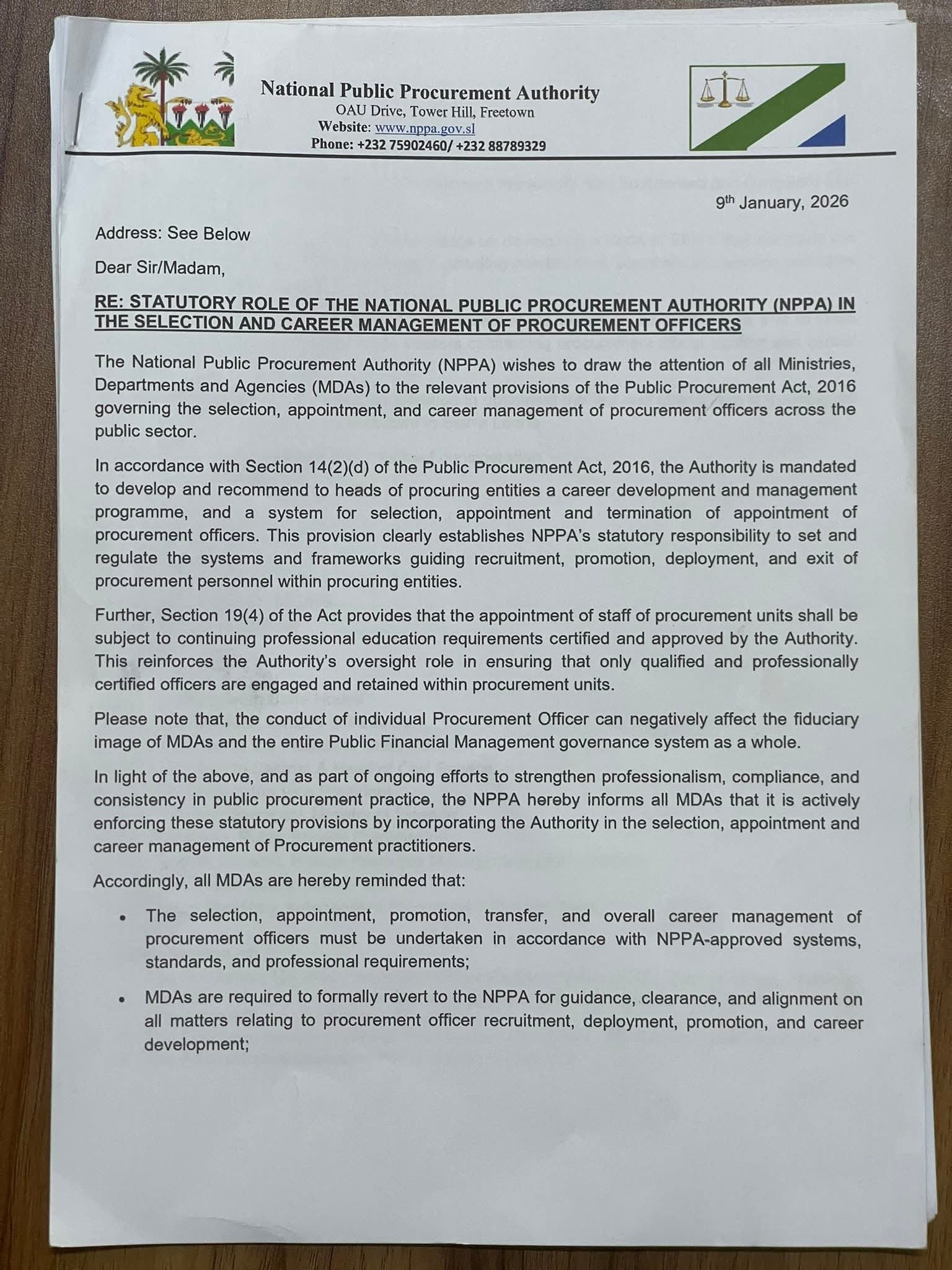
In a formal communication issued on January 9, 2026, the Authority reminded MDAs that the law clearly assigns the NPPA responsibility for developing, regulating, and overseeing systems governing the recruitment and professional progression of procurement officers within the public sector.
This mandate extends to setting standards for appointment, promotion, transfer, deployment, and exit from service.
The NPPA stressed that procurement staffing is a core element of public financial management and not a routine administrative matter. Citing Section 14(2)(d) of the Act, the Authority noted its responsibility to develop and recommend structured career development and management programmes for procurement officers. It is also mandated to establish systems guiding their selection, appointment, and termination.
Furthermore, Section 19(4) requires procurement officers to meet continuing professional education standards certified and approved by the NPPA, ensuring professional competence within procurement units.
According to the Authority, the conduct and performance of procurement officers have broader implications for public governance.
Unprofessional or unethical practices, it noted, can erode public trust, harm the fiduciary standing of MDAs, and weaken the overall public financial management framework. As such, professionalism, competence, and ethical conduct remain fundamental to effective procurement practice.
To promote uniformity and compliance across government institutions, the NPPA emphasized that all decisions related to recruitment, deployment, promotion, transfer, and general career management of procurement officers must conform to NPPA-approved systems and standards. MDAs were advised to formally engage the Authority for guidance and clearance on procurement staffing matters, warning that actions taken outside this framework may be considered non-compliant with the Public Procurement Act, 2016.
The Authority also disclosed that it is at an advanced stage of developing a comprehensive Code of Ethics to guide procurement practitioners, suppliers, and service providers.
The initiative forms part of broader reforms aimed at strengthening integrity, accountability, and professionalism within the public procurement system.
The NPPA concluded by calling on all MDAs to take immediate steps to ensure full compliance with the law and to maintain close collaboration with the Authority on both current and future procurement staffing matters. It reaffirmed its commitment to working with stakeholders to enhance transparency, professionalism, and public confidence in Sierra Leone’s public procurement processes.