

 1 Comment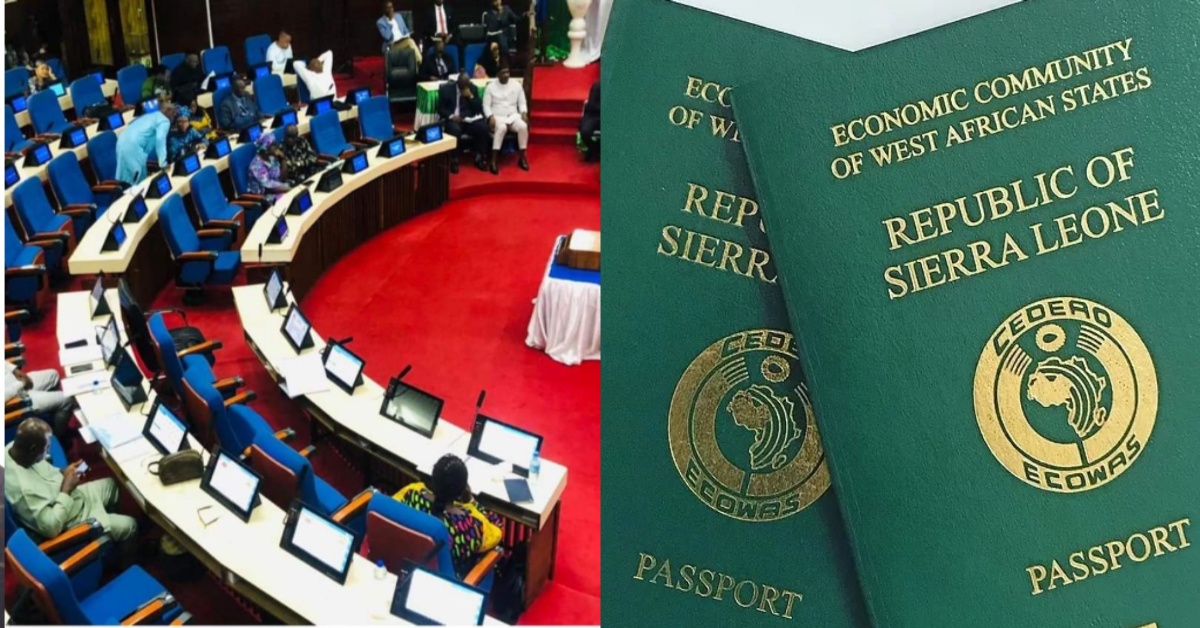
The production and sale of Sierra Leone’s passports have come under renewed scrutiny following fresh findings that raise serious constitutional and financial questions surrounding the renewal of the Netpage contract.
In its latest report, “Politics and Revenue Failures in Sierra Leone,” the Institute for Governance Reform (IGR) asserts that the Netpage contract was extended without any assessment of value for money. More critically, the Public Accounts Committee (PAC) had earlier determined that the contract was renewed without Cabinet approval or parliamentary ratification, casting doubt on its constitutional validity.
According to IGR estimates, between 65,000 and 70,000 passports are printed annually, generating sales of between $7 million and $9 million each year. Since 2016, passport sales are believed to have generated at least $70 million. However, the report suggests that the Government of Sierra Leone has realised little or no revenue in royalties from those sales.
In August 2021, the Financial Secretary at the Ministry of Finance directed that government should begin receiving royalties from Netpage, an effort aimed at correcting what many observers described as a fundamental flaw in the original agreement ratified by the Parliament of Sierra Leone.
However, the PAC later concluded that royalties imposed on Netpage were unlawful, as they were not part of the original contract approved by Parliament.
In April 2023, Netpage formally requested a refund of Le 5.2 billion (approximately US$250,000) in royalty payments for the 2022 financial year. The company stated that it intended to redirect the funds to settle tax liabilities with the National Revenue Authority (NRA).
In its communication to authorities, Netpage emphasized that royalty payments were not included in the original contract approved by Parliament and signaled its unwillingness to continue payments under what it described as a “gentleman’s understanding.”
Subsequently, the PAC noted that the Ministry of Internal Affairs approved the refund. The timing of the request has drawn attention, as it coincided with the expiration of Netpage’s contract in 2023, the same year the company sought reimbursement of the 2022 royalties.
The more pressing constitutional issue concerns the renewal of the contract itself. Despite prior concerns and the expiry of the original agreement, the Ministry reportedly proceeded to extend Netpage’s contract for an additional five-year term without recourse to Cabinet or Parliament.
According to IGR, this development fits into a broader structural concern about the capture of public institutions by business elites. The report suggests that procurement rules may sometimes be disregarded in favour of influential commercial actors. Testimonies cited by the think tank allege that certain civil service appointments and transfers may have been influenced by business interests seeking procurement advantages.
If the renewed passport production contract has indeed not been presented to or ratified by Parliament, its constitutional standing may be in question. Agreements requiring parliamentary approval derive their legal force from such approval; without it, their enforceability could be challenged.
The passport is one of the state’s most sensitive sovereign documents, representing both national identity and international credibility. As such, any uncertainty surrounding the legality of its production arrangement transcends routine administrative concerns. It directly touches on constitutional compliance, public revenue protection, and national accountability.
Sierra Leoneans are therefore entitled to clarity on whether due process was followed in renewing the Netpage contract, whether the arrangement complies with constitutional requirements, and whether the public interest has been adequately safeguarded.
Until those questions are conclusively addressed, the passport contract will remain at the centre of a debate that reaches far beyond revenue — into the core of governance, legality, and institutional integrity.


The big question to all & sundry in this plundered country is, when will this country have a truly patriotic, accountable & genuine representative of the people in governance. The scenario pictured from this report suggests that 100% of those in governance are conniving to fleece the country through foreign & business interests; to break the rules & regulations to get what advantage they can at the detriment of the economically emaciated people. For very long now, the interest of the people is cast aside in favor of that of influential & multinational entities. Bad contracts & agreements are signed that does not benefit the all term interests of the country, yet we the people are at each other’s throats each time to elect these same crop of national betrayers & squanderers of our destinies into public offices. If we continue to prioritize this noxious party allegiance syndrome in exchange & sacrifice for good governance: accountability, transparency & the rule of law, then progress for this nation’s governance & economic welfare remains a distant cry.