

 Post a comment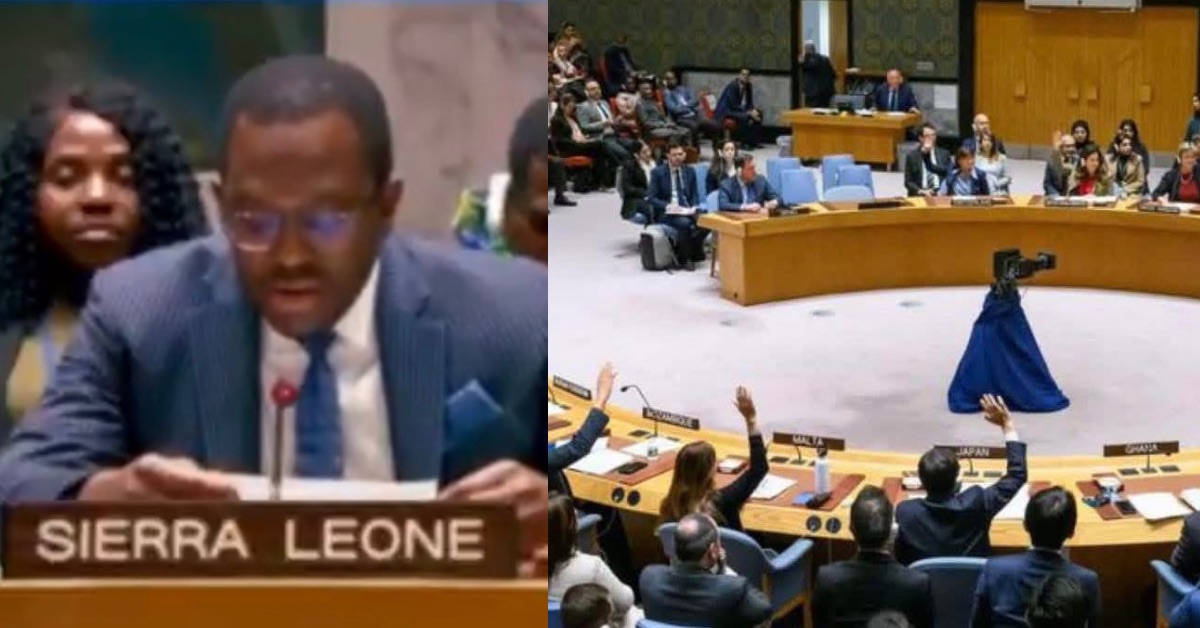
The United Nations Security Council has adopted what observers are describing as a landmark resolution formally endorsing Morocco’s autonomy plan for Western Sahara under Moroccan sovereignty, representing a decisive shift in the decades-long dispute.
Sierra Leone was among the eleven countries that voted in favour of the resolution, joining the United States, France, the United Kingdom, South Korea, Denmark, Slovenia, Greece, Guyana, Somalia, and Panama. Three countries, including Russia, China, and Pakistan abstained, while Algeria, a key party opposed to Morocco’s position, chose not to participate in the vote. Notably, no member voted against the resolution.
The United States, which drafted the text, maintained the core substance of the original proposal despite diplomatic pushback, including strong lobbying from Algeria. The resolution explicitly endorses Morocco’s 2007 Autonomy Proposal as “a basis for a just, lasting, and mutually acceptable solution” to the Western Sahara dispute.
Crucially, the resolution states that “genuine autonomy under Moroccan sovereignty could constitute the most viable solution,” effectively positioning Morocco’s autonomy plan as the only credible framework for future negotiations. The longstanding call for a referendum on self-determination, long championed by the Polisario Front and its backers, is notably absent from the final text, a sign many analysts interpret as its definitive sidelining.
By urging the UN Secretary-General, Antonio Guterres and his Personal Envoy to “facilitate and conduct negotiations based on Morocco’s Autonomy Proposal,” the resolution gives the Moroccan plan formal international legitimacy and establishes it as the UN’s guiding framework for resolving the conflict.
For Sierra Leone, which has maintained close diplomatic and economic ties with Morocco in recent years, the vote signals Freetown’s alignment with Rabat’s territorial integrity and its growing influence within the UN system. The West African nation’s support is also seen as a reflection of broader African backing for Morocco’s position, particularly among countries that view the autonomy plan as a pragmatic path toward stability in the region.
The Western Sahara conflict, which has persisted since the 1970s, centres on sovereignty claims over the territory following Spain’s withdrawal. Morocco asserts full sovereignty, while the Algeria-backed Polisario Front continues to call for an independent Sahrawi state.
With this latest resolution, the UN Security Council appears to have tilted decisively toward Morocco’s vision, marking what diplomats describe as a “paradigm shift” in international policy on the Western Sahara question.


