

 Post a comment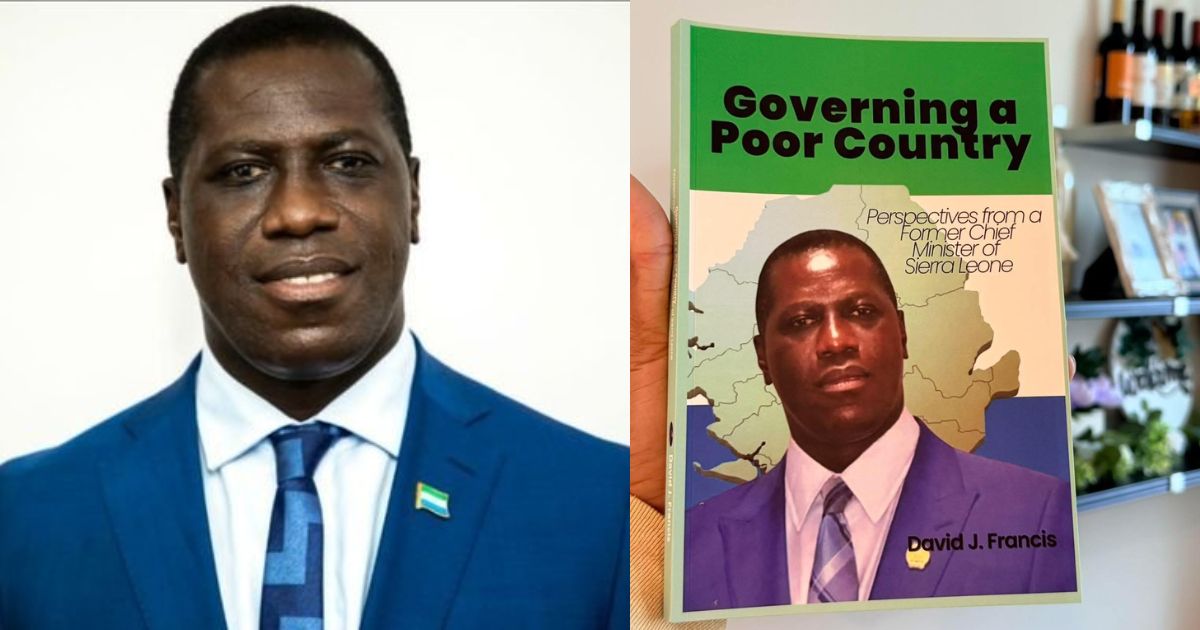
A book by the first Chief Minister in the post-colonial era on governing Sierra Leone should be essential reading for governance experts. In expatiating his views and experience in the Office of Chief Minister, Professor David Francis’, in his book GOVERNING A POOR COUNTRY: PERSPECTIVES FROM A FORMER CHIEF MINISTER OF SIERRA LEONE does not disappoint. However, when a man, who during his tenure of office attracts so much controversy, one could be excused for “pondering” beyond the strictures imposed by the book.
Let me go straight to the heart of the matter. What exactly is the mandate of the Chief Minister as conceived by those who launched a rebirth of the office, and what was Francis’s contribution to the governance landscape. We learn that one intention was to free President Bio from the shackles of “close allies” who had become his handlers and gatekeepers. The Chief Minister’s role was mainly to provide a professional and technocratic approach to governance. He was the coordinating node around which the rest of the governance structures revolved, especially the Ministries. We also learn that the Chief Minister is fourth in rank in terms of constitutional order of ministerial precedence and third in terms of Executive order. Francis tells us the Chief Minister is not a politician but an enforcer. He refers to the Chief Minister as an office messenger for the President and Vice President. The Professor carried out supervision and monitoring of 28 ministries, 14 legislative agencies in the Office of the President and had oversight of specialized agencies like the DSTI. He was also a Principal Adviser to the President.
Francis goes on to outline his successes as Chief Minister. He effectively coordinated the work of various Ministries, re-introduced Performance Management Contracts for Ministers, made inter-ministerial committees operational, was instrumental in President Bio’s first set of Executive orders and organised Cabinet retreats. He also set up institutions like the National Disaster Management Agency (NDMA) and the Independent Commission of Peace and National Cohesion (ICPNC).
The Professor is very candid about his failures. He did not succeed in getting the APC to attend the Bintumani 111 conference and the APC also walked out of the discussions related to the ICPNC bill in parliament. He also failed to get Cabinet approval to set up the first-ever National Reforestation and Timber Governance Agency as well as to deliver on the menace and health hazards of plastic pollution. Another major regret of his was the failure to provide leadership to implement key governance reform recommendations in the Governance Transition Team (GTT) report.
So, who does he blame for his failures? The APC obviously comes first. This is not surprising as Francis had pilloried the APC when he was Chairman of the GTT in April, 2028 referring to the party in colourful language such as “egregious corruption” and “organized criminal racketeering enterprise”, insinuating that the party had brought the country to the brink of economic collapse. He also blamed some of his colleagues in the SLPP for using the GTT report wrongly to settle old scores by freezing bank accounts of some APC members and requiring them to obtain clearance from the Office of President or Chief Minister to travel. He says a “small but misguided faction” of his SLPP colleagues misled the grassroots of the party into believing he was an alien to the party even though he had been instrumental in Bradford University’s conferring of an Honorary Doctorate to President Kabbah and had intellectually supported Vice President Solomon Berewa as a visiting Research Fellow at Bradford.
He accuses some of his colleagues for feeling he was trying too hard to outshine them and states that there were several attempts made by various parties to make the President feel insecure with him. He states- “My concerted efforts not to “outshine the Principal/Master” i.e., President Bio, in hindsight, my assertive, competitive, disciplined, and determinedly professional service delivery activities and interventions might have inadvertently and unknowingly created what Robert Greene warned against: “…..do not go too far in displaying your talents or you accomplish the opposite-inspire fear and insecurity”. He also did not take too kindly to comments made by the legal luminary, Dr. Abdulai Conteh in Sierra Eye Magazine describing his appointment as an “unconstitutional appointment” and an “anachronism and a misnomer”.
He claims he had a good working relationship with Vice President (VP) Dr. Juldeh Jalloh and that their functions never clashed. He praises the VP for his adept handling of the MCC programme and says he was instrumental in moving the programme to the VPs office, much to the annoyance of some of his colleagues who felt he was ceding power. He lauds the VP’s loyalty to President Bio, his competence and significant powers. He goes on to say- “What the majority of the country do not seem to appreciate and understand is the simple fact that Vice President Dr, Mohamed Juldeh Jalloh is the most powerful Vice President ever in the history of modern Sierra Leone”.
He states that the British Government and our other international partners had some initial reservations about the new government’s Free Quality Education Programme and that the British Government waited until three years after it had started to provide the 24 million pounds promised. He credits then Education Minister, Alpha Timbo, whose dogged determination helped achieve this feat. He recounts the story of his visit to the European Commission in a delegation with President Bio during which the President of the Commission, Jean-Claude Juncker shouted out his name aloud, much to his “mortified embarrassment”- “Where is the Chief? Where is the Chief?”. The unconventional President greeted him like they were old buddies, much to the amazement of President Bio. He cites this as a breach of the first law of the 48 Laws of power, which warned “Never outshine the Master”.
Modesty is probably not Professor Francis’s strongest suite. Writing about his influence over President Bio when he was at Bradford, he states:
“Naturally my academic pedigree, managerial leadership of the department, and high-profile status at the University of Bradford as the institution’s leading African academic all rubbed off on the doctoral candidate/PhD student, Julius Maada Bio”.
On whether he succeeded in his role as Chief Minister, he says- “As Chief Minister I brought gravitas, respectability, decorum, professionalism, disciplined leadership and competence in managing the affairs of the state. This professionalized and technocratic governance approach was perceived by the citizens as a welcome break from the previous nepotistic, privatized, rent-seeking, and “PadiPadi” (informal and friendship based) governance status quo”.
Does he have any regrets? Would he do things the same way all over again? Does Sierra Leone actually need a Chief Minister? He regrets the colourful language used against the APC and says that this period of the GTT report represents his “baptism of fire”. He attributes failures in our governance system and the poor and undeveloped state of the country to “the entrenched and rent-seeking nature of neo-patrimonial governance”., He however, says that having the Office of the Chief Minister is necessary. He says, “complexities of our domestic landscape demand a central coordinating node, making the existence of the office not an option but a functional imperative”.”..rince Harding, the SLPP Chairman said this about him on a visit to Kenema- ‘Only Chief Minister Professor Francis can bring cats and dogs to sit at the same high table for Kenema deliberations.”
Does he have any regrets? Would he do things the same way all over again? Does Sierra Leone actually need a Chief Minister? He regrets the colourful language used against the APC and says that this period of the GTT report represents his “baptism of fire”. He attributes failures in our governance system and the poor and undeveloped state of the country to “the entrenched and rent-seeking nature of neo-patrimonial governance.” He, however, says that having the Office of the Chief Minister is necessary. He says, “complexities of our domestic landscape demand a central coordinating node, making the existence of the office not an option but a functional imperative”.
There are a few things I wish were in the book. It does not apportion blame on any individual and talks in generalities. Where is the beef? I also wish he could have dilated a bit more on his role in the SLPP before his appointment as Chief Minister.
After reading the book, I could be excused for wearing my political hat to ask the following questions: Why does he think he was removed as Chief Minister? What are his views on the many attempts to smear his reputation? What does David Francis think about the handling of the office by those who came after him-J.J.Saffa and Dr. David Sengeh? Why is he so effusive in his praise of VP Juldeh Jalloh? Does he now want to wear his political hat or is he still in his “egregious” academic corner?
Thanks to Professor Francis for an enlightening book. People may still continue misunderstanding the good Professor and probably accuse him of having an ivory tower attitude. Some may wonder if the theory of the duck will not continue to dog him – “If it looks like a duck, swims like a duck, and quacks like a duck, then it probably is a duck”.
Some may say the book gives short shrift to mistakes made and is heavy on casting blame elsewhere. You be the judge and decide after reading on whether it is a mea culpa or ex culpa.
Ponder my thoughts.


