

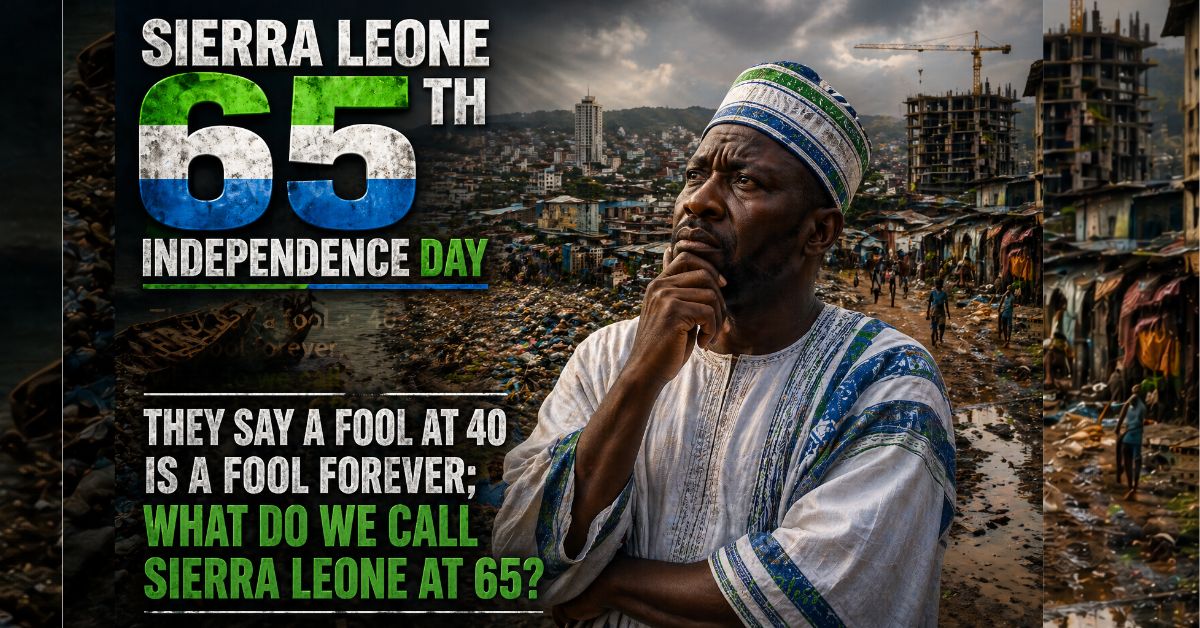
They Say a Fool at 40 Is a Fool Forever; What Do We Call Sierra Leone at 65?
 Sahid Bangura
 On April 27, 1961, Sierra Leone gained independence with high expectations and a strong sense of possibility. Sixty-five years later, it is only fair to acknowledge that some progress has been made.
There has been expansion in education access, the return and consolidation of democratic governance after the civil war, improvements in mobile connectivity, and gradual rebuilding of key institutions. These gains matter, and they should not be dismissed.
However, measured against the passage of time and the country’s potential, progress has been far too slow and uneven. Sierra Leone still ranks among the least developed countries in the world. According to global economic estimates, GDP per capita remains just above $1,000, placing the country near the bottom of global income rankings. Poverty remains widespread, and many citizens continue to live without reliable electricity, clean water, quality healthcare, or stable employment.

The country’s human development indicators tell a similar story. Life expectancy, literacy levels, and access to essential services remain low compared to global averages. While primary school enrollment has improved, the quality of education remains a serious concern. Many graduates leave school without the skills required for the modern job market, contributing to high youth unemployment and underemployment.

When Sierra Leone’s trajectory is compared with countries that gained independence around the same time-or even later-the gap becomes more striking. Singapore, which became independent in 1965, transformed itself from a resource-scarce island into a global financial and technological hub with one of the highest per capita incomes in the world. South Korea, emerging from war in the 1950s, invested heavily in education, industrialization, and export-driven growth, and is now one of the world’s leading economies. Even Rwanda, which suffered a devastating genocide in 1994, has in recent decades made significant strides in governance, infrastructure, and economic reform.
The difference between these countries and Sierra Leone is not simply a matter of resources. In fact, Sierra Leone is rich in natural assets, including diamonds, iron ore, fertile land, and fisheries. The real difference lies in how these resources have been managed.
One of the most persistent challenges has been weak governance. Corruption, lack of accountability, and inconsistent policy implementation have slowed development and discouraged investment. Public institutions often struggle to function effectively, and national planning is too frequently influenced by short-term political considerations rather than long-term goals.
The structure of the economy is another major limitation. Sierra Leone continues to rely heavily on the export of raw materials, especially minerals. These resources are often exported without processing, which means the country misses out on the higher value that comes from manufacturing and industrialization. This dependence also makes the economy vulnerable to global price fluctuations.
Infrastructure remains inadequate. Electricity supply is unreliable and limited, especially outside major urban areas. Road networks and transport systems are underdeveloped, making it difficult for goods and services to move efficiently. These challenges reduce productivity and limit economic growth.
The healthcare system, although improved since the Ebola virus disease crisis, still faces serious constraints. Many communities lack access to quality medical care, and the system remains underfunded and overstretched. The Ebola outbreak itself exposed deep structural weaknesses that have not yet been fully addressed.
Despite these challenges, Sierra Leone is not without hope. The country has a young and energetic population, abundant natural resources, and a strategic geographic position. What is needed is a clear shift in priorities and a stronger commitment to national development.
To move forward, Sierra Leone must focus on building strong and independent institutions that can enforce laws and reduce corruption. Governance must be based on transparency, accountability, and merit rather than political loyalty. Without this foundation, progress in other areas will remain limited.
Education reform is also essential. The system must move beyond basic literacy to emphasize critical thinking, technical skills, and innovation. Investment in vocational training and entrepreneurship can help equip young people with practical skills and reduce unemployment.
Economic diversification should become a central goal. Agriculture, manufacturing, and technology all offer opportunities for growth. Instead of exporting raw materials, Sierra Leone should invest in processing and value addition to increase earnings and create jobs.
Infrastructure development must be treated as a priority. Reliable electricity, better roads, and improved digital connectivity are necessary to support businesses and attract investment. Without these, economic transformation will remain difficult.
The responsibility for change does not lie with the government alone. Citizens also have a role to play. National development requires a shift in mindset, where integrity, hard work, and civic responsibility are valued. Corruption at any level, whether large or small, undermines progress.
For the government, leadership must be defined by results. Policies should be consistent, inclusive, and focused on long-term national interest. For the people, there must be a willingness to demand accountability while also contributing positively to society.
At 65, Sierra Leone stands at an important moment in its history. The country has made progress, but it has not yet fulfilled its potential. The next chapter will depend on the choices made today.
If wisdom is expected to come with age, then Sierra Leone must now show that it is ready to learn, adapt, and move forward.
Thank you very much Mr presenter, u totally made me feel cry today all what u mentioned no one is out of track, but again I can just say the cause of this, is bad leadership and lack of discipline.
Ya Allah, the Almighty grant us your mercy over Sierra Leone the country is drowning in hardship the youths are everyday leaving going all over the world searching for better lives… It’s unbearable, corruption is at the highest peak…ya Allah bless us with leader who will fear you Ameen
They Say a Fool at 40 Is a Fool Forever; What Do We Call Sierra Leone at 65?
Proverbs 4:7 Wisdom is the principal thing therefore get wisdom: and with all thy getting get understanding.
Hosea 4:6 My people are destroyed for lack of knowledge
Isaiah 43:18-19 Forget the former things do not dwell on the past. See, I am doing a new thing
At 65, We Are Not Fools Forever We Are Accountable.
The proverb about 40 is a warning not a life sentence. At 65, Sierra Leone has enough history to know what works and what destroys.
We call Salone a Nation at a crossroads. We can choose wisdom now.
We call Sierra Leone a student of hard lessons.
Israel messed up for generations, yet God said in Joel 2:25 I will restore to you the years that the locust hath eaten. Nineveh at the brink was spared because they changed.
We call Sierra Leone a candidate for restoration. But restoration requires truth, justice, and each citizen saying the change starts with me.
We don’t have to accept fools forever. Proverbs 23:7As a man thinketh in his heart, so is he. If we call ourselves cursed, hopeless, or finished, we’ll live that. If we call ourselves rising, rebuilding, and God’s project, we’ll fight for that. At 65, let’s call Sierra Leone The Land That Woke Up. Because Lamentations 3:22-23 says His mercies are new every morning. Today can be morning for Salone.
A nation at 65 can become wise the moment it decides to value truth over tribe, work over handouts, and God over greed.
We are not fools forever. We are Sierra Leoneans and it’s time to get wisdom.