

Why Sierra Leone Must Protect the 55 Percent Threshold — Not Weaken It
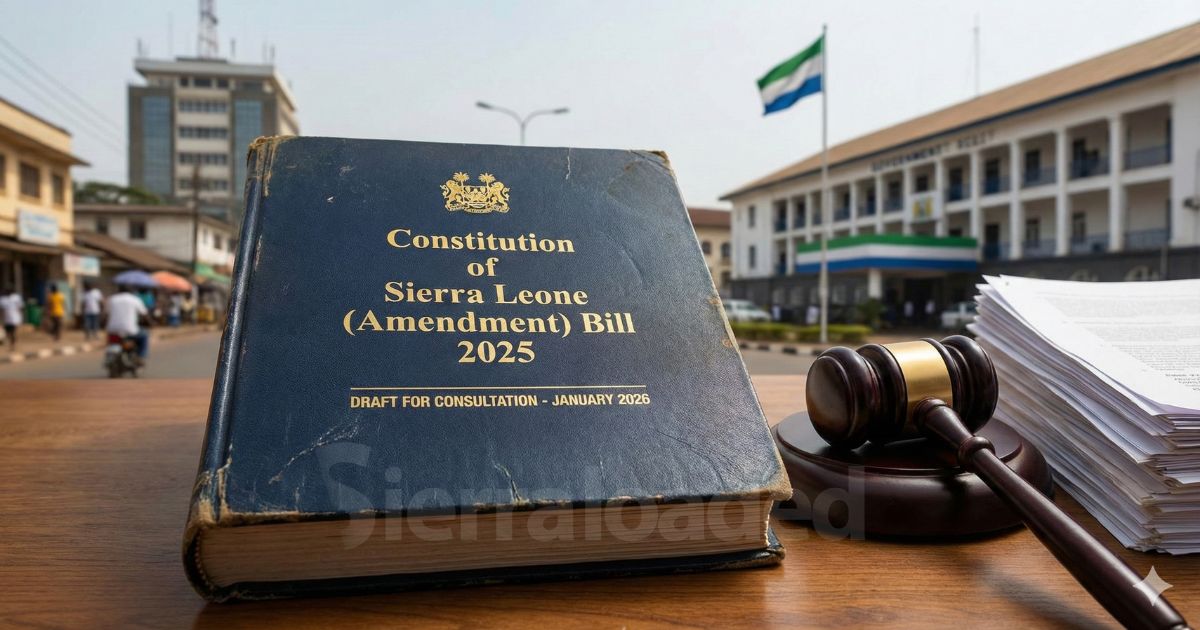
Sierra Leone’s proposed constitutional amendment to change the presidential election threshold deserves serious national debate. The proposal would replace the existing requirement that a presidential candidate secure 55 percent of the valid national vote with a simple majority, while adding a requirement that the candidate obtain at least 20 percent of the vote in at least two-thirds of the country’s districts.
In my view, Sierra Leone should reject this change and retain the 55 percent threshold.
This is not simply an argument about mathematics or the convenience of avoiding a run-off. It is an argument about the kind of political system Sierra Leone wants to build and, more importantly, the kind of political history it must never repeat.
The 1991 Constitution was born out of a political lesson

There is an important historical point that must be made clearly. The 1991 Constitution did not establish a 50 percent presidential threshold; it established a 55 percent threshold. Under Section 42, a presidential candidate had to obtain at least 55 percent of valid votes to win in the first round. If no candidate reached that threshold, the top two candidates proceeded to a run-off.
The importance of the 1991 Constitution, however, goes far beyond the 55 percent figure.
It represented Sierra Leone’s return from one-party constitutionalism to multiparty democracy after the 1978 Constitution had effectively eliminated political competition. The 1991 Constitution expressly declared Sierra Leone a state based on freedom, democracy and justice, with sovereignty belonging to the people and their participation in governance guaranteed.

That historical context matters.
Sierra Leone should be extremely careful about altering constitutional provisions that strengthen the legitimacy of the winner of a presidential election. A presidential system concentrates enormous political power in one individual. The person who occupies State House controls majorappointments, executive authority and national resources. The mandate required to occupy that office must therefore be as broad and unquestionable as reasonably possible.
Fifty percent plus one may be enough to win an election. But 55 percent provides a stronger mandate.
We should remember why Sierra Leone went to war
The argument for retaining 55 percent becomes even stronger when viewed through the painful history of Sierra Leone’s civil war. The Truth and Reconciliation Commission (TRC) Report did not describe the conflict as the product of a single cause. But its findings were unequivocal about the role played by corruption, greed, nepotism, bad governance, political exclusion and the collapse of democratic institutions.
The TRC found that the central cause of the war was endemic greed, corruption and nepotism, while government accountability was virtually non-existent. It also found that political expression and dissent had been crushed and that, by 1991, “democracy and the rule of law were dead.”
The report was particularly critical of the one-party era under Siaka Probyn Stevens. It found that the creation of the one-party state neutralised checks and balances on executive power and systematically closed avenues for open debate and democratic activity.
The 1978 One-Party Constitution was therefore not simply a change in the number of political parties. It fundamentally altered the relationship between the citizen and the state. Opposition parties were suppressed. Parliament was weakened. The President’s powers were substantially increased. The President gained influence over institutions that were supposed to provide checks on executive authority.
The TRC specifically observed that the 1978 Constitution increased presidential powers in relation to Parliament and the judiciary, while the political party controlled by the President could influence who became a parliamentary candidate.
That history should make Sierra Leoneans extremely cautious about constitutional reforms that could inadvertently make it easier for one political force to secure and consolidate presidential power.
Multiparty democracy is not a luxury for Sierra Leone
For a country that emerged from a devastating civil war, multiparty democracy is not merely a constitutional decoration. It is part of the country’s peace architecture. Political competition gives citizens peaceful alternatives. It gives opposition parties space to challenge government policy. It gives journalists and civil society room to scrutinise those in power. And it gives voters the ability to remove a government without having to remove the state itself.
The TRC recognised this connection between governance and peace. It concluded that Sierra Leoneans wanted a system that upheld the rule of law rather than the rule of strong patrons, with effective checks and balances protecting citizens from abuses of power. The Commission also warned that when one branch of government, particularly the executive, operates without sufficient restraint, authoritarian government can emerge. It regarded authoritarianism and the absence of effective checks and balances as direct contributors to injustice and conflict. That is perhaps the most important lesson for today’s lawmakers: Constitutional reform should make it harder, not easier, for political power to become concentrated.
Why weaken 55 percent?
Supporters of the proposed change may reasonably argue that 55 percent can produce run-offs and that requiring a candidate to secure a majority in the first round can be demanding in a competitive multiparty environment.
That is a legitimate debate. But the answer should not necessarily be to weaken the national threshold.
If a candidate cannot secure 55 percent of the national vote, the Constitution already provides a democratic solution: a run-off between the two leading candidates. A run-off is not a failure of democracy. It is democracy working.
It allows voters whose preferred candidate has been eliminated to decide between the two remaining contenders. More importantly, it forces the eventual winner to seek support beyond the initial electoral coalition.
In a country with Sierra Leone’s history of regional and political polarisation, that process can be valuable.
The proposed formula, which is simple majority nationally plus 20 percent in two-thirds of districts, may appear to encourage national spread. But it also creates a complicated new test for determining whether a candidate has won. The more fundamental question is whether Sierra Leone should abandon a clear national threshold that has been part of the constitutional framework since 1991.
I believe it should not.
The real constitutional problem is presidential power
If the Attorney-General genuinely wants to strengthen Sierra Leone’s democracy, there are more important constitutional questions to address. The lawmakers should focus on reducing the excessive concentration of power in the presidency.
The TRC itself repeatedly stressed the importance of separation of powers, institutional independence and checks and balances. It warned that the concentration of power in the executive was a major feature of Sierra Leone’s troubled political history.
The Report’s recommendations also called for restrictions on presidential powers during states of emergency, including removing provisions that allowed the President to make regulations or take measures capable of suspending fundamental rights.
These are the reforms that deserve greater attention.
Parliament should be asking:
• How can Parliament become a stronger and genuinely independent check on the Executive?
• How can appointments to key institutions be made more independent from the presidency?
• How can the judiciary be better protected from political influence?
• How can the Electoral Commission for Sierra Leone (ECSL) remain institutionally independent?
• How can the Anti-Corruption Commission (ACC) operate without political interference?
• How can Parliament strengthen its oversight of public finances and executive appointments?
• How can citizens and civil society have stronger mechanisms for holding government accountable?
These questions go much closer to the heart of Sierra Leone’s constitutional problem than changing 55 percent to a simple majority.
Do not rewrite the lesson of history
Sierra Leone’s constitutional history should teach us that the danger is not simply who wins an election. The greater danger is what happens after someone wins and how many institutional restraints exist on the exercise of that power.
The 1978 One-Party Constitution showed what happens when political competition is suppressed and executive authority becomes dominant.
The Sierra Leone Legal Information Institute believes that the 1991 Constitution was, in part, a response to that experience. It restored multiparty democracy and established a constitutional framework intended to protect democratic participation, political competition and institutional checks and balances.
The TRC later reinforced the lesson: Sierra Leone needed an open and vibrant democracy to prevent a repetition of the abuses and conditions that contributed to the war. We should therefore be strengthening that democratic architecture, not gradually weakening it.
Keep 55 percent. Reform the real problem.
Sierra Leone does not need a weaker presidential mandate. It needs stronger democratic institutions.
The 55 percent threshold should remain. If no candidate achieves it, let the people decide in a run-off. That is a straightforward, transparent and democratic mechanism. The bigger constitutional task should be to ensure that whoever wins the presidency, whether SLPP, APC or any other political party, cannot accumulate excessive power without effective institutional checks.
Sierra Leone’s post-war democracy must never be built around the personality of the individual occupying State House. It must be built around institutions strong enough to survive whoever occupies State House.
The lesson of the TRC is clear: corruption, exclusion, weak accountability and excessive concentration of power helped create the conditions for conflict. The country’s response must therefore be more democracy, more accountability, stronger institutions and genuine political competition.
Keep the 55 percent threshold. Protect multiparty democracy. And, above all, reduce the excessive powers of the presidency.
That would be a constitutional reform worthy of Sierra Leone’s history and worthy of the peace for which so many Sierra Leoneans paid such a terrible price.