
ECOWAS Court, Sierra Leone AG’s Office Launch Four-Day Training for State Attorneys
 Sia Lucy Kannah
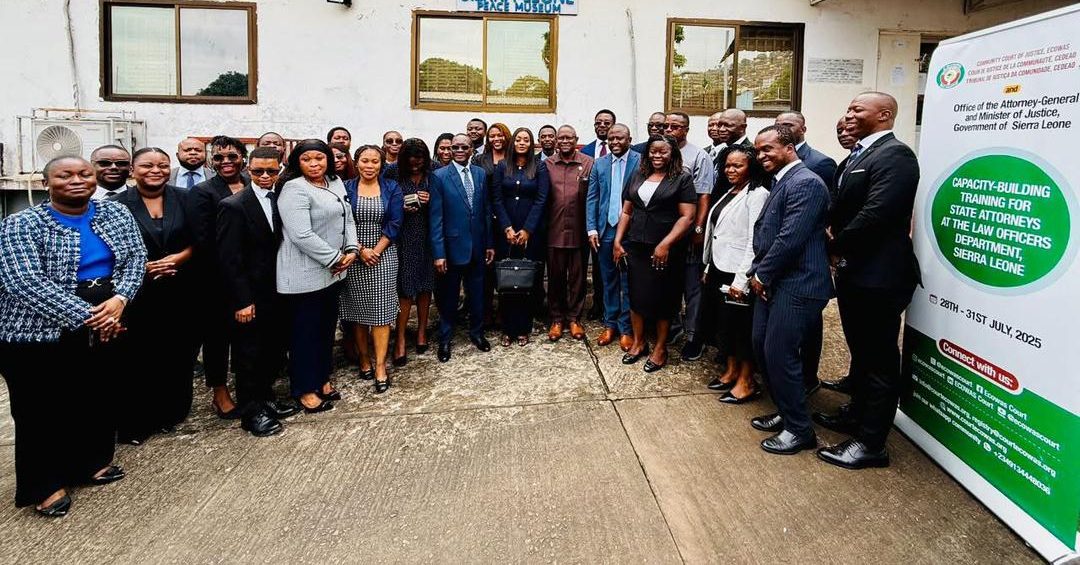
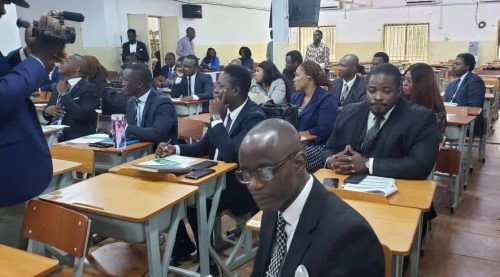
 The Economic Community of West African States (ECOWAS) Court of Justice, in collaboration with the Office of the Attorney-General and Minister of Justice of Sierra Leone, commenced a four-day intensive training session for State Attorneys, hosted at the Special Court Complex, New England Ville, on July 28, 2025.
Justice Sengu Koroma, Vice President of the ECOWAS Court of Justice and a distinguished envoy of Sierra Leone, delivering his remarks, acknowledged that a pivotal request from the Attorney General and Minister of Justice was met with deep appreciation, signifying a renewed pledge to fulfill their responsibilities under the revised ECOWAS Treaty.
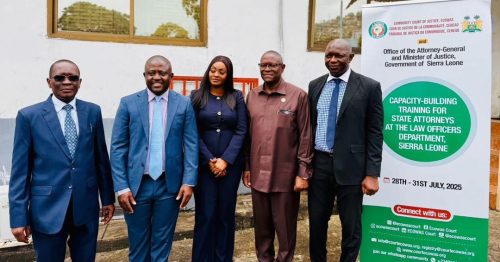

He explained that this backdrop inspired the development of a comprehensive program designed to meet outlined objectives and foster a collaborative network aimed at strengthening ties between the ECOWAS Court of Justice and Sierra Leone.


Justice Koroma reassured that his concerns were alleviated by steadfast support from the Attorney General, his Deputy, and the Director of Public Prosecutions, whose prior active engagement with the Court’s mission predates his appointment. Their invaluable contributions have been instrumental in translating this vision into reality, and he extended his sincere gratitude.
Also, Osman Kanu, Director of Public Prosecutions, shed light on the origins and expansion of ECOWAS’s judicial authority. He clarified that initially established virtually to resolve disputes among member states, the Court’s jurisdiction has since widened considerably.
Director Kanu underscored that human rights are held in the highest regard by the state, a sensitive yet crucial issue demanding careful management. The Court’s authority now encompasses nearly every dimension of daily life concerning fundamental liberties.
Alpha Sesay, Esq., Attorney General and Minister of Justice, expressed appreciation for the ECOWAS Court’s provision of free legal services. He urged practitioners to broaden their perspective beyond courtroom confines, viewing law as a catalyst for societal transformation.
He stressed that judicial decisions within regional mechanisms are instrumental in establishing vital legal standards that drive systemic reform. “These rulings can bring about meaningful change within our legal frameworks and foster an environment where human rights are protected,” he asserted.
Minister Sesay highlighted the importance of strategic legal action and advocacy outside the courtroom to promote wider societal reforms. He maintained the government’s dedication to defending its actions legally while recognizing the need for broader reform efforts championed by civil society and legal professionals.
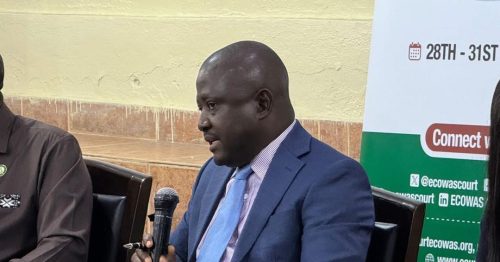
“We desire our legal practitioners to see their work not merely as a profession but as a noble calling, an exciting and impactful journey of service.” He said, after these four days, I am confident this training will inspire and empower legal practitioners even further.
Finally, he encouraged delegates to leverage their understanding of the community’s socio-legal landscape, confident that their insights would significantly enrich the program. He expressed optimism that the knowledge exchange during this workshop would yield mutual benefits.