


 1 Comment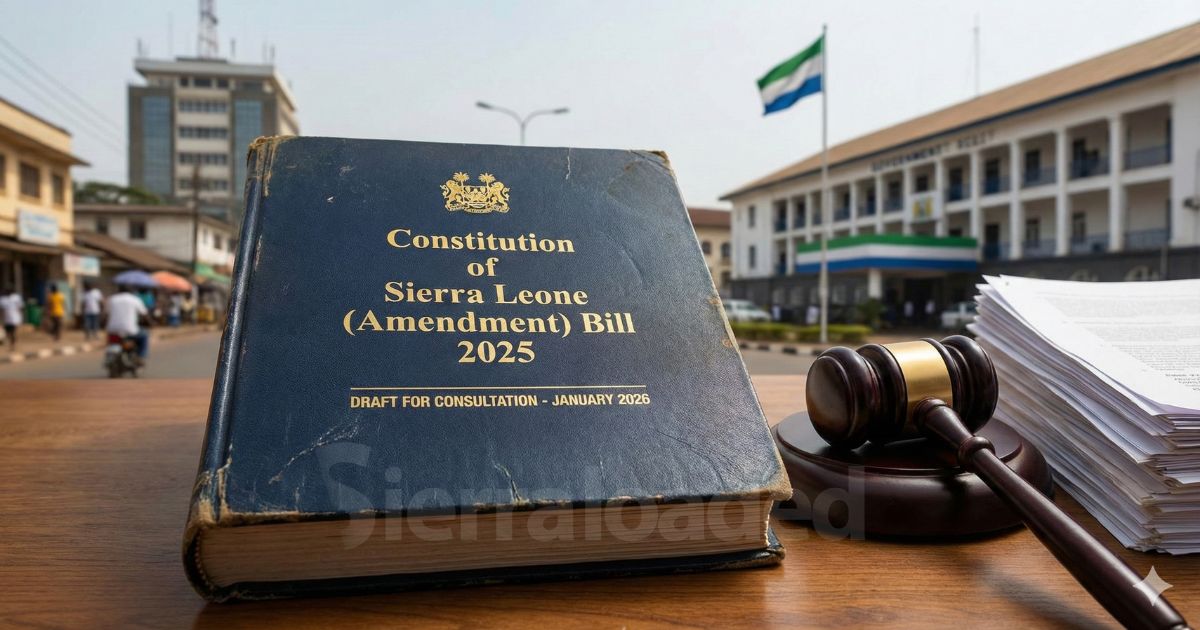
The Institute for Legal Research and Advocacy for Justice (ILRAJ) has issued a stern warning regarding the proposed Constitution of Sierra Leone (Amendment) Bill 2025, arguing that the legislation, in its current form, poses an “existential threat” to the nation’s democracy.
In a position paper released on January 23, 2026, the legal advocacy group contended that the Bill risks entrenching ruling party power and echoing the “dark precedents” of the 1978 constitutional amendments that ushered in a one-party state.
While acknowledging the Bill’s intent to enhance electoral integrity and promote gender inclusivity, ILRAJ warns that critical deviations from established recommendations could erode public trust and facilitate executive capture.

ILRAJ’s primary concern centers on the potential for the Constitution to be “weaponised to entrench power”. The Institute draws parallels to the 1978 era, where constitutional changes were used to suppress opposition and secure dominance for the All Peoples’ Congress (APC).
“In Sierra Leone… where institutions remain fragile post-conflict and economic vulnerabilities heighten political stakes, such tactics risk eroding public trust and perpetuating cycles of instability,” the paper states. ILRAJ argues that without significant amendments, the 2025 Bill could serve as a “veiled mechanism” to secure electoral victories for a specific political faction.
The position paper highlights several specific clauses within the Bill that ILRAJ believes undermine democratic principles:
Presidential Threshold Lowered: The Bill proposes repealing the requirement for a presidential candidate to secure 55% of the vote to win in the first round. It replaces this with a simple majority plus 20% in two-thirds of the districts. ILRAJ argues this lowers the bar too far, potentially yielding presidents with “weak, fragmented mandates” and allowing smaller, loyalist districts to distort the national majority.
Party Expulsion and Executive Removal: Clauses 9 and 12 would allow for the removal of the President or Vice-President if they are expelled from their political party. ILRAJ criticizes this as a sharp deviation from the 2016 Cowan Constitutional Review Committee (CRC) recommendations, warning it could be “weaponised” by ruling majorities to oust executives and subvert the electorate’s mandate.
Partisan Influence in the Electoral Commission: While the Bill renames the Electoral Commission to the National Electoral Commission (NEC) and raises educational qualifications for commissioners, ILRAJ notes a “glaring omission” of non-partisanship requirements. The group recommends mandatory “cooling-off periods” for former politicians to prevent the Commission from becoming a tool for the ruling party.
Independent Candidates: The Bill permits independent presidential candidates but conditions their eligibility on “financial capacity and community support” to be defined by future laws. ILRAJ fears this vague language could be exploited to erect “prohibitive barriers,” effectively reserving the presidency for the wealthy or establishment-backed figures.
The Institute also flagged procedural issues that could hinder justice in election disputes. The Bill sets a 3-day filing window for election petitions, which ILRAJ describes as “unrealistically short” compared to international standards, such as Nigeria’s 21-day window. They argue this timeline renders the right to petition “illusory” for opposition parties with limited resources.
Furthermore, the Bill proposes moving the fixed election date to the second Saturday of November. ILRAJ opposes this, citing conflicts with end-of-year festivities that could lead to “rushed tallying” and “voter fatigue”. They instead back the Tripartite Committee’s recommendation for elections in March, April, or May to avoid the rainy season.
ILRAJ asserts that several changes, particularly those affecting the tenure of the President and the election date (Sections 85 and 87 of the 1991 Constitution), are “entrenched provisions”. As such, they argue these amendments constitutionally require a national referendum with two-thirds approval, rather than a simple parliamentary vote.
The Institute is urging Parliament to reject or “fundamentally revise” these provisions and calls for immediate, inclusive pre-legislative hearings.
“Reforms must prioritise transparency, inclusivity, and adherence to past recommendations… to prevent the Constitution from becoming an instrument of entrenchment rather than empowerment,” the paper concludes.


How to know about the news in datial