
VP Juldeh Jalloh Engages EU on Maritime Security, Food Security and Waste Management Reform
 Osman Tolo Sesay
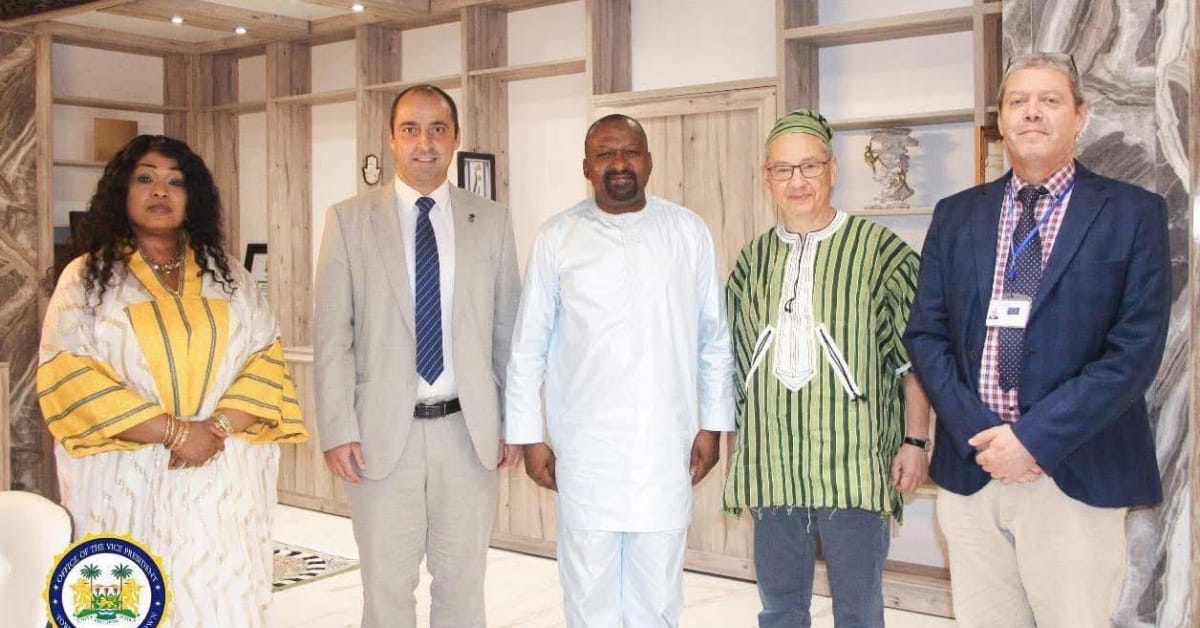
 Vice President Mohamed Juldeh Jalloh on February 13, 2026, held high-level talks with the European Union Ambassador and his delegation to review ongoing cooperation and explore new areas of partnership between Sierra Leone and the European Union.
Discussions focused on strengthening collaboration in international maritime security, advancing food security initiatives, and leveraging opportunities under the EU’s Global Gateway programme.
The Vice President also used the meeting to outline Government’s new priority to reform Sierra Leone’s waste management system as part of its broader climate action agenda.

According to officials, both sides reaffirmed the importance of sustained cooperation in maritime security.

Given Sierra Leone’s reliance on fisheries, port operations, and maritime trade, safeguarding territorial waters and combating illegal activities at sea remain strategic priorities. Enhanced collaboration with international partners is expected to improve surveillance, enforcement capacity, and regional coordination to protect marine resources.
Food security was another key area of engagement. The Vice President reiterated Government’s commitment to agricultural transformation through the “Feed Salone” strategy, which seeks to increase domestic food production, reduce reliance on imports, and build resilience against climate-related shocks.
He emphasized the importance of partnerships in strengthening agricultural value chains, improving productivity, and supporting smallholder farmers. The EU has been a longstanding partner in rural development and agricultural support initiatives.
The meeting also explored potential benefits under the EU Global Gateway initiative, a €300 billion infrastructure investment programme aimed at supporting green and digital transitions worldwide.
Sierra Leone is seeking to utilize the initiative to expand infrastructure, enhance digital connectivity, and accelerate investments in renewable energy and climate-resilient development.
Beyond these areas, the Vice President highlighted waste management reform as an emerging national priority. He described the overhaul of the country’s waste management system as central to climate mitigation efforts and environmental protection.
Dr. Jalloh disclosed that consultations are ongoing with relevant ministries, sector leaders, the Freetown City Council, other local councils, and private sector operators to design a sustainable and market-driven waste management framework. The proposed reforms aim to replace outdated infrastructure with systems that are environmentally sound and economically viable.
He noted that modernizing waste management presents not only environmental benefits but also public health and economic opportunities, including job creation and the development of a circular economy.
The meeting follows the February 6, 2026 launch of a $5.4 million initiative led by the United Nations Development Programme to promote circular economy and zero-waste systems in Sierra Leone.
Additionally, a waste-to-energy project in Freetown, supported by the EU-backed Climate Investor Two fund, is expected to convert approximately 365,000 tonnes of annual waste into renewable electricity.
Observers say the engagement underscores deepening Sierra Leone–EU relations, with climate action, sustainable infrastructure, maritime security, and food resilience emerging as central pillars of cooperation.