

The Seduction of Being “Dangerously Educated”
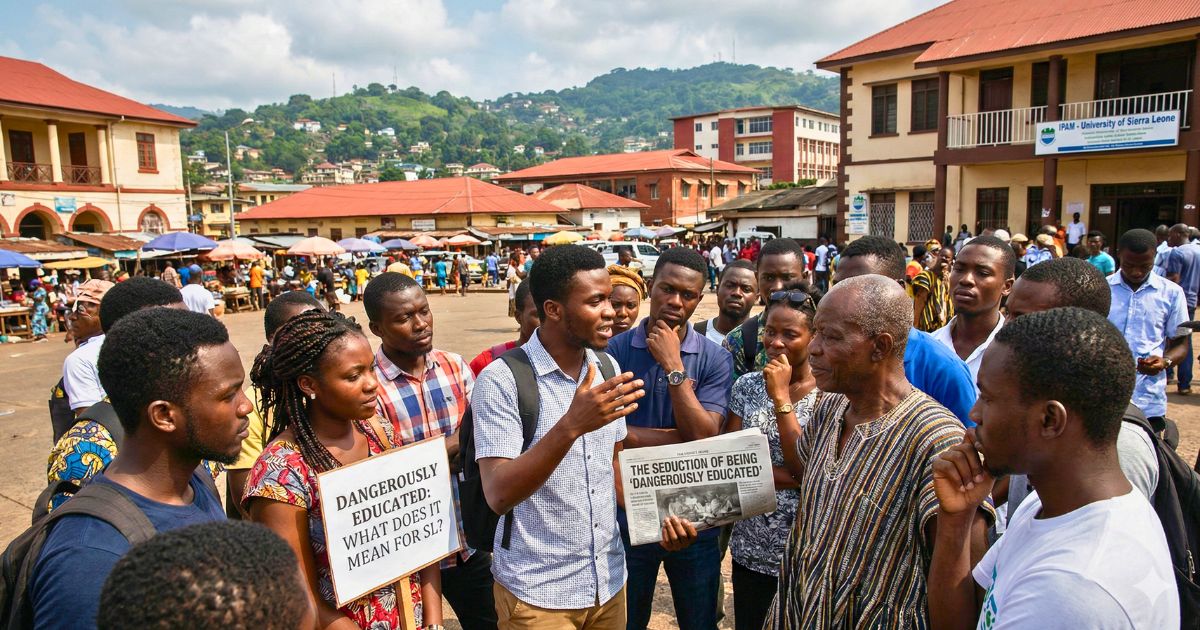
The Seduction of Being “Dangerously Educated”
In the theatre of African politics, language is rarely accidental. It is choreography. It is branding. It is signal. When a presidential aspirant describes himself as “dangerously educated,” he is not merely presenting a résumé; he is constructing a political persona. The phrase is designed to provoke admiration in some and unease in others. It evokes intellectual audacity—perhaps even insurgent clarity. Yet in a polity like Sierra Leone, where historical memory, identity, and institutional fragility coexist, one must interrogate not the slogan itself, but its deeper implications.
Dangerous to whom? Dangerous to what?

The allure of intellectual militancy is understandable. Post-conflict societies often oscillate between two structural deficits: institutional weakness and leadership timidity. In such contexts, a leader who claims formidable knowledge and promises to unsettle complacency can appear both refreshing and necessary. Education, after all, is power—epistemic power. It sharpens diagnosis, exposes structural decay, decodes fiscal illusions, and dismantles rhetorical camouflage. Yet when education is aestheticized as “danger,” it occupies a delicate threshold between reformist courage and performative aggression. The presidency is not a seminar room, nor a revolutionary manifesto; it is, fundamentally, an exercise in institutional stewardship.
I. Institution Building: Intelligence or Impatience?
Sierra Leone’s enduring challenge is not the absence of leaders, but the fragility of institutions. Public administration, regulatory oversight, and fiscal discipline are not conquered by charisma; they are cultivated through procedural endurance.
An intellectually rigorous leader can, in principle, recalibrate bureaucratic culture and strengthen institutional architecture. Education equips a president with constitutional literacy, macro-fiscal competence, and policy sequencing insight. Such intellectual grounding can be indispensable in confronting corruption and administrative inertia.
Yet there is an inherent paradox. Institutions thrive on restraint. They require patience with process, tolerance for oversight, and respect for incremental progress. If “dangerous” implies impatience with institutional friction—if it suggests an impulse to bulldoze rather than build—then intellectual brilliance risks degenerating into administrative volatility.
Institutions do not respond well to intellectual theatrics. They respond to disciplined continuity.
Thus, the central question is not whether a leader is educated, but whether his education is institutionally anchored or temperamentally impatient.
II. National Unity: Transcending Identity or Intensifying It?
Sierra Leone’s political landscape remains deeply textured by regional alignments and ethnic sensibilities. Leadership in such a context is not merely administrative; it is symbolic. It must reassure, include, and unify.
Education can serve as a bridge across these divides. It can provide the analytical distance necessary to transcend parochial loyalties and articulate a genuinely national vision. Intellectual depth can help a leader frame citizenship not as tribal belonging, but as constitutional belonging.
However, intellectual self-branding carries its own risks. When a leader foregrounds his cognitive superiority, supporters may internalize a narrative of enlightened vanguardism—the belief that the educated few must rescue the unenlightened many. In plural societies, such narratives easily harden into suspicion and resentment.
National cohesion demands more than intellectual sharpness; it requires emotional intelligence. Unity is not engineered through argument alone. It is cultivated through humility, symbolic inclusion, and deliberate listening.
A dangerously educated leader must therefore ask: does my education unify the nation, or does it inadvertently stratify it?
III. Economic Stewardship: Technocracy or Detachment?
If rhetoric is symbolic capital, economic management is empirical proof. Sierra Leone’s economy faces structural vulnerabilities: debt pressures, extractive dependence, youth unemployment, and persistent fiscal leakage. In such an environment, a president equipped with deep economic literacy could potentially reorient national development strategy.
Education provides the tools to understand global financial systems, negotiate sovereign obligations, and design policies that prioritize long-term national resilience. Intellectual competence can help move economic governance beyond improvisation toward strategic planning.
Yet technocratic confidence can easily drift into technocratic detachment. Economic governance is not merely an exercise in models and projections; it is an exercise in legitimacy. Policies that are analytically sound but socially disconnected risk alienating the very citizens they intend to serve.
Dangerous education becomes perilous when theory eclipses lived experience—when intellectual certainty substitutes for public consultation.
The true test of economic leadership lies not in analytical sophistication alone, but in distributive wisdom and social responsiveness.
IV. Democratic Protection: Conviction or Centralization?
Democracy survives not through rhetoric, but through restraint. An educated leader versed in constitutional principles may be uniquely positioned to strengthen judicial independence, enhance institutional accountability, and modernize transparency systems.
Education can deepen respect for democratic norms by clarifying the philosophical and legal foundations of constitutional governance. It can cultivate an appreciation for pluralism and procedural legitimacy.
Yet history reminds us that intellectual sophistication does not immunize leaders against authoritarian temptation. When intellectual certainty fuses with executive authority, the line between conviction and coercion narrows. A leader convinced of his superior insight may begin to view dissent not as democratic necessity, but as obstruction.
Democracy depends precisely on the legitimacy of disagreement.
The constitutional order is not safeguarded by brilliance alone; it is preserved by humility before law and procedure.
V. The Quiet Test: The Capacity to Listen
Perhaps the most revealing measure of leadership is not eloquence, but receptivity. Listening is the discipline of democratic maturity.
Education, at its highest level, cultivates epistemic humility—the recognition that knowledge is always partial, and that wisdom emerges through dialogue. To listen is to acknowledge the limits of one’s own perspective.
If “dangerously educated” implies openness to critique, intellectual courage to revise assumptions, and moral readiness to engage adversaries, then the phrase may signify strength. But if it signals rigidity—a posture of intellectual finality—it becomes corrosive to governance.
Leadership in Sierra Leone demands engagement across the full spectrum of society: rural farmers, urban youth, civil servants, traditional authorities, entrepreneurs, and opposition voices alike. Listening is not concession. It is strategic intelligence.
Beyond the Slogan
The seduction of being “dangerously educated” lies in its rhetorical force. It promises disruption. It suggests intellectual insurgency. It flatters those who crave decisive rupture with the past. Yet the presidency is not an arena for intellectual exhibitionism. It is an architecture of responsibility.
A nation emerging from fragility does not require danger for its own sake. It requires disciplined intelligence, institutional reverence, and integrative vision. Education becomes transformative not when it intimidates, but when it builds; not when it dominates, but when it stabilizes.
Ultimately, the electorate must decide whether the proclaimed danger is directed at corruption, inefficiency, and stagnation—or whether it risks destabilizing the very institutions it seeks to reform.
The distinction is subtle.
But in democracies, it is precisely such subtleties that determine national destinies.
Chernor M. Jalloh is a Lecturer of Governance, Leadership & Development Studies at IPAM – University of Sierra Leone